
Most listeners never notice a great mix. They just feel the music. But every producer knows the moment something sounds "off," whether it is a vocal that feels buried, a kick drum fighting the bass, or a reverb that screams "I've been processed." The real craft in mixing is not stacking dramatic effects or reaching for the loudest, most aggressive compression you can find. True mastery means making every technical decision so seamlessly that the processing itself disappears, leaving only the emotional impact of the performance. That is what invisible mixing is all about, and this guide will show you exactly how to achieve it.
Table of Contents
- Defining invisible mixing in music production
- The science behind invisible mixing: frequency masking and transparency
- Practical techniques for achieving invisible mixes
- Advanced invisible mixing: ghost signals and hidden triggers
- Why invisible mixing matters: emotional impact and listener experience
- Why most producers underestimate invisible mixing
- Take your mixes further with professional feedback
- Frequently asked questions
Key Takeaways
| Point | Details |
|---|---|
| Invisible mixing defined | Invisible mixing means blending processing so the listener hears music, not the engineering. |
| Clarity via masking control | Reducing frequency masking lets each element breathe, improving mix separation. |
| Subtle technique wins | Targeted, minimally invasive actions and hidden triggers capture a polished, natural sound. |
| Emotional engagement | Invisible mixes strengthen emotional impact by keeping technical moves unseen. |
| Feedback and growth | Reference mixes and external feedback help you master this essential mixing skill. |
Defining invisible mixing in music production
Having previewed the article, we first need to nail down exactly what invisible mixing is, and what it is not. The term gets thrown around loosely, and it is easy to mistake it for "doing nothing" or relying on some mysterious plugin that magically fixes everything. Neither is true.
Invisible mixing means making processing and edits feel seamless so the listener hears the song, not the technique. It is the opposite of "loud mixing," where obvious compression, heavy-handed EQ, or extreme effects draw attention to themselves. When a mix is truly invisible, every instrument sits in its place naturally, the song breathes, and the listener is emotionally connected from the first bar to the last.
Here are the three core benchmarks that define a genuinely invisible mix:
- Seamlessness: Transitions, edits, and effects blend so naturally that no single moment disrupts the listening flow.
- Transparency: Processing shapes the sound without adding obvious colour or character that was not there originally.
- Emotional connection: The mix amplifies the performance rather than competing with it, ensuring the listener feels the song rather than analysing the production.
One of the most common misconceptions I see is producers assuming invisible mixing means no EQ, no compression, or no effects. In reality, it often requires more precise and considered processing, not less. It demands that every move serves the song and nothing more. You also need to be aware of your audio content policy and artistic intent before you start reaching for tools.
"The best mix is the one the listener never notices. When the processing disappears, the performance takes centre stage."
That mindset is everything. Keep it close.
The science behind invisible mixing: frequency masking and transparency
With a clear definition in place, let us look at the core technical principle that makes an invisible mix possible: managing frequency masking. This is where the science gets genuinely fascinating, and where a lot of mixes either succeed or fall apart.
Frequency masking (also called auditory masking) happens when two sounds share overlapping frequencies, causing one to hide the other from the listener's perception. The core mechanic of invisible separation is reducing this masking effect so each element can breathe and be heard on its own terms.
A classic example is the relationship between kick drum and bass guitar. Both typically have significant energy around 60 to 100 Hz. When they collide at, say, 80 Hz, neither sounds its best. The kick loses its punch and the bass loses its weight. Listeners may not be able to name the problem, but they will feel the mix sounds "muddy" or "thick" in an unpleasant way. That is masking in action.

Here is a simplified breakdown of how masking affects common instrument pairs:
| Instrument pair | Typical collision zone | Common symptom |
|---|---|---|
| Kick and bass | 60 to 100 Hz | Muddy low end, lost punch |
| Lead vocal and guitar | 1 kHz to 3 kHz | Vocal feels buried or thin |
| Snare and piano | 200 to 500 Hz | Piano sounds boxy, snare lacks snap |
| Synth pad and vocals | 2 kHz to 5 kHz | Vocal intelligibility reduced |
The key insight is that masking is not always about individual levels being too loud. It is about where the energy sits and how sounds interact contextually. This is why simply turning one element down rarely solves the problem cleanly.
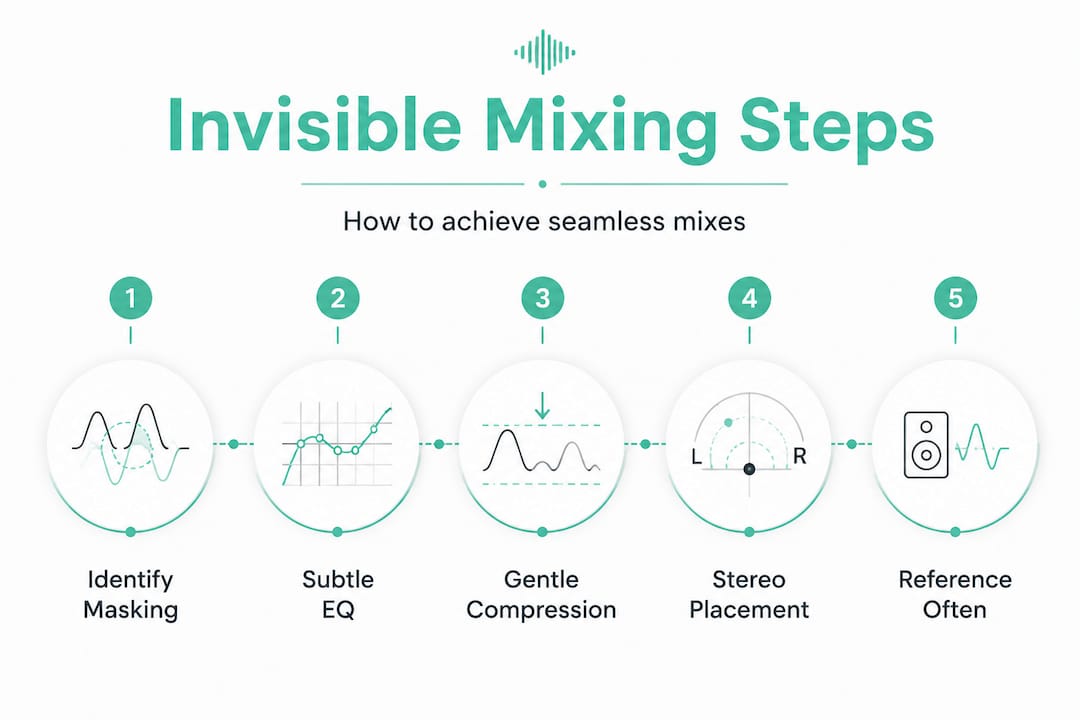
To resolve masking without making obvious sonic moves, consider these five steps:
- Identify the collision zone by listening critically in the context of the full mix, never in solo.
- Apply a narrow notch EQ cut on the non-lead element at the exact frequency where masking occurs.
- Use a high-pass filter (a filter that removes low frequencies below a set point) on elements that do not need sub-bass energy.
- Try a dynamic EQ to apply cuts only when masking actually occurs, rather than permanently shaping the sound.
- Use a sidechain (where one sound's level is controlled by another) to create micro-ducking that frees up space at just the right moment.
Referencing your mix through the evaluation framework can help you spot these collision zones more systematically, especially if you are newer to hearing masking in a dense arrangement.
Practical techniques for achieving invisible mixes
Understanding the science is vital. Now, let us translate that knowledge into real mixing moves you can use today. The goal is always the same: fix clashes with targeted, context-aware actions so the listener never notices the engineering work underneath.
One of the most important choices you will make is between static EQ and dynamic EQ. Here is a quick comparison to help you decide when to use each:
| Technique | When to use | Invisible mixing advantage |
|---|---|---|
| Static EQ | Consistent tonal issues | Clean and transparent on stable sounds |
| Dynamic EQ | Occasional frequency clashes | Only activates when masking occurs |
| Automation | Level variations across sections | Precise control without colouration |
| Subtle multiband compression | Broad tonal balance issues | Controls energy without obvious pumping |
| Ghost sidechain | Rhythmic space and movement | Creates breathing without an audible trigger |
The invisible mixer's toolkit also includes some techniques that many producers overlook:
- Automation: Rather than applying a permanent EQ cut, automate a subtle dip in a specific frequency range only during the bars where two instruments clash. This is invisible because it is context-specific.
- Volume rides: Micro-adjustments to a vocal's level across a whole section, sometimes as small as 0.5 dB, keep a performance feeling dynamic and natural rather than machine-flat.
- Subtle multiband compression: Applied with a light touch, this tames only the frequency range that is problematic, leaving the rest of the sound untouched and natural.
- Ghost sidechains: A muted track triggers compression or effects without the trigger sound ever being heard (more on this shortly).
What not to do is just as important. Drastic EQ boosts (especially anything over 6 dB) create obvious tonal artefacts. Heavy-handed limiting that kills dynamic range makes a mix feel suffocating. These are the enemies of invisible mixing.
Pro Tip: Always make adjustments while listening to the full mix, never in solo mode. A move that sounds extreme on a soloed instrument may be perfectly transparent in context, and vice versa. Soloing can fool you into over-processing.
When exploring approaches to stereo placement and width, you might also want to read through our stereo widening guide to see how spatial decisions contribute to a mix that feels open and natural without obvious processing. You can also see exactly how invisible mixing feedback looks in practice by checking out our sample mix report.
Advanced invisible mixing: ghost signals and hidden triggers
For producers ready to level up, invisible mixing techniques extend to sophisticated signal routing and control. Let us look at one of the most powerful advanced methods: the ghost sidechain.
A ghost sidechain uses a muted or "silent" track as the trigger for compression or effects on another element. Using inaudible control signals like ghost triggers creates effects without the trigger sound ever being heard by the listener. The result is rhythmic breathing and dynamic space that feels organic rather than mechanical.
Here is how producers typically use ghost sidechains:
- Rhythmic pumping without the kick: Route a copy of your kick drum to a bus, mute it, and use it as the sidechain trigger for light compression on your pad or synth. The listener hears gentle movement in the pad, but never the kick itself as a trigger.
- Vocal-shaped ducking: Use a ghost copy of your vocal to sidechain the reverb return, so the reverb ducks slightly when the singer is singing and blooms during pauses. This creates a natural "breathing" quality.
- Percussive transient control: Use a ghost kick trigger to briefly duck the low end of the bass, giving each kick hit a moment of space without visible pumping.
The advantages of ghost sidechaining are significant. It delivers dynamic movement and a sense of life in the mix without introducing any audible artefacts from the trigger signal itself. It is genuinely invisible because there is no sound to notice, only the emotional effect of space and rhythm.
Pro Tip: Carefully balance the level of your trigger signal before muting it. Too much gain reduction creates an obvious "ducking" effect that the listener will notice. Aim for 1 to 3 dB of gain reduction as a starting point and adjust from there.
Why invisible mixing matters: emotional impact and listener experience
We have explored tools and approaches. Now, let us address why invisible mixing is core to artistic impact and listener satisfaction, because this is ultimately what it is all about.
When a mix is invisible, something remarkable happens. The listener stops hearing a "production" and starts experiencing a performance. Every subtle detail, the warmth in a vocalist's midrange, the attack of a snare drum, the sustain of a piano chord, becomes emotionally immediate and immersive. Nothing gets in the way.
Contrast that with a mix where the compression is pumping audibly, the EQ is removing tone in obvious ways, or the reverb sounds like it was applied in isolation. These are the moments that pull listeners out of the experience. The emotional connection breaks. The song loses its power.
Consider a before-and-after scenario that illustrates this perfectly. A vocalist's track is competing with a thick guitar layer around 2.5 kHz. In the "before" version, a static 6 dB boost on the vocal at 3 kHz makes it feel harsh and processed. In the "after" version, a narrow dynamic EQ cut of just 2 dB on the guitar at 2.5 kHz (only when both are playing simultaneously) gives the vocal room to breathe without any tonal change that the listener can detect.
The "after" version sounds like the better performance, not better engineering. That is the magic of invisible mixing.
Here is what invisible mixing delivers for your audience:
- Listeners engage with the song on an emotional level from the very first bar.
- No single element distracts from the overall experience.
- The mix translates well across headphones, speakers, and car stereos, because natural-sounding mixes tend to translate better than heavily processed ones.
- The music feels timeless rather than dating itself with obvious production trends.
Creating space so each element becomes clearer while staying natural is the philosophical heart of invisible mixing. Getting pro feedback for your mixes is one of the fastest ways to gauge whether you are achieving this standard consistently.
"The mix that serves the song is always the right mix. When technology serves art, art wins."
Why most producers underestimate invisible mixing
Having explored the practice and philosophy, let us reflect on why invisible mixing is so rarely discussed yet so crucial for professional growth.
I think the honest answer is this: invisible mixing is not flashy. There are no dramatic before-and-after demos where you toggle a plugin on and suddenly the mix sounds huge. The improvements are subtle, cumulative, and deeply satisfying, but they do not make great social media content. And so producers end up chasing what looks impressive rather than what sounds natural.
The industry's obsession with new tools feeds this cycle. Every month there are new plugins promising to "fix" your mixes automatically, and while some genuinely help, none replaces the act of trained listening. Invisible mixing is less about the plugins in your session and more about the refined judgement you bring to every decision. It is about knowing when not to add something.
There is also a psychological element at play. When you have spent hours building a mix, it is tempting to want your work to be audible. You want the listener to notice the reverb you agonised over, the compression character you dialled in so carefully. But the listener does not owe you that. Their only job is to feel the music. Your job is to get out of the way.
My practical advice: regularly reference your mixes on completely different playback systems, including cheap earphones, a laptop speaker, and a car stereo. If something sounds processed or unnatural in any of those contexts, it is not invisible yet. Also, seek out honest, high-level critique rather than surface praise. Seeing how a trained ear describes your subtle choices can be genuinely revelatory. You can see the kind of in-depth, actionable notes this produces by looking at our detailed mix feedback.
Try this exercise: bypass all non-essential processing in your current mix and listen back. If you miss it, then it probably was not invisible in the first place. That moment of realisation is where real growth starts.
Take your mixes further with professional feedback
Invisible mixing takes consistent practice and, crucially, honest critique from ears that know what to listen for. You can study the theory and apply the techniques, but without unbiased feedback, it is difficult to know whether your subtle moves are truly transparent or whether they are quietly undermining the emotional power of your music.

At AubioMix, you can upload your track and receive detailed, actionable feedback on every element of your mix and master, including whether your processing is genuinely serving the song or drawing attention to itself. If you want to understand exactly how your mixes are evaluated, explore the mix evaluation framework for a clear and structured approach to improvement. You can also browse a mix sample report to see the kind of precision feedback that helps producers at every level refine their invisible mixing skills and build consistently professional results.
Frequently asked questions
Can you achieve invisible mixing with stock plugins?
Yes, invisible mixing is more about the engineer's decisions than any specific plugin. Careful EQ, thoughtful compression, and intentional automation with stock tools can absolutely produce transparent, professional results.
How do I know if my mix is invisible?
If every element is clear, natural, and nothing jumps out as obviously processed, your mix is approaching invisible. Blending elements naturally so they sound balanced rather than engineered is the ultimate measure, and referencing professional mixes will help you calibrate.
Are dynamic EQs necessary for invisible mixing?
Dynamic EQs make it easier to address masking only when it actually occurs, but smart static EQ and automation can achieve similar results when applied with restraint. Tools like iZotope Neutron automatically detect masking and apply gentle, targeted corrections, but they are a helpful starting point rather than a requirement.
What is masking in mixing?
Masking is when overlapping frequencies cause one element to hide another, reducing clarity and separation across the mix. The core mechanic of invisible mixing involves identifying and resolving these collisions without obvious tonal changes.
Is invisible mixing only for certain music genres?
Invisible mixing improves clarity in all genres, from pop to jazz to electronic music, because every style benefits when each instrument is audible, natural-sounding, and emotionally engaging without any element competing unnecessarily for the listener's attention.