
Most producers assume that pushing everything louder is the secret to a powerful, professional mix. It's a tempting idea, but it's also one of the most common traps in music production. The truth is, dynamic contrast in mixes is what actually gives your music its emotional punch, its sense of journey, and its ability to hold a listener's attention from the first bar to the last. In this guide, we're going to break down exactly what dynamic contrast is, why it matters more than raw volume, the mistakes that quietly kill it, and the practical techniques you can use to build it into every mix you make.
Table of Contents
- What is dynamic contrast? Foundations and key concepts
- How dynamic contrast shapes energy and movement in a mix
- Techniques for creating and controlling dynamic contrast
- Pitfalls and common mistakes: Where dynamic contrast goes wrong
- Evaluating, measuring, and maintaining dynamic contrast
- Why real impact comes from the contrast you almost didn't keep
- Get expert feedback and tools for dynamic, expressive mixes
- Frequently asked questions
Key Takeaways
| Point | Details |
|---|---|
| Dynamic contrast amplifies mix impact | Using contrast in mixes gives sections clarity, punch, and emotional lift compared to making everything loud. |
| Techniques matter more than volume | Small automation and smart processing decisions are more effective for contrast than simply raising faders. |
| Avoid over-compression mistakes | Heavy compression flattens dynamics, so resist smoothing out all peaks to keep the mix alive. |
| Evaluate with ears and tools | Check dynamic contrast using listening tests, metering, and reference mixes to maintain impact through final mastering. |
What is dynamic contrast? Foundations and key concepts
Dynamic contrast is one of those concepts that sounds simple on the surface but runs surprisingly deep once you start applying it. At its core, dynamic contrast refers to using deliberate differences between quiet and loud, dense and sparse, intimate and enormous, so that your arrangement feels expressive rather than flat. It's the reason a chorus hits harder after a stripped-back verse. It's the reason a drop feels devastating after a tense build. Without it, your mix is just a wall of sound.
It's also worth separating two terms that often get confused: dynamic range and headroom. They are not the same thing. Dynamic range is the quiet-to-loud span of the audio content itself, while headroom is the unused space between your loudest peak and the point of digital distortion. You can have a mix with plenty of headroom that still has virtually no dynamic range, because the audio content itself has been squashed flat.
Here's a quick comparison to make this concrete:
| Term | What it describes | Why it matters |
|---|---|---|
| Dynamic range | Difference between softest and loudest audio | Determines emotional expressiveness |
| Headroom | Space before digital clipping | Affects loudness ceiling and safety |
| Dynamic contrast | Intentional variation between sections | Creates drama, energy, and movement |
| Compression | Reduces dynamic range | Can help or harm contrast depending on use |
Understanding these distinctions gives you a much clearer picture of where to focus your energy. You're not just managing levels. You're sculpting an emotional arc.
"The best mixes don't just sound loud. They sound alive. Dynamic contrast is what puts the life in."
Now that we know dynamic contrast is critical for musical impact, let's dig into how it actually shapes your mixes.
How dynamic contrast shapes energy and movement in a mix
Understanding what dynamic contrast is, let's see how it affects the actual energy and perception of your music. Think about the last song that genuinely moved you. Chances are, it had moments that felt intimate and close, followed by sections that felt enormous and expansive. That shift is not accidental. It's the result of careful, intentional contrast between sections.
Dynamic contrast in practice is achieved through dynamic processing and automation choices that sculpt dynamics, including compression settings, transient shaping, and level automation techniques such as making choruses feel bigger than verses. Even a shift of just 3 to 6 dB between a verse and a chorus can completely transform the perceived energy of a track. That's a relatively small number on a fader, but the emotional effect is massive.
Here's a direct comparison to illustrate what this looks like in practice:
| Characteristic | Flat mix | Expressive mix |
|---|---|---|
| Section volume | Verse and chorus at similar levels | Chorus noticeably louder and fuller |
| Instrument density | Same number of elements throughout | Sparse verse, dense chorus |
| Transient feel | Compressed, rounded hits | Sharp, punchy transients in key moments |
| Emotional arc | Monotonous, fatiguing | Engaging, with peaks and valleys |
| Listener retention | Drops off quickly | Sustained through contrast and surprise |
If your mix feels like it's missing something but you can't quite put your finger on it, dynamic contrast is often the culprit. Here are the most telling signs your mix lacks it:
- Every section feels roughly as loud and energetic as the next
- The chorus doesn't feel like a release or a payoff
- Listeners lose interest before the track ends
- Your waveform looks like a solid rectangle from start to finish
- Instruments feel like they're competing rather than complementing each other
- The mix sounds exhausting rather than exciting
Automation for contrast is one of the most underused tools in a producer's arsenal. Many engineers reach for more compression when a section feels weak, but often what's actually needed is a bit of automation to create space before the big moment arrives.
Techniques for creating and controlling dynamic contrast
With a grasp of what dynamic contrast achieves, let's explore how you can actively build it into your own mixes. The good news is that you don't need to reinvent your whole workflow. A few targeted techniques can make an enormous difference.
One of the most powerful methods is parallel compression. Rather than slapping heavy compression across your whole mix, parallel compression blends a heavily compressed duplicate with the dry signal, so transients and movement remain intact while low-level detail and body are increased. You get the density and sustain of compression without sacrificing the life in your transients. It's a technique used on everything from drums to full mix buses, and it genuinely works.
Here's a step-by-step approach to boosting contrast without harming clarity:
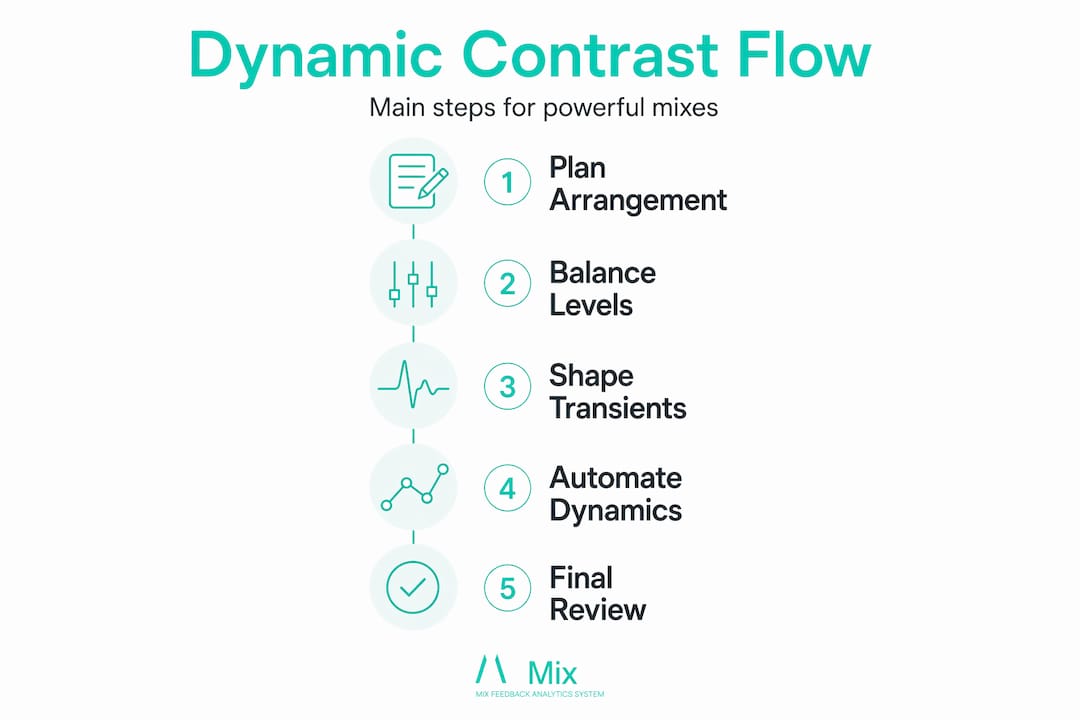
- Start at the arrangement level. Before touching a single plugin, ask whether your verse is genuinely sparser than your chorus. If they have the same number of elements, no amount of processing will fix the contrast problem.
- Automate your section volumes. Even a 2 to 3 dB lift into the chorus, combined with a slight pull-back on the verse, creates a noticeable sense of lift and release.
- Use parallel compression on your drum bus. Blend a heavily squashed version of your drums with the original to add body without killing the snap.
- Shape transients deliberately. A transient shaper on your snare or kick can make hits feel sharper and more separated, adding perceived contrast without touching volume.
- Thin out the verse. Mute elements, reduce reverb tails, and narrow the stereo image in verses so the chorus feels wider and more open by comparison.
- Use stereo image techniques strategically. A narrower verse and a wider chorus is a simple but devastatingly effective contrast tool.
- Check your low end. A fuller, more present bass in the chorus versus a tighter, more restrained bass in the verse adds contrast you feel as much as hear.
Pro Tip: Think arrangement before plugins. If your sections aren't meaningfully different in terms of what's playing, no amount of compression or automation will manufacture genuine contrast. Fix the arrangement first, then use processing to enhance what's already there.
It's also worth remembering that perceived contrast goes beyond literal loudness. Engineers use transient sharpness, reverb density, stereo width, and even the emotional "bigger vs intimate" feel to create contrast that listeners experience physically, not just analytically. A mix can feel huge without actually being louder, simply because the elements surrounding it were carefully restrained. And the energy and contrast for promotion of your music matters too: a track with strong dynamic contrast simply performs better in playlists, sync licensing, and audience retention.
Practical benchmark thinking means treating dynamic contrast as an arrangement-level goal first, then implementing it using the smallest processing and automation moves needed. Chasing constant loudness typically harms contrast, and that's a trade-off most mixes can't afford to make.
Pitfalls and common mistakes: Where dynamic contrast goes wrong
Knowing how to create dynamic contrast is crucial, but understanding what not to do is just as important for a punchy, effective mix. The most common culprit is over-compression. When you over-control dynamics, heavy compression and limiting shrinks dynamic range, making transients feel less separated from the rest of the mix. The result is a track that feels relentless and fatiguing rather than exciting and dynamic.
Another major mistake is planning too late. If your verse is already too loud relative to your chorus, there's simply nowhere left for the chorus to go. Dynamic contrast planning matters early in the process, not just when you're choosing loudness targets at the mastering stage. By then, the decisions have already been made.
Here are the most common mistakes producers and engineers make, along with practical solutions:
- Compressing every track heavily from the start. Solution: Use compression purposefully and sparingly, and always check what it's doing to your transients.
- Mixing at a constant volume throughout. Solution: Automate section levels so each part of the song has its own energy signature.
- Adding more elements when a section feels weak. Solution: Often, removing elements from the verse is more effective than adding to the chorus.
- Ignoring the waveform view. Solution: Zoom out and look at your full mix waveform. If it looks like a solid brick, your contrast is gone.
- Treating mastering as a fix-it stage. Solution: Contrast must be built in the mix. Mastering can polish, but it cannot restore lost movement.
- Relying on a single tool (usually a limiter) to do all the heavy lifting. Solution: Spread your dynamic shaping across arrangement, automation, compression, and transient design.
Pro Tip: After you've finished a rough mix, zoom your DAW's arrangement view out to see the full track waveform. The choruses should visibly be denser and more active than the verses. If everything looks uniform, you've got work to do before reaching for the dynamic range analysis tools.
Evaluating, measuring, and maintaining dynamic contrast
Having learned the techniques and pitfalls, here's how to check your actual mixes for healthy dynamic contrast. The most important tool you have is your ears, but that doesn't mean you should ignore the visual and metering tools available to you.
Remember, dynamic range is the quiet-to-loud span of the audio content, while headroom is the unused space before digital distortion. Confusing the two leads to mixes that feel safe on the meters but lifeless in the speakers. Use your dynamic range tools to measure the actual content, not just the ceiling.
Here's a practical checklist for your final mix review:
- Section A/B listening test. Play your verse, then immediately play your chorus. The energy shift should be immediately obvious and satisfying.
- Waveform inspection. Zoom out and check that high-energy sections are visually denser and more active than low-energy sections.
- Metering check. Use a loudness meter (LUFS) to confirm that your sections have meaningfully different integrated loudness values.
- Transient check. Solo your drums and listen for snap and separation. If hits feel rounded or buried, your compression may be too heavy.
- Headroom vs. dynamic range audit. Confirm you have adequate headroom (typically around 1 to 3 dB before the limiter) while also checking that the dynamic range of your content is not excessively squashed.
- Reference track comparison. Play a commercially released track in a similar genre and compare section-to-section energy shifts with your own mix.
- Fresh ears test. Leave the mix for a few hours, then listen back. Does the chorus still feel like a payoff? Does the verse feel like it breathes? If not, revisit your contrast decisions.
Developing strong content strategies for engagement around your music also benefits from this kind of structured review, because a mix with strong dynamic contrast is simply more compelling in every context it's heard.
Why real impact comes from the contrast you almost didn't keep
Here's a perspective that took me a long time to fully appreciate: the most powerful moments in a great mix are often the ones that felt "wrong" during the process. A verse that felt too quiet. A breakdown that felt too empty. A pre-chorus that felt almost uncomfortably restrained. These are the moments engineers are tempted to fix, to fill in, to smooth over. And that's exactly where so many mixes lose their emotional power.
The listener's brain is constantly predicting what comes next. When you honour that tension by holding back, by genuinely leaving space and resisting the urge to fill every gap, the payoff when the chorus arrives is visceral. It's not just louder. It feels earned. That's the difference between a mix that sounds technically correct and one that makes someone stop what they're doing and turn up the volume.
I've seen this pattern repeatedly: producers spend hours trying to make a verse feel more exciting, adding layers, boosting frequencies, pushing compression. But the verse isn't the problem. The chorus just isn't contrasting enough. The fix isn't addition. It's subtraction. Strip the verse back further, and suddenly the chorus feels like a revelation.
The report insights on contrast we see from mix evaluations consistently show the same thing: mixes that feel flat have usually had their most dramatic moments smoothed over in pursuit of a polished, consistent sound. Polished is great. But consistent energy is the enemy of emotional impact. Great producers leave room for surprise. They protect the quiet moments as fiercely as they build the loud ones, because they understand that the contrast between the two is where the music actually lives.
Get expert feedback and tools for dynamic, expressive mixes
If you want to put everything in this guide into real-world practice, getting objective feedback on your actual mix is the fastest way to make genuine progress. It's one thing to understand dynamic contrast intellectually, and another to hear clearly where your specific mix is falling short and exactly what to do about it.
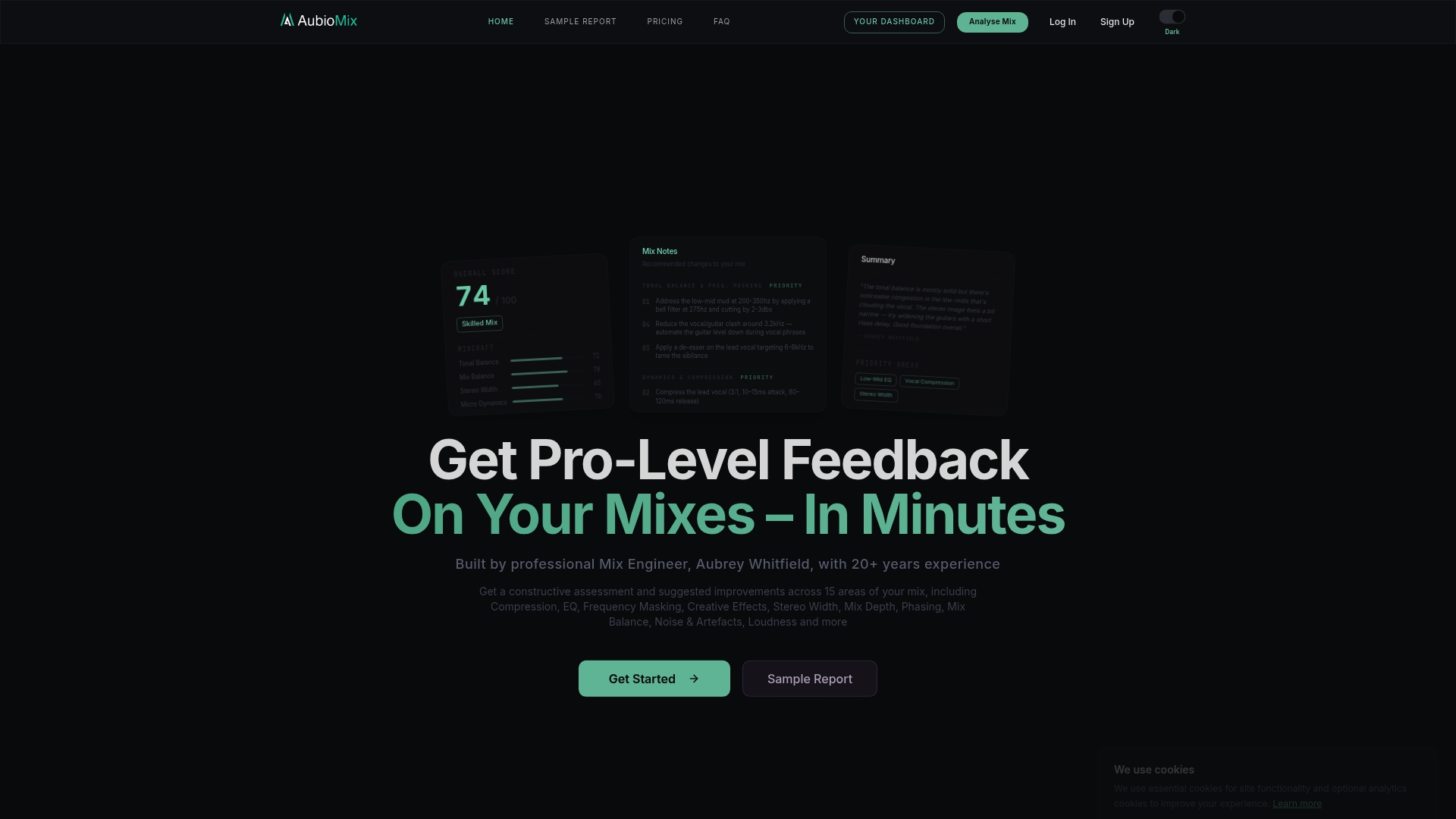
AubioMix is built precisely for this. You can submit your mix for expert feedback by uploading your audio file directly to the platform, and you'll receive a detailed, actionable report covering dynamic contrast, mix balance, stereo image, and more. The evaluation framework for mixes is designed to give you the kind of specific, practical guidance that turns a good mix into a great one. Whether you're working on your first release or your fiftieth, there's always something to sharpen. See pricing and take the next step towards mixes that genuinely move people.
Frequently asked questions
How do I know if my mix has enough dynamic contrast?
Compare your section levels: if every part feels as loud and energetic as the rest, dynamic contrast is likely lacking. Use metering tools and critical listening to check, keeping in mind that dynamic range is the quiet-to-loud span of your audio content, not just your headroom ceiling.
Can I increase dynamic contrast after mastering?
Usually not effectively, because dynamic contrast must be built during the mixing stage. Heavy compression and limiting at the mastering stage can't restore lost transient movement or recreate section-to-section energy shifts that were never there to begin with.
Is dynamic range the same as headroom?
No, they are distinct concepts. Dynamic range is the difference between the softest and loudest audio in your mix, while headroom is the safety buffer between your loudest peak and the point of digital distortion.
Does making everything loud make my mix better?
No, and this is one of the most persistent myths in music production. Chasing constant loudness typically harms dynamic contrast, reducing the emotional impact and sense of journey that makes a mix genuinely compelling to listen to.
What's a fast way to add dynamic contrast?
Try level automation and parallel compression to shape section impact and movement without losing detail. Automate a 2 to 3 dB lift into your chorus and blend a heavily compressed drum bus with your dry signal for immediate, noticeable results.