

You spend hours on a mix, you export it, you listen back on your laptop speakers, and something feels off. But what, exactly? And who do you ask? Getting genuinely useful feedback on your mix is one of the most underrated skills in music production, and most producers go about it the wrong way. They share a rough export in a WhatsApp group, get a "sounds great mate" in response, and call it done. This guide is here to change that. We'll walk through how to prepare your mix for review, where to get feedback worth acting on, and how to implement it without losing your mind or your creative vision.
Table of Contents
- Key takeaways
- Getting feedback on your mix: prepare first
- Where to get mix critiques that count
- How to give and receive feedback effectively
- Implementing feedback and verifying your improvements
- My honest take on the feedback process
- Try Aubiomix for fast, professional mix feedback
- FAQ
Key takeaways
| Point | Details |
|---|---|
| Prepare before submitting | Share a clean stereo file with genre, goals, and reference tracks to get focused, useful feedback. |
| Choose the right feedback source | Match your budget and project scale to the appropriate service tier, from peer communities to professional evaluation. |
| Use timestamped comments | Pinning feedback to exact moments in the waveform cuts revision rounds significantly and eliminates guesswork. |
| Run a structured feedback loop | Collect, filter, implement, and re-check your changes rather than making edits reactively and at random. |
| Know when to stop | Use a "fresh ears" test and A/B comparison to confirm improvements and avoid endless revision cycles. |
Getting feedback on your mix: prepare first
Before you send your mix anywhere, the quality of the feedback you receive is almost entirely determined by what you give the reviewer to work with. Think of it like visiting a doctor. The more clearly you describe your symptoms, the more precise the diagnosis. Turning up with a vague "something feels wrong" gets you a shrug. Coming in with specifics gets you answers.
Here is what you should have ready before seeking any mix feedback online:
- A clean stereo export. Most services and communities accept either a high-quality MP3 (320 kbps) or a WAV file. As noted by professional evaluators, a single stereo mix is all that is required. No stems, no sessions, no multi-track uploads.
- Genre and sub-genre context. A trap beat and a jazz fusion piece are evaluated against completely different sonic benchmarks. Tell the reviewer what they are listening for.
- Reference tracks. Pick one or two commercial releases in your genre that represent the sound you are aiming for. This gives the reviewer a calibration point and saves a great deal of back and forth.
- A short description of your goals. Are you aiming for streaming release? A film placement? A club system? Each context demands different priorities, from loudness and width to dynamic range and low-end control.
- Specific questions. Vague submissions invite vague responses. "Does the vocal sit well in the chorus?" is infinitely more useful to a reviewer than "what do you think?"
Pro Tip: Before you export for review, do a quick level balance check to make sure obvious issues like a buried kick or a clipping master bus are sorted. Reviewers should be commenting on the nuance of your mix, not the basics.
Here is a simple reference table to help you choose your export format based on use case:
| Use case | Recommended format | Notes |
|---|---|---|
| Online community review | MP3 320 kbps | Quick to upload and share |
| Professional service submission | WAV 24-bit / 44.1 kHz | Higher detail for accurate evaluation |
| AI-based mix analysis | WAV or MP3 (tool dependent) | Check the platform's requirements |
| Pre-mastering review | WAV 24-bit, no limiting | Leave headroom for the mastering stage |
Where to get mix critiques that count
Once your materials are in order, the next question is where to actually go. There are several distinct paths, each with genuine trade-offs.

Professional feedback services
Structured services offer tiered options that scale with your budget and timeline. A typical service structure includes a free scorecard tier with turnaround up to one week, a paid basic tier with detailed written notes in around 48 hours, and a comprehensive tier with timestamped waveform notes delivered in 24 hours. The comprehensive tier is worth the investment for anything you plan to release commercially, because the precision of timestamped notes (more on that shortly) is transformative.
Online communities and peer review
Forums, Discord servers, and subreddits dedicated to music production offer peer review for music mixes at no cost. The trade-off is consistency. You might receive one brilliant critique and four contradictory opinions in the same thread. The value here is exposure to a range of listening perspectives, which is genuinely useful in the early stages of a mix. It is less useful when you need a clear, authoritative answer on whether your low-mids are masking the vocal.
AI-assisted mix evaluation tools
AI mix analysers are increasingly capable of flagging frequency imbalances, dynamic issues, and stereo width problems in seconds. They will not tell you whether your arrangement is emotionally compelling, but they are excellent at catching technical blind spots before you submit to a human reviewer. You can explore alternative AI tools if you want to compare what is available in 2026.
Pro Tip: Combine AI analysis with human review rather than choosing one over the other. Use the AI report to fix obvious technical issues first, then submit to a professional for the interpretive, creative-level critique that a machine cannot provide.
Here is a quick comparison to help you decide:
| Feedback source | Cost | Turnaround | Best for |
|---|---|---|---|
| Online community | Free | 1 to 48 hours | Early-stage mixes, exploratory feedback |
| AI analysis tool | Free to low cost | Instant | Technical issues, quick checks |
| Professional service | Paid | 24 to 72 hours | Pre-release mixes, commercial projects |
| Industry professional | High cost | Variable | Career-level work, label submissions |
How to give and receive feedback effectively
This is where most producers drop the ball, even when they have found a good reviewer. The feedback process itself has mechanics that either amplify or destroy its usefulness.
-
Use timestamped comments wherever possible. Timestamped waveform comments lock each note to a specific sonic event in the timeline, eliminating the guesswork that kills revision rounds. Tools like Feedtracks, Notetracks, and Frame.io all offer this within an integrated playback environment. Professional studios are increasingly adopting this as a standard workflow.
-
Separate "where" from "what to do". The most effective feedback format identifies both the exact timestamp and a specific processing suggestion. Something like "at 1:23, the snare is too prominent, try pulling 4 kHz down by 2 dB" is genuinely actionable timestamped feedback. "The snare sounds weird" is not.
-
Prioritise structural issues over cosmetic ones. If a reviewer flags that the low-end is muddy and the vocal has a harsh 3 kHz peak, fix both before you even think about tweaking the reverb tail on the hi-hat. Work from the most significant problems outward.
-
Manage multiple reviewers carefully. Conflicting feedback from several reviewers can feel paralysing. Centralising comments on a waveform through a collaborative tool lets you see patterns. If three people independently flag the same moment, that is signal. One person's isolated opinion may just be personal preference.
-
Acknowledge the creative boundary. Feedback should inform your decisions, not override them. A reviewer might suggest the vocal needs to be louder in the verse, but if your artistic intent is a lo-fi, buried vocal texture, you are allowed to hold your ground. Note the suggestion, weigh it, and decide.
"A precise, actionable feedback approach reduces revision rounds, saves money, and accelerates the mix process for both artists and engineers." — Feedtracks Blog
Implementing feedback and verifying your improvements
Collecting feedback is only half the work. Implementing it well is where the real improvement in your mix actually happens.
-
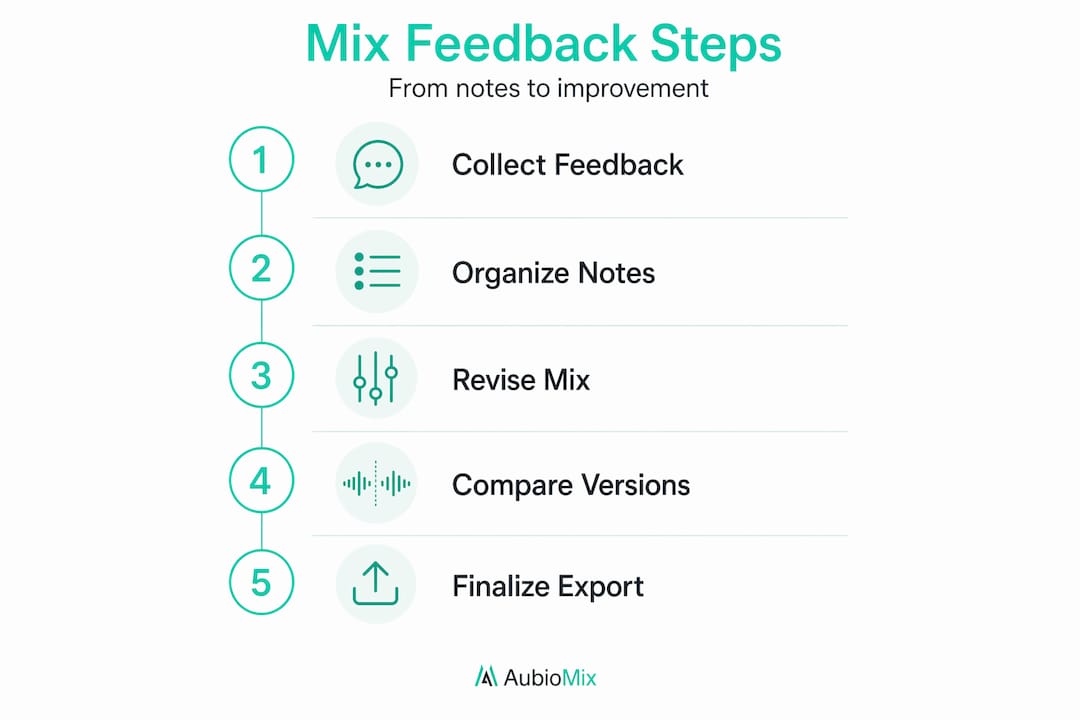
Run a structured feedback loop. Gather your notes, filter out the noise (vague opinions, contradictions without pattern), implement the prioritised fixes, and then re-check. Artists who follow this explicit process consistently produce mixes that connect with listeners more effectively than those who revise reactively.
-
Take a break before you re-check. Running a 48-hour "fresh ears" test before evaluating your revisions is one of the most underused tools in mixing. Stepping away from the mix helps you distinguish between a genuine remaining issue and a subjective doubt born from overexposure to the material.
-
Use A/B comparison with references. Load your revised mix alongside your reference track in your DAW and switch between them at matched loudness levels. This is not about sounding identical to the reference. It is about confirming that the gap has narrowed in the areas you were working on. Low-end weight, vocal presence, stereo width, transient punch. These are all measurable perceptually.
-
Know when to draw the line. There is a real phenomenon called feedback fatigue, where a mix gets worse through over-revision. Vague feedback and unstructured revision cycles are the usual culprits. If your fresh ears test returns no specific, fixable issues and your reference comparison is solid, the mix is done. Send it to mastering.
Pro Tip: When implementing multiple rounds of feedback, keep versioned exports (v1, v2, v3) rather than overwriting files. Comparing across versions using a structured feedback approach lets you confirm actual improvement rather than just change.
My honest take on the feedback process
I have seen producers chase feedback from every direction and end up more confused than when they started. The problem is almost never a shortage of opinions. It is a shortage of useful opinions.
What I have learned, working with mixes across genres, is that the producers who improve fastest share one trait: they ask precise questions and they know exactly what they are going to do with the answer before they receive it. They are not collecting feedback to feel validated. They are using it as a diagnostic tool.
The shift from vague to timestamped feedback changed things considerably in my experience. When a reviewer can drop a pin at exactly 2:04 and say "the bass guitar is masking the kick around 80 Hz, try a narrow cut on the bass at that frequency," you do not need to interpret anything. You just act on it.
I would also push back on the idea that more feedback is always better. There is a sweet spot. One or two sharp, experienced reviewers who understand your genre will consistently outperform a crowd of twenty mixed-experience commenters. Quality of input beats quantity every time.
The other thing worth saying: protect your creative instincts. Feedback is medicine, not instruction. Take what serves the mix, leave what does not, and do not apologise for either.
— AubioMix
Try Aubiomix for fast, professional mix feedback
If you are ready to stop guessing and start getting real answers about your mix, Aubiomix was built for exactly that moment. Upload your stereo file, get detailed professional feedback on the core elements of your mix including balance, clarity, loudness, low-end, and stereo width, and receive a structured report with specific, actionable steps you can apply immediately.

Aubiomix evaluates your mix against a clear, professional evaluation framework so you always know what was assessed and why. You can even review a sample report before you commit, so you know exactly what you are getting. No vague opinions. No waiting weeks. Just the precise mix feedback you need to make your track sound the way you intended.
FAQ
What should I include when submitting a mix for feedback?
Submit a stereo export (MP3 at 320 kbps or WAV at 24-bit), along with your genre, one or two reference tracks, and specific questions about what you want evaluated. Engineers note that context around goals and references allows for a much more focused and useful critique.
How do timestamped comments improve mix feedback?
Timestamped comments attach each note to an exact moment in the waveform, eliminating ambiguity about which part of the mix is being discussed. Research from Feedtracks shows this approach can reduce revision rounds from three or four down to just one or two.
Where can I get mix feedback online for free?
Free options include music production communities on Reddit, Discord servers dedicated to mixing and production, and some professional services that offer a free evaluation tier with a basic scorecard, as offered by services like Mike's Mix and Master.
How do I know when my mix is finished?
Step away from the mix for at least 48 hours, then listen back with fresh ears. If no specific, fixable issues stand out and your A/B comparison with a reference track feels solid, your mix is ready. Ongoing doubt without a concrete target usually signals fatigue, not a real problem.
How many rounds of feedback should I go through?
Two to three focused rounds is typically sufficient for most mixes. More than that often signals either vague feedback driving aimless revisions or a structural issue in the arrangement that mixing alone cannot resolve.