
Linear-phase EQ preserves waveshape but pays for it with pre-ring and added latency, so audition it against minimum-phase before you commit. If a snare or vocal transient sounds smeared or "wet" before it even hits, run a phase invert test and a correlation check. When pre-ring shows up on percussive material, switch to minimum-phase, try a blended mode, or render offline.
TL;DR:
- Linear-phase EQ can cause pre-ring artifacts that are most audible on transient-heavy sources like snares and plucks, especially with steep filters or narrow Q.
- The latency and CPU demands of linear-phase processing increase with correction depth and lower frequencies, making it unsuitable for tracking and live monitoring but useful for final mixing stages.
- Diagnostic tools include looped transient tests, phase invert checks, correlation meters, and spectrogram analysis to identify pre-ring and phase issues accurately.
- Switching to minimum-phase or blended modes, widening the Q, or offline rendering are effective ways to reduce artifacts without sacrificing phase coherence.
- Using diagnostic platforms like AubioMix can save time by quickly identifying phase and EQ problems that require targeted fixes.
Table of Contents
- What causes linear phase EQ artefacts (pre-ring and group delay)
- The real latency and CPU cost of linear phase processing
- When linear phase EQ is genuinely the right tool
- How to detect linear phase EQ problems by ear and by meter
- Fixing linear phase EQ artefacts without losing the benefits
- Verifying the fix actually worked
- AubioMix expert guidance for faster phase diagnosis
- Why experienced engineers keep both EQ types in the toolbox
- Get a faster read on your phase and EQ decisions
- Sources
- FAQ
What causes linear phase EQ artefacts (pre-ring and group delay)
Linear-phase EQ delays every frequency by the same amount, which is what keeps your kick and snare in perfect time relationship across bands. That consistency is the whole selling point. The cost is a phenomenon called pre-ring, where filtering energy appears before a transient rather than after it.
Minimum-phase filters, the kind built into most stock EQs, ring after a transient, the way a room naturally decays after a drum hit. Your ears are used to that. Listening tests and Matlab modelling from CCRMA show zero-phase and linear-phase filters instead smear energy backwards in time, ahead of the transient, which breaks the forward-masking your brain relies on to ignore quiet noise before a loud hit. That is why pre-ring often sounds more audible than an equivalent amount of after-ringing, even when the total energy is similar.
A few things make it worse:
- Steep filters and narrow Q stretch the filter's impulse response, which lengthens the pre-ring tail.
- Percussive, transient-heavy sources (snares, plucks, claps) expose pre-ring far more than sustained pads or bass.
- FIR-based implementations, which most linear-phase EQ plugins use, trade some correction accuracy for the artefact reduction that windowed filtering offers, per CCRMA's filter design notes.
The real latency and CPU cost of linear phase processing
Linear-phase EQ is not free. Sonarworks notes that FIR-based linear-phase filtering typically adds noticeably more latency than a minimum-phase equivalent, and the deeper the correction or the lower the frequency being addressed, the worse it gets. CPU load climbs alongside it, since the plugin is now convolving a much longer impulse response instead of running a simple recursive filter.
Your DAW's plugin delay compensation will usually absorb this on playback, but it starts to break down in a few common situations:
- Live monitoring while tracking, where round-trip latency becomes audible and distracting.
- Sessions with many linear-phase instances stacked, where cumulative latency and CPU load strain the buffer.
- Sample-accurate editing or comping, where delay compensation errors surface as timing mismatches between tracks.
The workaround is straightforward: use lower-latency or minimum-phase modes while tracking and comping, then switch to full linear-phase only for final passes, or render the affected tracks offline once decisions are locked.
When linear phase EQ is genuinely the right tool
Linear phase earns its place in specific, narrow situations rather than as a default setting. iZotope's guidance points to three scenarios where it consistently outperforms minimum-phase:
- Narrow, surgical notches on sustained material. A tight resonance cut on a pad, bass synth, or vocal doesn't create the transient exposure that reveals pre-ring, so you get the phase-coherence benefit with none of the cost.
- Parallel processing chains. When you're blending a heavy EQ'd parallel path with a dry signal, phase misalignment between the two causes cancellation. Linear phase keeps them locked in time.
- Multi-mic and stereo bus duties. Drum overheads blended with close mics, or mastering-stage EQ across a stereo bus, both rely on preserved relative phase between channels. Shifting one mic's phase relative to another audibly thins the sound.
Three quick session checks decide it fast: is the source transient-heavy, is this a narrow or wide correction, and does the track need to stay phase-locked against another signal. Two "yes" answers to the first and third questions, with a "narrow" for the second, is your green light.
Pro Tip: Keep one linear-phase EQ and one minimum-phase EQ loaded as favourites in your plugin browser. Auditioning both takes seconds and saves you from committing to the wrong one out of habit.
How to detect linear phase EQ problems by ear and by meter
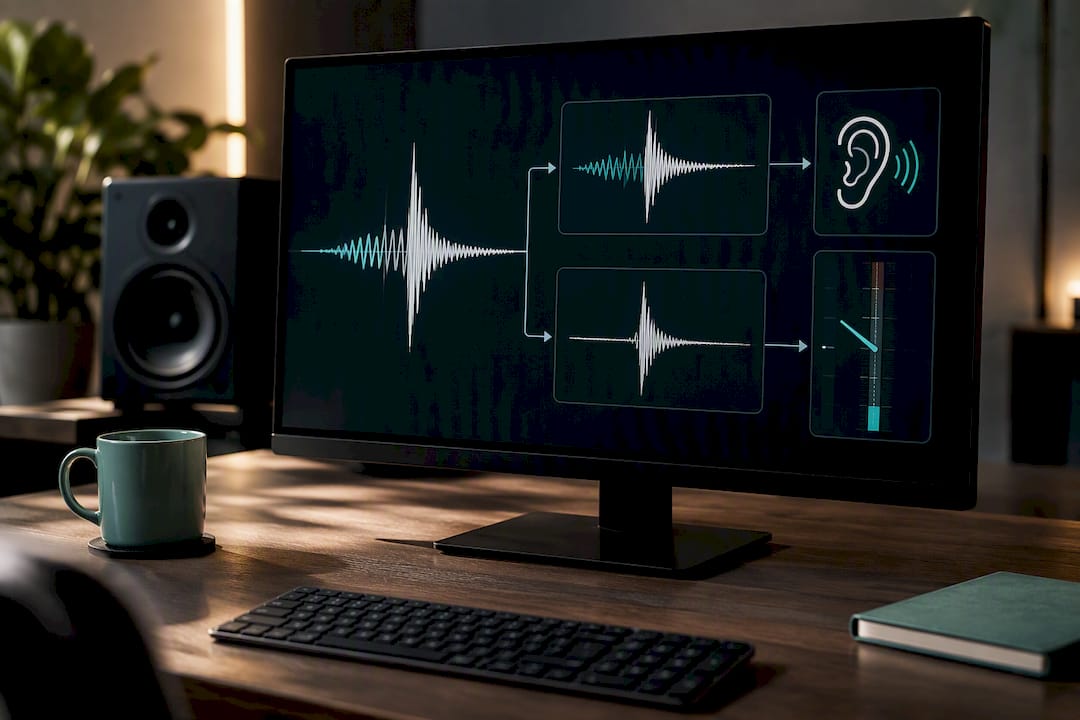
Diagnosis should never rely on gut feeling alone, because pre-ring at low levels is genuinely hard to catch on a first listen. Build a short, repeatable routine instead.
Start with a bypass and solo test on the processed track alone, focused on its transient content. Loop a single hit, a snare crack or a plucked note, for two or three seconds and switch the EQ in and out on that loop. Pre-ring reveals itself far more clearly in a tight loop than across a full mix pass.
- Phase invert test: flip polarity on one of two paired signals (parallel EQ path against dry, or two overhead mics) and listen for thinning or cancellation that changes with the EQ engaged.
- Correlation meter: a healthy stereo or dual-mic signal usually sits close to +1; a drop toward zero or negative after adding linear-phase EQ flags a phase problem worth investigating.
- Spectrogram view: pre-ring shows as faint energy smeared just before a transient's leading edge, visible as a soft "shadow" on a zoomed-in spectrogram.
- Blind A/B across two monitoring systems (main monitors and headphones, for instance) confirms whether what you're hearing is a mix issue or a monitoring artefact.
AubioMix's own step-by-step phase troubleshooting guide walks through this exact invert-and-correlate sequence in more detail if you want a repeatable checklist to keep on hand.
Fixing linear phase EQ artefacts without losing the benefits
Once you've confirmed pre-ring or excess latency is genuinely a problem, work through fixes in order of least disruptive first.
- Confirm the artefact is real, using the loop and invert tests above, before changing anything. Chasing a ghost wastes time.
- Switch to minimum-phase or a blended mode. Many current plugins let you dial between the two responses, and Boris FX's guidance on linear-phase EQ notes that a blended setting often removes most of the audible pre-ring while keeping a meaningful share of the phase-linearity benefit.
- Widen the Q or reduce the slope of the offending band. A gentler curve shortens the filter's impulse response and shrinks the pre-ring tail along with it.
- Move to parallel processing if the goal was tonal shaping rather than surgical correction, since a parallel blend with a dry signal masks residual artefacts more forgivingly than a fully wet path.
- Render offline when latency, not tone, is the sticking point. Freezing or bouncing the track removes the real-time monitoring penalty entirely while keeping the linear-phase result.
If pre-ring survives all of that, and it occasionally does on very steep mastering-stage cuts, spectral repair tools or a transient designer placed after the EQ can tighten the attack back up as a last resort. Keep this order deliberate: fixing Q and slope first avoids reaching for heavier tools you don't need.
Pro Tip: Automate a linear-phase EQ's blend or bypass so it's only active on the final render pass, not during tracking or comping. You get the sonic benefit without living with the latency all session long.
Verifying the fix actually worked
Repeat the exact detection steps you ran earlier, on the same looped transient, and compare the result directly rather than trusting memory.
- Re-run the phase invert test and check whether the correlation meter reading has genuinely improved, not just shifted.
- Overlay the waveform or spectrogram before and after the fix; the pre-transient smear should visibly shrink or disappear.
- Do a blind A/B across at least two playback systems, and note down which setting won and why in your session notes.
- If latency compensation felt fragile during the diagnosis, freeze or render the stem now so the fix survives further editing.
Documenting the change matters more than it sounds. A quick note in the session ("switched Snare Bus EQ to blended mode, correlation up from 0.4 to 0.8") saves you re-diagnosing the same track in a later revision.
AubioMix expert guidance for faster phase diagnosis
Running every one of these tests manually takes time you may not have mid-session. Some online mix analysis platforms accept uploaded mixes and return detailed, actionable feedback across phase, EQ, and various other mixing categories, flagging exactly where correlation drops or transient smearing occurs rather than leaving users to hunt for it. For a faster read on your own troubleshooting, pair a review with AubioMix's guide to fixing phase and polarity in five steps.
To get the most useful result, prepare stems or the dry, unprocessed mic signals alongside your processed mix, plus a reference track if you have one in mind. That gives the review something concrete to compare against.
Why experienced engineers keep both EQ types in the toolbox
There's no single correct filter type, only trade-offs suited to the material in front of you. Minimum-phase suits most mixing work; linear-phase earns its place on narrow, transient-light, or phase-critical jobs. Keep a short mental checklist, audition before committing, and write down what you changed. That habit beats any fixed rule.
— AubioMix
Get a faster read on your phase and EQ decisions
Working through invert tests, correlation meters, and spectrograms is worthwhile, but it eats session time you'd rather spend mixing. AubioMix gives you that diagnostic pass in minutes instead of hours: upload your mix and get specific, written feedback on where phase correlation is weak, where EQ choices are introducing smearing, and what to adjust first.

A single Mix Review costs £4.99 and covers phase, EQ, and the rest of your mix in one pass, ideal if you just want a second opinion on a track you suspect has a linear-phase problem. If you're troubleshooting regularly across projects, the Professional plan at £19.99 per month bundles a fixed number of reviews each month, which works out considerably cheaper per track than one-off credits. Upload your stems or dry mic signals alongside the mix for the clearest diagnosis, and check the sample report first to see exactly what the feedback looks like before you commit.
Sources
- Linear Phase Really Ideal (CCRMA)
- Should you be using linear phase EQ? (Sonarworks blog)
- What is linear phase EQ? How to use it in your mix (iZotope)
FAQ
What is pre-ring in linear phase EQ?
Pre-ring is filtering energy that appears just before a transient instead of after it, caused by linear-phase filters delaying all frequencies equally. CCRMA's research shows this breaks forward masking, which is why it often sounds more obvious than ordinary minimum-phase ringing.
How do I know if linear phase EQ is causing problems in my mix?
Loop a short transient, bypass the EQ, and listen for smearing right before the hit, then confirm with a correlation meter or phase invert test. A visible shadow before the transient on a spectrogram confirms pre-ring is present.
Is linear phase EQ or minimum phase better for mixing?
Neither wins outright. Minimum-phase suits most general mixing and transient-heavy sources, while linear-phase performs better for narrow surgical cuts, parallel processing, and multi-mic or mastering-bus work where relative phase matters most.
How much latency does linear phase EQ add?
Latency varies by plugin and filter depth, but linear-phase FIR processing is consistently higher than minimum-phase, enough that Sonarworks recommends offline rendering when it starts interfering with tracking or live monitoring.
Can AubioMix help me identify linear phase EQ issues in my track?
Yes. AubioMix reviews an uploaded mix and reports back on phase correlation and EQ problems specifically, alongside a dozen-plus other mix areas, starting at £4.99 for a single review.