

Phasing is defined as the timing relationship between two or more audio waveforms, where differences in arrival time create either constructive or destructive interference. When two identical signals align perfectly at 0°, their amplitudes double. When they sit 180° apart, they cancel completely. Every mix engineer working with multi-mic recordings, layered synths, or parallel processing will encounter phase issues. Understanding phasing at a technical level is what separates a mix that sounds full and powerful from one that sounds thin, hollow, and lifeless.
What is phasing and how does it affect your mix?
Phasing describes the degree to which two signals are offset in time, measured in degrees from 0° to 180°. At 0°, the waveforms reinforce each other. At 180°, they cancel. Every angle in between produces a partial combination of both effects, which is why phase problems rarely sound like total silence but instead create a filtered, scooped quality that is hard to pin down.
The most common phase artefact is comb filtering. This occurs when a slightly delayed copy of a signal mixes with the original, creating a series of notches and peaks across the frequency spectrum. The pattern resembles the teeth of a comb on a spectrum analyser, hence the name. Comb filtering is the reason a snare drum recorded with both a top and bottom microphone can sound thin and nasal if the two signals are not time-aligned.
Multi-mic setups are the most frequent source of phase problems in recording. A kick drum recorded with a close mic and a room mic will have different arrival times at each capsule. When you blend those two signals in your DAW, the timing offset creates partial cancellation. The low end suffers most, because longer wavelengths are more sensitive to small timing differences relative to their cycle length.
Two practical starting points for fixing these issues are polarity inversion and time-alignment. Polarity inversion flips the signal 180°, which can resolve cancellation when the offset is close to half a cycle. Time-alignment moves one signal forward or backward in the DAW to reduce the timing gap. Neither method is perfect on its own, but together they address the majority of real-world phase conflicts.
- Comb filtering: partial cancellation across a range of frequencies, creating a hollow or nasal tone
- Low-end thinness: phase offset between bass-heavy signals causes the fundamental frequencies to cancel
- Transient smearing: phase differences blur the attack of drums and percussive elements
- Stereo image collapse: out-of-phase signals in a stereo mix fold to mono and lose width
Pro Tip: Always check your mix in mono. Phase cancellation that is invisible in stereo becomes immediately obvious when you sum the channels. If your low end disappears or your snare goes thin, you have a phase problem.
Phase shift, polarity, and phase response: what is the difference?
These three terms are used interchangeably by many engineers, but they describe entirely different phenomena. Confusing them leads to wrong corrections and wasted time.
Phase shift is a frequency-dependent change in the timing of a signal. Different frequencies arrive at slightly different times after passing through a filter or processor. This is measured using group delay, which quantifies how much delay each frequency band experiences. A processor with high group delay at low frequencies will smear the timing of bass transients relative to the rest of the signal.
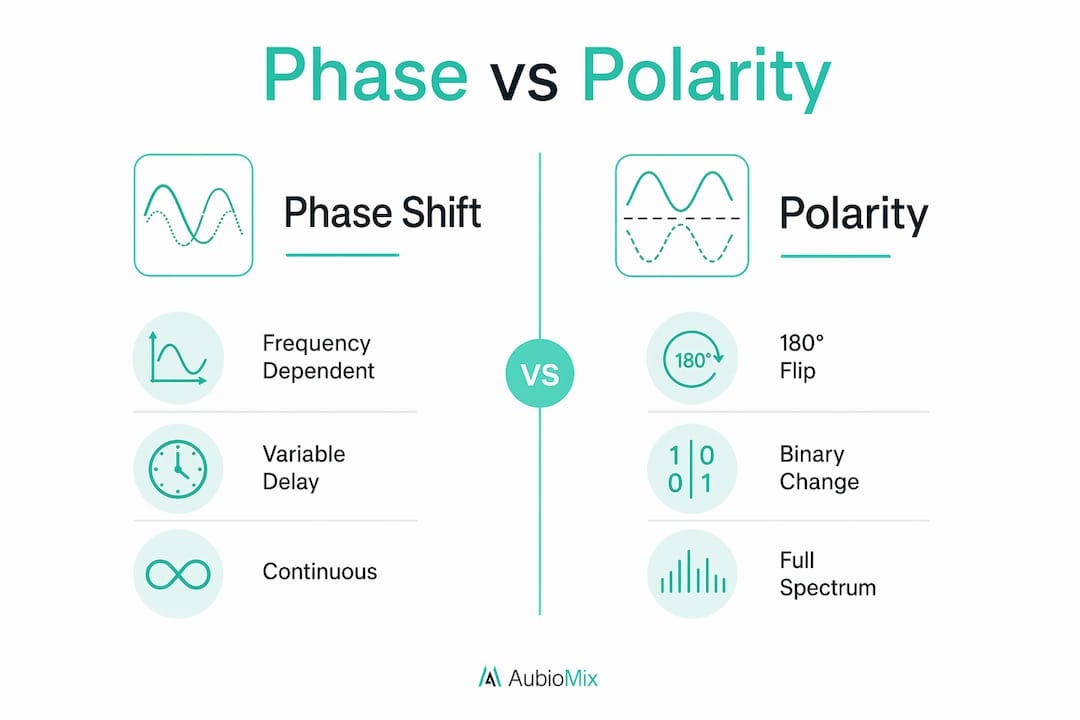
Polarity is a simple binary flip. Inverting polarity rotates the signal 180° across all frequencies simultaneously. It is not frequency-dependent. The polarity switch on a channel strip or the phase button on a microphone preamp does this. Many engineers call this a "phase flip," which is technically incorrect and leads to confusion when diagnosing problems.
Phase response describes how a processor or filter affects the phase of different frequencies across its entire range. An EQ with a steep low-cut filter will introduce significant phase shift around the cutover frequency. This is where the distinction between linear phase and nonlinear phase EQ becomes critical.
- Nonlinear phase EQ (IIR filters): introduces frequency-dependent phase shift, which can smear transients but sounds natural and musical
- Linear phase EQ (FIR filters): preserves temporal relationships across all frequencies, maintaining transient integrity at the cost of pre-ringing artefacts
- Phase rotators (all-pass filters): shift phase at specific frequencies without affecting amplitude, useful for correcting frequency-dependent phase problems that polarity inversion cannot fix
- Polarity inversion: a blunt 180° flip across all frequencies, not a substitute for nuanced phase correction
The practical takeaway is this: use polarity inversion as a quick diagnostic tool and a first-pass fix. Use phase rotators for frequency-specific correction. Use linear phase EQ on mix buses where transient accuracy matters more than CPU efficiency.
How do phaser effects work?
A phaser is an audio effect processor that exploits phase shift to create a sweeping, animated texture. It is one of the most distinctive sounds in electronic music, heard on everything from classic funk guitar to modern synthesiser pads. Understanding how it works helps you use it with intention rather than guesswork.
The phaser splits the input signal into two paths. One path passes through a series of all-pass filters, which shift the phase of different frequencies without changing their amplitude. The other path remains dry. When the two paths recombine, frequency notches) appear at the points where the phase-shifted signal is 180° out of phase with the dry signal. These notches are what give the phaser its characteristic hollow, swirling quality.
A low-frequency oscillator (LFO) modulates the all-pass filters over time, sweeping the notches up and down the frequency spectrum. This creates the iconic whooshing movement. The number of filter stages determines how many notches appear. A four-stage phaser produces two notches; an eight-stage phaser produces four. More stages create a denser, more complex timbre.
The mix ratio between the dry and wet signals has a direct impact on effect depth. Deepest notches occur) at a 50% dry/wet mix ratio, because that is where the cancellation between the two paths is most balanced. Pushing the wet signal higher or lower reduces notch depth and softens the effect.
| Feature | Phaser | Flanger |
|---|---|---|
| Source of effect | All-pass filters (phase shift) | Short delay line |
| Notch spacing | Non-uniform across spectrum | Uniform (harmonic series) |
| Character | Smooth, swirling, organic | Metallic, jet-like, intense |
| Typical LFO rate | Slow to moderate | Slow to fast |
| Mix ratio for depth | 50% dry/wet | 50% dry/wet |
Pro Tip: Try running a phaser on a sustained pad with a very slow LFO rate, around 0.1 Hz. The movement is almost imperceptible in real time but adds a living, breathing quality to the sound that static processing cannot replicate.
How do you fix phase problems in multi-miked recordings?
Fixing phase problems requires a systematic approach. Guessing and flipping polarity switches at random rarely produces consistent results. A clear workflow saves time and produces better outcomes.
The 3:1 rule is the first line of defence during recording. It states that the distance between two microphones should be at least three times the distance from the closer mic to the sound source. This spacing reduces the timing offset between the two signals enough to minimise destructive interference when they are combined.
Phase problems can also emerge at the mix stage, even when the recording was clean. EQ and processing alter phase relationships between signals, and a chain of nonlinear phase processors can introduce cumulative phase shift that was not present at the point of capture. This is why a mix that sounds fine during tracking can develop a thin or hollow quality after processing.
Manual sample-accurate time-alignment between signals is often the most effective correction method, particularly when combining a DI bass signal with a miked amplifier. Plugins alone rarely resolve this type of conflict. Zooming in to the waveform in your DAW and nudging one track by a few samples can restore the low-end weight that polarity inversion alone cannot recover.
- Use a phase correlation meter: most DAWs include one. A reading consistently below zero indicates phase cancellation in the stereo field
- Zoom to the waveform: align transient peaks visually before committing to any processing
- Apply polarity inversion first: it is fast and free. If the mix improves, keep it. If not, move to time-alignment
- Use all-pass filter phase rotators: for frequency-dependent correction that polarity inversion cannot address
- Check in mono regularly: mono playback reveals cancellation that stereo monitoring hides
| Phase problem | Recommended fix |
|---|---|
| Two mics on one source | 3:1 rule during recording; time-alignment in DAW |
| DI and miked amp | Sample-accurate time-alignment |
| EQ-induced phase shift | Linear phase EQ on bus; all-pass filter rotator |
| Stereo image collapse | Polarity inversion; check mid/side balance |
| Thin low end in mix | Time-align kick and bass; check polarity of sub layers |
Key takeaways
Phasing in audio is a technical relationship between waveforms that directly determines whether your mix sounds full and powerful or thin and hollow.
| Point | Details |
|---|---|
| Phase is measured in degrees | Signals at 0° reinforce; signals at 180° cancel completely. |
| Polarity and phase are not the same | Polarity is a binary 180° flip; phase shift is frequency-dependent and requires different tools. |
| Comb filtering is the main artefact | Partial cancellation creates notches across the spectrum, causing a hollow or nasal tone. |
| The 3:1 rule prevents problems | Space microphones so the farther mic is at least three times the distance of the closer mic. |
| Linear phase EQ preserves transients | Use FIR-based linear phase mode on mix buses where timing accuracy matters most. |
Phase management: what I have learnt from years in the mix
Phase is the most misunderstood technical concept in mixing, and I say that with confidence. Engineers reach for the polarity button as a reflex, hear a slight improvement, and move on without realising they have only partially solved the problem. The real issue is often a timing offset of just a few samples, and no polarity flip in the world will fix that cleanly.
What I find most interesting is how subtle phase shifts affect the perceived weight and density of a mix. You do not always hear cancellation as silence. You hear it as a mix that lacks conviction, where the kick feels soft and the snare sounds like it is behind glass. That quality is almost always a phase issue, and it is almost always fixable with sample-accurate time-alignment rather than any plugin.
On the creative side, phaser effects remain one of my favourite tools for adding life to static elements. A slow phaser on a Rhodes piano or a sustained string pad creates movement that reverb and chorus cannot replicate. The electronic music mixing world has embraced this for decades, and the technique still sounds fresh when used with restraint.
The 2026 generation of linear phase processing has also made bus processing more transparent than ever. FIR-based EQs with zero group delay at high frequencies mean you can apply corrective EQ on a drum bus without smearing the snare transient. That was a real compromise five years ago. It is much less of one now.
— Aubiomix
Aubiomix: get instant phase feedback on your mixes
Phase problems are notoriously difficult to hear in isolation, especially after hours of listening to the same session. A fresh analytical perspective catches what tired ears miss.

Aubiomix is an online tool where you upload your audio file and receive detailed, pro-level mix feedback within minutes. It identifies phase cancellation, low-end thinness, and mix clarity issues with specific, actionable steps to fix them. Whether you are tracking a live band with multiple microphones or finalising an electronic production, Aubiomix gives you a clear picture of what is happening in your mix and exactly what to do about it. Upload your track at Aubiomix and hear the difference a proper phase analysis makes.
FAQ
What is phasing in audio mixing?
Phasing is the timing relationship between two or more audio signals, where differences in phase angle cause constructive or destructive interference. It affects the amplitude, tone, and perceived weight of a mix.
What causes a mix to sound thin due to phase?
Thin mixes are typically caused by partial cancellation between signals that are slightly out of phase, most commonly in multi-mic recordings or layered bass signals. The low-frequency content suffers most because longer wavelengths are more sensitive to small timing offsets.
What is the difference between phase and polarity?
Polarity inversion is a binary 180° flip applied equally across all frequencies. Phase shift is frequency-dependent and varies across the spectrum. Confusing the two leads to incorrect corrections and persistent mix problems.
How does a phaser effect create its sweeping sound?
A phaser splits the signal, passes one path through all-pass filters to create phase-shifted frequency notches, then recombines it with the dry signal. An LFO sweeps the notches up and down the spectrum, producing the characteristic swirling movement.
When should I use linear phase EQ?
Use linear phase EQ on mix buses and mastering chains where transient accuracy is critical. FIR-based linear phase processing preserves frequency timing across the spectrum, unlike nonlinear phase IIR filters which introduce frequency-dependent delays.