
Most producers think mixing starts when the arrangement is done. That thinking is exactly what leads to muddy, overprocessed tracks that take hours to fix. The role of arrangement in mixing is far more fundamental than most people realise. What you place, where you place it, and how it moves through a song determines whether your mix fights itself or flows naturally. This guide covers why arrangement is your most powerful mixing tool, how arrangement effects on mixing are felt at every stage, and the practical strategies you can use right now to produce cleaner, more professional results.
Table of Contents
- Key takeaways
- The role of arrangement in mixing
- How arrangement impacts mixing
- Techniques for arrangement-aware mixing
- Arrangement-first mixes versus overprocessed mixes
- Collaborative workflows for arrangement and mixing
- My honest take on arrangement and mixing
- Take your arrangement-mix workflow further
- FAQ
Key takeaways
| Point | Details |
|---|---|
| Arrangement shapes mix clarity | Thoughtful arrangement assigns each instrument its own sonic space, reducing frequency masking before mixing begins. |
| EQ cannot fix arrangement clashes | If two instruments compete in the same frequency range throughout a track, no amount of EQ will resolve the conflict. |
| Staged workflows save time | Separating arrangement from mixing reduces costly rework and improves consistency across the whole production. |
| Less processing, better sound | Tracks built on strong arrangements need fewer plugins and corrective tools to achieve a clean, professional mix. |
| Prosody drives mix decisions | Every part should emotionally support the song's message, which naturally guides how you balance and process elements. |
The role of arrangement in mixing
Before we get into technique, let us be clear about what arrangement actually is. Arrangement transforms a simple musical idea into a finished track by defining instrumentation, structure, and transitions that prevent a wall of sound. It is the process of organising instruments, melodies, rhythms, and textures over time into sections that make sense together.
Arrangement is not the same as composition. Composition creates the musical idea. Arrangement decides how that idea is expressed, which instruments carry which parts, when they enter and leave, and how energy builds or drops across the song. The arranger's role is closer to that of an architect than a songwriter. You are deciding how the building holds together, not just what it looks like.
One concept that sits at the heart of great arrangement is prosody. This means that all parts support the song's emotional message rather than just filling space. A sparse, breathy pad under a vulnerable vocal lyric is prosody in action. A dense, distorted synth under the same lyric is an arrangement decision that works against the song. Getting prosody right does not just serve the listener emotionally. It also tells you, before you even open a mix session, which parts belong and which parts need to go.
Arrangement decisions directly influence how listeners experience mood and tension throughout a track. That emotional curve, how energy rises into a chorus and breathes back out in a verse, is built entirely in the arrangement stage.
Pro Tip: When you finish a rough arrangement, listen through and ask yourself whether each part is serving the song's emotional moment. If you cannot answer clearly, the part probably does not belong there.
How arrangement impacts mixing
Here is where things get very practical. The importance of arrangement in mixing becomes obvious the moment you sit down with a track that was arranged without any thought for sonic space. You will find kick drums buried under basslines that occupy the same frequency range. You will find three synth layers all sitting in the mid-range, competing for the same real estate. You will find vocal melodies that get lost because a guitar part is running in exactly the same register.
Mixing problems such as muddiness often originate from arrangement clashes that cannot be fixed by EQ alone. This is one of the most underestimated truths in music production. You can spend an hour carving notches in a synth pad with a surgical EQ, and the problem will still be there because the arrangement put two instruments in conflict from the start. If two instruments overlap in frequency range constantly, they will clash regardless of mixing effort.

Compare these two workflows:
| Scenario | Approach | Result |
|---|---|---|
| Arrangement-first mix | Instruments assigned distinct frequency roles before mixing begins | Clean balance, minimal corrective EQ, fast mix decisions |
| Mix-fix approach | Heavy reliance on EQ and compression to separate crowded layers | Overprocessed sound, phase issues, hours of rework |
| Frequency conflict ignored | Two instruments sharing the same tonal range throughout | Persistent muddiness, masking, listener fatigue |
| Space built into arrangement | Instruments enter and leave at different points in the track | Natural dynamics, clear headroom, mix translates well |
Proper arrangement gives each instrument its own sonic space before a single fader is touched. A bassline that sits in the sub-low frequencies, a rhythm guitar that lives in the upper-mids, and a lead synth that occupies the high-mids: these are arrangement decisions, not mixing decisions. When you get them right, the mix almost works on its own.
Pro Tip: After finishing an arrangement, pull up a spectrum analyser across your full mix bus. Look for areas of constant congestion. If two instruments are always occupying the same frequency range, rearrange one of them rather than reaching for the EQ.
Techniques for arrangement-aware mixing
Knowing that arrangement matters is one thing. Knowing what to do about it is where the real learning begins. The most effective optimal mixing strategies start before the mix session opens, and here is how to build them into your arrangement process.
-
Layer with purpose, not volume. Layering is one of the most effective arrangement techniques for adding depth without clutter. Each layer should occupy a different part of the frequency or stereo field. A lead vocal sits centre and forward. A pad sits wide and back. A counter-melody sits slightly off-centre. When layers are assigned distinct spatial roles in the arrangement, they reinforce each other instead of competing.
-
Use call-and-response to clear space. Instead of having every instrument play throughout the whole track, let them answer each other. A guitar riff that plays when the vocal rests, or a piano melody that fills the gap between vocal phrases: this creates natural breathing room in the arrangement that translates directly into clarity in the mix.
-
Build contrast between sections. If your verse, pre-chorus, and chorus all use the same density of parts, the mix will feel relentless and hard to manage. Varying the number of active parts across sections makes it easy to distinguish each moment and gives your mix natural dynamics without heavy automation.
-
Think spatially from the start. Distributing vocal layers across 3D sound fields before detailed mixing reduces masking and increases harmonic clarity, a principle that applies even in stereo formats. Position elements in your arrangement with a sense of where they will live in the stereo field.
-
Ask the right question. The mindset of asking 'what does this section need?' is more effective than asking 'what else can I add?' This single shift in thinking prevents arrangement clutter and saves hours of corrective mixing later.
Pro Tip: Try a 'part reduction' pass before you mix. Go through the arrangement and remove or mute anything that does not have a clear sonic role. You will often find the track sounds better immediately, with no mixing required.
Arrangement-first mixes versus overprocessed mixes
The difference between an arrangement-first workflow and a mix-fix approach is not subtle when you hear them side by side. Solo artists relying on excessive plugins to fix arrangement issues produce less clear, less impactful mixes, and that quality gap is audible even to untrained ears.
An overprocessed mix tends to feel dense and fatiguing. Every element is competing, and the processing applied to contain that competition adds artefacts: subtle distortion from limiters pushed too hard, phase smearing from too many EQ nodes, pumping from compressors working overtime to manage dynamic conflicts. The track might be loud, but it will not be clear.
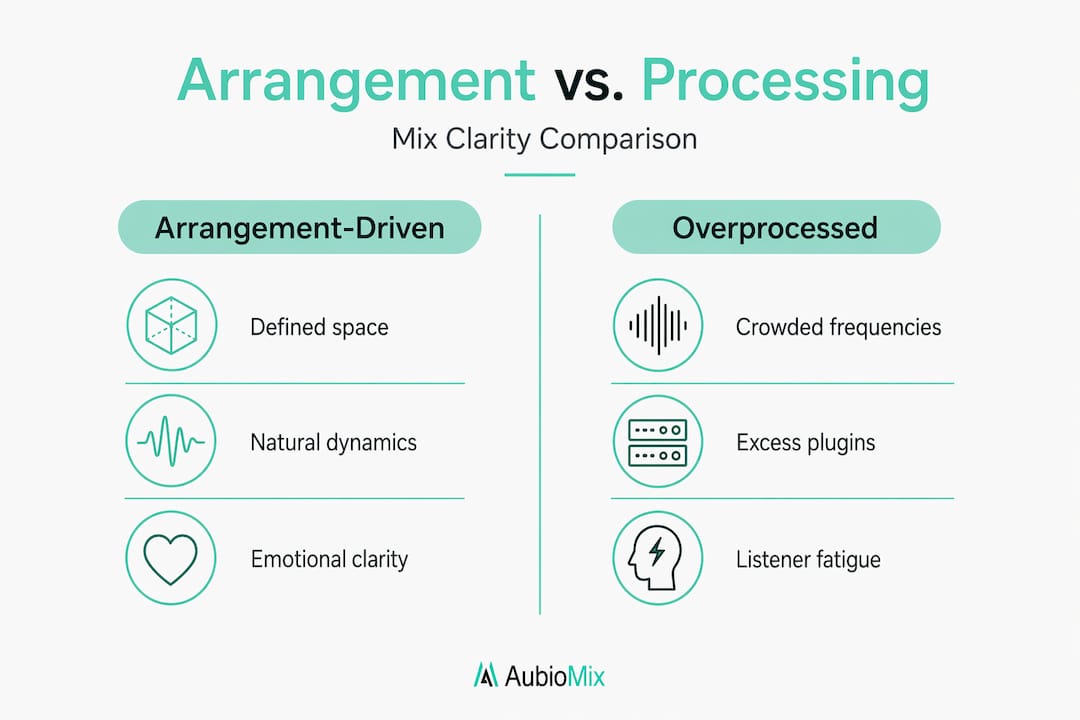
An arrangement-driven mix, by contrast, has room. The instruments sit in their own spaces, the dynamics breathe naturally, and the perceived 'wall of sound' disappears because no two elements are constantly fighting for the same sonic territory. Processing becomes creative rather than corrective. You are adding character with compression and reverb, not trying to rescue a track from itself.
The emotional impact follows directly from this. When a listener does not have to work to separate the elements of your mix, they can focus on the feeling of the music. A clean, well-arranged mix communicates emotion more directly. That is not a mixing achievement. It is an arrangement achievement that the mixing simply carries forward.
Pro Tip: If you find yourself adding more than five or six corrective plugins to a single channel just to make it sit, treat that as a signal to go back to the arrangement. The mix is showing you an arrangement problem.
Collaborative workflows for arrangement and mixing
One of the most practical shifts you can make as a producer is to treat arrangement and mixing as genuinely separate creative stages, with a clear handover point between them.
Separating composition, arrangement, vocals, and mastering improves consistency far more than swapping audio tools mid-session. When you move into mixing with a finalised arrangement, you are working with a stable foundation. You are not making arrangement decisions at the same time as mixing decisions, which is one of the most common sources of wasted time and creative confusion. You can read more about where this boundary sits clearly in this guide to mixing vs mastering.
Here is how to structure that workflow in practice:
- Lock the arrangement before mixing. Set a point in your process where the arrangement is considered done. No new parts, no structural changes. This forces clear creative thinking at the right stage.
- Export stems with arrangement intent intact. When you print stems for mixing, make sure the spatial and dynamic intent of the arrangement is preserved. Stems that have already been panned and levelled according to the arrangement make the mix session far more efficient.
- Use automation to support arrangement ideas. Mixing automation is most powerful when it reinforces arrangement decisions already made, such as bringing a pad wider in the chorus or pushing a vocal forward in the final verse, rather than compensating for sections that were not planned properly.
- Build in a feedback loop. Whether you are working solo or with a collaborator, listening back with fresh ears between the arrangement pass and the mix session is one of the highest-value habits in production. Problems that feel invisible when you are deep in the arrangement become obvious after 24 hours away.
My honest take on arrangement and mixing
I have reviewed a lot of mixes, and the pattern I keep seeing is this: the producers who struggle most in the mix are not struggling because they lack mixing knowledge. They are struggling because they are trying to fix arrangement problems with mixing tools. And that is an exhausting fight to have.
When I look at tracks that took dozens of hours to mix, the issue is almost never a lack of technique. It is that the arrangement was never really finished before mixing started. Parts were added without clear purpose. Instruments were competing in the same space. The song's emotional shape was blurry. And all of that gets passed into the mix session like unresolved debt.
The producers I find most impressive are not necessarily the ones with the most technical mixing skill. They are the ones who know when a section needs nothing more. There is a kind of confidence in restraint, in leaving space, in trusting that the arrangement is carrying the emotion without needing more layers piled on top.
What I find genuinely moving in production is when the mix barely needs to do anything. The arrangement has already done the work. The mix just makes it shine. That is the standard worth aiming for.
— AubioMix
Take your arrangement-mix workflow further
If you want to know exactly how well your current arrangement and mix are working together, Aubiomix was built for that. Upload your track and within minutes you get pro-level mix feedback on clarity, frequency balance, spatial placement, and everything else that reveals how well your arrangement is serving your mix.

Aubiomix also provides an evaluation framework that breaks down how your arrangement-driven decisions are landing sonically, giving you specific, practical steps rather than vague notes. Whether you are preparing a track for release or working through the structural and mixing challenges covered in this article, Aubiomix gives you the pro-level perspective that makes the difference between guessing and knowing.
FAQ
What is the role of arrangement in mixing?
Arrangement defines the sonic space each instrument occupies before mixing begins, which directly determines how clearly elements sit together in the mix. Strong arrangement reduces the need for heavy corrective processing by preventing frequency conflicts at the source.
Can EQ fix poor arrangement decisions?
No. If two instruments constantly share the same frequency range, EQ can reduce the clash but cannot eliminate it. Frequency conflicts rooted in arrangement require arrangement solutions, not mixing ones.
How does arrangement affect mixing workflow?
Separating arrangement from mixing improves workflow consistency by removing structural decisions from the mix session, allowing you to focus entirely on sound shaping rather than rebuilding parts.
Why do overprocessed mixes sound less clear?
Overprocessing typically compensates for arrangement clashes, adding layers of EQ, compression, and limiting that introduce phase issues and artefacts. A well-arranged track needs fewer plugins to achieve clarity, which preserves the natural sound of each element.
How do I know if my arrangement is ready to mix?
Listen through your arrangement on a spectrum analyser and check for constant frequency congestion between instruments. If key elements have distinct tonal spaces and the track has clear energy variation between sections, your arrangement is ready to mix.