

Yes, uploading a WAV for feedback works, and it can genuinely change your mix before release. Send an uncompressed, correctly labelled WAV prepared against basic loudness checks, and a proper review returns Integrated LUFS and true-peak readings, a spectral breakdown, and a ranked list of DAW moves tailored to your genre. The catch is preparation: a rushed upload gets you vague notes, while five minutes of housekeeping gets you a report you can act on today.
TL;DR:
- Upload uncompressed, 24-bit WAV files with clear labeling, metadata, and references, avoiding lossy formats like MP3 to ensure accurate spectral and loudness analysis.
- Measure and record your track's Integrated LUFS and true peak, keeping true peak at or below -1 dBTP before encoding to prevent overshoot on streaming platforms.
- Provide specific known issues and your final loudness goals to help reviewers focus on the most impactful corrections and avoid vague feedback.
- Use genre-appropriate benchmarks for spectral balance and loudness to ensure meaningful comparisons and avoid mismatched suggestions.
- Upload to private, reputable platforms with proper metadata and file integrity checks to prevent size or format rejections and protect your unrelease files from public access.
Table of Contents
- What files should you upload: WAV, stems, metadata and naming
- How do you prepare a WAV for review?
- What does a professional mix analysis actually check?
- How do you use mix feedback once you've got it?
- How do you upload a WAV to a feedback platform?
- Why does a WAV upload fail, and how do you fix it?
- Is it safe to share your WAV files online?
- AubioMix perspective: why benchmarked, genre-specific feedback matters
- How AubioMix turns your WAV into a fix list
- Sources
- FAQ
What files should you upload: WAV, stems, metadata and naming
Send the reviewer an uncompressed WAV, ideally 24-bit, rather than an MP3. Compression artefacts distort high-frequency content, which throws off any spectral or masking analysis before it even starts, a point echoed by automated mix QA tools that flag lossy formats as unreliable for acoustic measurement.
A stereo mixdown is fine for a general mix and master critique. If you want feedback on a specific stem clash, say high-end fighting a kick, or you're preparing for mastering and want gain-staging checked per group, send stems instead. AES guidance on project delivery recommends Broadcast Wave Format, clear stems, and standardised naming precisely because a mislabelled file wastes a reviewer's time and yours, as set out in the AES recommendation for delivery of recorded music projects.
Before you hit submit, get these basics in order:
- Name the file clearly: artist, track title, version number (e.g.
Artist_TrackTitle_v3.wav). - Note the tempo, BPM, and key if it's relevant to the genre.
- Attach your reference track or a link to it.
- State your intended final loudness and where the track is headed (Spotify, a club system, a sync brief).
- Flag any known issues, a muddy chorus, a vocal that fights the lead synth, so the reviewer isn't guessing where you already have doubts.
That last point matters more than people expect. A reviewer working blind spends their time confirming what you already suspected. Tell them, and they spend it solving the parts you couldn't hear yourself.
How do you prepare a WAV for review?
Two numbers determine whether your file is even usable for comparison: Integrated LUFS and true peak. Measure both before you submit, and write the values in your notes. A reviewer working from your self-reported numbers alongside their own measurement can immediately tell you whether your loudness strategy matches your genre or whether you've over-pushed the limiter chasing volume.
Follow this sequence before uploading:
- Measure Integrated LUFS across the full track using your DAW's metering or a plugin, not just a peak meter glance.
- Check true peak (dBTP), not just sample peak. Intersample peaks routinely exceed 0 dBFS even when your meter reads clean.
- Leave headroom. Keep true peak at or below roughly -1 dBTP before encoding. AES TD1008 and the ITU-R BS.1770 loudness standard both point to this ceiling for lossy-encoded streaming distribution, since codecs can add overshoot after encoding.
- Preview through a codec simulator if your tools allow it. Hearing how AAC or Ogg Vorbis reshapes your master before you commit to a final ceiling saves a second round of fixes, a step iZotope's mastering guidance recommends for exactly this reason.
- Pick a genre-matched reference. A deep house cut compared against a pop ballad tells you nothing useful. Musiversal's guide to reference tracks is right that matching mood, tempo, and instrumentation is what makes spectral comparison meaningful, not just matching genre labels loosely.
Pro Tip: Don't master-normalise your file to streaming loudness before submitting for review. Send your working master at its natural level with true peak controlled, and let the reviewer tell you where the loudness sits relative to your genre's benchmark rather than guessing what the platform will do to it later.
What does a professional mix analysis actually check?
A proper review works through the same diagnostic categories every time, whether it's a trap beat or a worship ballad, because the checks themselves don't change even when the targets do.
- Spectral balance and masking. Reviewers look for frequency collisions, often a muddy 200 to 400Hz zone where bass and low mids fight, and suggest specific EQ moves such as a 2 to 3dB cut on the offending element rather than a vague "clean up the low end". Splice's explainer on frequency masking describes exactly this kind of collision as the most common culprit behind a mix that sounds loud on a meter but small on speakers.
- Dynamics and compression. Over-compression shows up as pumping or a flattened transient response. Expect notes on release time, and sometimes a suggested threshold and ratio range rather than just "less compression".
- Stereo field and phase. Mono compatibility checks catch elements that vanish or thin out when summed. Mid/side analysis often leads to a specific panning or width recommendation, not just "widen it".
- Loudness and peak control. Your LUFS target gets checked against genre norms, and true-peak handling gets flagged if it risks codec overshoot on release.
A genre-specific benchmark matters here more than most people realise. Comparing a hardstyle master's LUFS or spectral tilt against an acoustic folk benchmark makes the whole exercise meaningless, whichever engineer is doing the comparing.
A typical report follows a structure: a measurement summary up top, a priority-ranked action list underneath, visual plots (spectrum, stereo image, dynamics), and a note on when to resubmit. That structure is the difference between feedback you can act on this afternoon and a list of impressions you'll forget by tomorrow.
How do you use mix feedback once you've got it?
Feedback only helps if you act on it in the right order. Working through every note randomly wastes time and can undo progress on the parts of the mix that were already working.
- Fix high-impact, low-effort issues first. Clipping, true-peak overshoot, and obvious frequency collisions take minutes to address and often improve the mix more than anything else on the list.
- Move to stylistic and tonal notes next. Width adjustments, subtle EQ shaping, reverb tails, the things that shape character rather than fix faults.
- A/B constantly. Compare your revised mix against both your reference track and your original bounce, not just against the reviewer's notes in isolation.
- Re-measure before resubmitting. Run the same LUFS, spectral, and phase checks the reviewer used. If your numbers have shifted in the direction they suggested, you're on track.
Pro Tip: If a reviewer's suggestion conflicts with a deliberate artistic choice, say a heavily saturated bassline that "shouldn't" pass a strict masking check, don't discard your instinct automatically. Note it, ask for a recheck once the objective issues are sorted, and decide whether the character is worth the technical trade-off.
How do you upload a WAV to a feedback platform?
Most paid review platforms and forums follow a similar sequence, even when the interface looks different from one to the next.
First, create an account or log in, since most services tie your uploads to a history so you can track revisions over time. Second, locate the upload or submission button, usually on a dashboard or "new review" screen, and select your WAV file directly rather than a zipped folder unless the platform specifically asks for one. Third, fill in the metadata fields the platform provides: track title, genre, reference track link, and any specific notes about what you want checked. Skipping this step is the single biggest reason feedback comes back generic.

Fourth, confirm the upload completed by checking the file size and duration shown against your original, since a partial upload will often still "succeed" silently. Fifth, submit and note any confirmation or reference number, particularly on forums where threads can get buried.
If the platform offers a reference-track upload alongside your main file, use it. Reviewers working against your chosen reference, rather than a generic internal benchmark, catch issues specific to what you're actually trying to sound like.
Why does a WAV upload fail, and how do you fix it?
Upload failures are almost always one of a handful of predictable problems, and most take under a minute to solve.
File size limits trip people up most often, since an uncompressed WAV of a five-minute track can run past 150MB depending on sample rate and bit depth. If a platform caps uploads, check whether it accepts 16-bit instead of 24-bit, which roughly halves the file size with a negligible practical loss for review purposes.
Slow or unstable connections cause uploads to stall partway, particularly on longer stem bundles. Switching to a wired connection or a less congested network usually resolves this faster than repeated retries on Wi-Fi.
Incorrect file formats get rejected outright. Some platforms only accept WAV or FLAC and will silently reject an AIFF or a renamed MP3, so check the accepted format list before you export.
Browser or cache issues occasionally block an upload that should otherwise work. Clearing your cache or trying a different browser solves this more often than it should reasonably need to.
Corrupted exports happen when a bounce is interrupted or a plugin crashes mid-render. If a file uploads but won't play back correctly on the platform, re-export from your DAW rather than assuming the platform is at fault.

Is it safe to share your WAV files online?
Sharing an unreleased track always carries some exposure, and it's worth thinking about before you upload anywhere, not after.
Check a platform's terms of service for what happens to your file after review. A reputable service processes your audio for analysis and storage tied to your account, rather than claiming any ownership or right to redistribute your work. That distinction matters more than most people check for.
Avoid posting unreleased WAVs on open public forums where anyone can download them, particularly if the track is unpublished and uncopyrighted in any formal sense yet. Copyright exists the moment you create the work, but proving provenance later is far easier if you've kept dated project files and haven't scattered the master across unsecured public threads.
Where possible, use platforms with private, account-based uploads rather than open shares. A reviewer needs the file to do their job, not the wider internet. If you're sending stems to a third party for detailed critique, a short note confirming the file is for review purposes only, and not for reuse, remixing, or redistribution, costs nothing and clarifies expectations on both sides.
AubioMix perspective: why benchmarked, genre-specific feedback matters
Most feedback fails for one reason: it's either all measurement or all opinion, rarely both at once. A LUFS reading tells you nothing about whether your track sounds right for its genre. A subjective note from a single ear tells you nothing about whether your true peak will clip on encode. Aubiomix's approach pairs the two deliberately, because a number without genre context is just noise, and an opinion without measurement is just taste.
Genre benchmarking is the part conventional feedback usually skips entirely. Comparing a techno master against a folk benchmark, or vice versa, produces advice that sounds authoritative and fixes nothing. Genre-specific benchmarks exist precisely to stop that mismatch before it wastes a producer's revision cycle.
— AubioMix
How AubioMix turns your WAV into a fix list
Uploading your track to Aubiomix means you get more than a single engineer's opinion. You get a report combining measured genre benchmarks with real production expertise, so the feedback tells you what's technically off and what actually matters for how your genre is meant to sound.
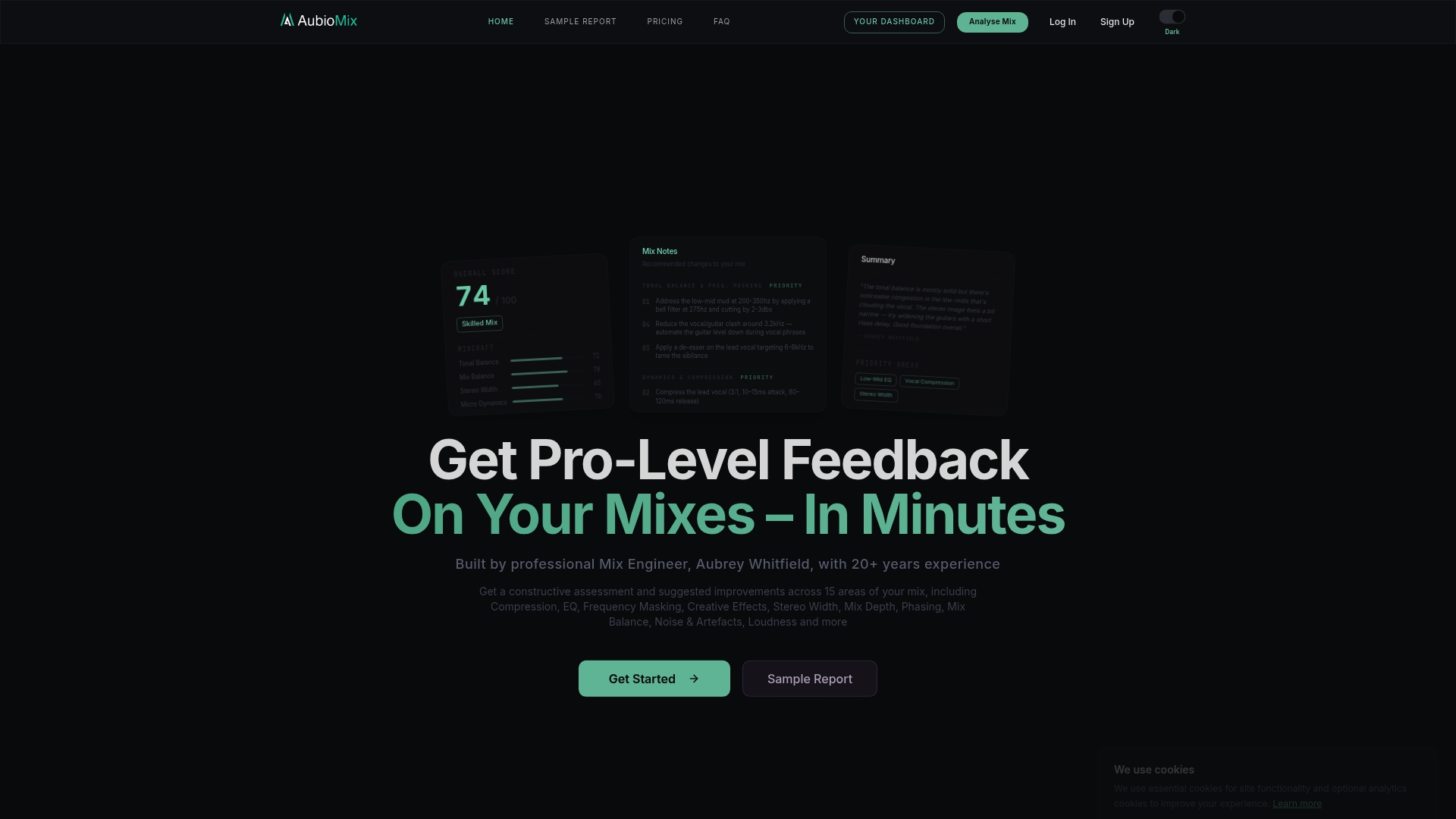
The process is straightforward: upload your WAV, choose your genre for benchmark comparison, and add a reference track using a Reference Pass if you want your mix measured directly against a track you admire. Your report comes back with a measurement summary covering LUFS, true peak, and spectral balance, a list of suggested DAW actions, and visual plots you can compare against before and after your revisions. A single Mix Review covers one track, while the Professional and Professional + plans suit anyone submitting multiple mixes across a project or a release schedule.
What a report won't do is make artistic decisions for you. It will tell you your low end is masking your kick and by roughly how much; it won't tell you whether that saturated bass is the sound you actually want. That call stays yours. Start with one track through the pricing page and see where your mix sits against the benchmark for your genre.
Sources
The measurement criteria behind any serious mix review trace back to a small set of established standards rather than house rules invented by any one platform. Integrated LUFS and true-peak guidance come from ITU-R BS.1770 and are detailed further in AES TD1008, which sets the -1 dBTP ceiling widely used before lossy encoding. File delivery practice, including stems, naming, and metadata, follows AES TD1002. For picking a reference track correctly, Musiversal's guide and Splice's explainer on frequency masking cover the reasoning reviewers apply when they flag a spectral collision.
- Choose the best reference track for mixing music | Musiversal (blog)
- What is frequency masking? | Splice
- AES TD1008: Recommendations for loudness of Internet audio streaming and on-demand distribution (AES)
- AESTD1002: Recommendation for delivery of recorded music projects - AES
FAQ
What format should I use when I upload a WAV for feedback?
Use an uncompressed WAV at 16-bit or 24-bit rather than an MP3, since compression artefacts distort the high-frequency readings a reviewer depends on. Send a full stereo mixdown for general feedback, or stems if you need a specific clash diagnosed or you're preparing for mastering.
What LUFS target should I aim for before submitting?
There's no single universal LUFS target since it depends heavily on genre and release platform, which is exactly why genre benchmarks matter more than a generic streaming number. Keep true peak at or below roughly -1 dBTP regardless of genre, in line with AES TD1008 guidance, and report your measured Integrated LUFS alongside your upload.
Can a reviewer tell if I've over-compressed my mix?
Yes, over-compression shows up clearly in dynamics analysis as pumping, flattened transients, or an unusually narrow dynamic range for the genre. A good review will point to specific release-time or ratio adjustments rather than a vague instruction to "compress less".
Is it safe to upload an unreleased track for feedback?
Check the platform's terms before uploading anything unreleased, and favour services with private, account-based submissions rather than open public forums. A reputable review platform processes your file for analysis tied to your account and doesn't claim rights to reuse or redistribute your work.