
If you have spent any time mixing in a DAW and wondered what is a mix bus, you are not alone. Many producers confuse it with mastering, treating the two as interchangeable. They are not. The mix bus is the final routing point where all your individual tracks and subgroups come together before hitting the master output, and it is where you shape the collective character of your mix. This guide covers the mix bus definition, how to use one, the types of mix bus processing available, and the practical steps to apply it well.
Table of Contents
- Key takeaways
- What is a mix bus in music production?
- Mix bus processing: the chain explained
- Mix bus vs mastering: clearing up the confusion
- How to use a mix bus effectively
- Types of buses and how they relate
- My honest take on mix bus processing
- Get pro feedback on your mix bus decisions
- FAQ
Key takeaways
| Point | Details |
|---|---|
| Mix bus definition | The mix bus is the final channel consolidating all tracks before master output, not a mastering stage. |
| Processing goal | Mix bus processing targets cohesion and tonal balance across the whole mix, not individual track problems. |
| Typical processing chain | Gentle compression, broad EQ, subtle saturation, and a limiter form the standard mix bus chain. |
| Distinct from mastering | Mix bus processing is part of mixing; mastering is a separate stage that prepares audio for distribution. |
| Practical organisation | Routing tracks into subgroups before the mix bus makes your workflow cleaner and your processing more precise. |
What is a mix bus in music production?
Let's get the mix bus definition nailed down clearly. The mix bus is the final channel in your DAW where every individual track and subgroup gets consolidated before it reaches the master output. Think of it as the single funnel that everything pours through on its way out of your session.
In most DAWs, it is labelled as the stereo bus, master bus, or simply the master channel. The terms get used interchangeably in casual conversation, but there is a practical distinction worth understanding.
Here is how the routing hierarchy typically looks in a DAW:
- Individual tracks (kick drum, snare, lead vocal, synth pad, etc.) sit at the bottom of the signal chain.
- Subgroup buses collect related tracks together, such as a drum bus receiving all drum and percussion tracks, or a vocal bus collecting lead and backing vocals.
- The mix bus receives the output of all subgroups and remaining individual tracks, merging everything into a single stereo signal.
- The master output is the final destination, sending audio to your DAW's audio engine or to a rendered file.
Bus processing groups related tracks to process them collectively, which saves CPU and creates a unified sound across those elements. On the mix bus specifically, you are processing everything at once, which means every decision you make there touches every element in your mix simultaneously. That is precisely why subtlety matters so much here.
The mix bus is not just a passive routing point. It is where you apply what many engineers call "big picture" processing. The processing you place on the mix bus does not target the kick or the vocal individually. It shapes how the whole arrangement sits and breathes together as a single piece of music.
Mix bus processing: the chain explained
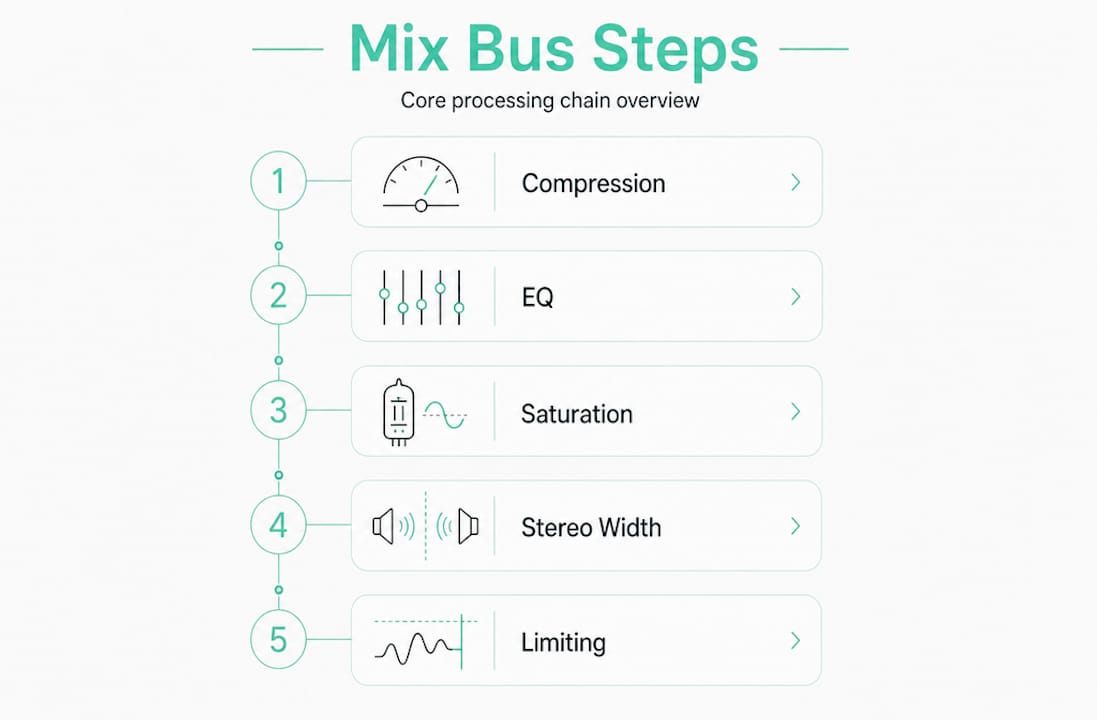
Understanding mix bus processing means understanding what each processor in your chain is actually doing and why. A typical mix bus chain is not random. It follows a logical order that shapes, controls, and refines the full mix signal progressively.
Here is the standard processing order, and the purpose behind each stage:
- Broad EQ. A gentle shelving boost or cut at the high and low ends to add warmth or air to the entire mix. You are talking about small moves here, often 1 to 2 dB at most.
- Gentle compression. Mix bus compression settings typically use conservative ratios between 1.5:1 and 3:1, aiming for a maximum gain reduction of around 3 dB to maintain transient clarity. This compression "glues" elements together, smoothing out level inconsistencies between instruments and making the mix feel like one cohesive piece rather than a collection of separate parts.
- Subtle saturation. A touch of harmonic saturation adds warmth and analogue character. Plugins like a tape emulator or a gentle tube saturator work beautifully here, fattening up the low mids and giving the mix a more organic, lush quality.
- Stereo widener (optional). Used carefully to add space and width without creating phase issues. Less is always more on the mix bus.
- Limiter. Placed last in the chain to catch stray peaks and protect headroom. This is not where you do loudness maximisation. That is mastering's job.
Parallel processing on a bus can enhance density by blending a heavily processed duplicate signal with the original dry input. On the mix bus, this means you can push compression or saturation aggressively on a parallel channel and blend it back in to taste, adding thickness and vibe without destroying your transients or dynamics.
Pro Tip: Set your mix bus compressor before you start mixing individual tracks. With a gentle compressor already running on the mix bus, you are mixing into the glue from the start, and every decision you make on individual tracks will reflect how they sound in the final chain.
Mix bus vs mastering: clearing up the confusion
This is where a lot of producers go wrong, and it is worth being direct about. Mix bus processing is distinct from mastering. It shapes the character of your mix during the mixing stage. Mastering, on the other hand, prepares the audio for distribution, addressing things like loudness normalisation, format compatibility, and tonal consistency across an album.
Here is what mix bus processing should and should not do:
- Should do: Enhance cohesion, add warmth and glue, shape the overall tonal balance, and manage peaks lightly.
- Should not do: Fix a muddy kick, tame a harsh vocal, correct stereo imbalances from individual tracks, or act as a loudness maximiser.
Mix bus processing improves connection between elements but should never be used to fix fine track-level details. If your kick is clashing with the bass, sort that out at the track level. Reaching for the mix bus EQ to fix specific instrument problems is a trap that leads to a mix that sounds over-processed and odd.
"Experienced engineers treat the mix bus as a tool for macro-level cohesion rather than a fix for micro-level mix problems."
Many mastering engineers prefer moderate bus compression in submitted mixes because heavy dynamic processing on the mix bus reduces their flexibility during the mastering stage. If you have already slammed the mix bus limiter and maxed out the compression, the mastering engineer has very little room to work with. Leave headroom. Leave dynamics. Let mastering do its job.
How to use a mix bus effectively
Now we get to the practical side. Knowing what a mix bus does is one thing. Using it well is another.
Organising your session first
Before you even think about mix bus processing, organise tracks into subgroups for workflow efficiency. Route all your drum tracks to a drum bus, all vocals to a vocal bus, all synths to an instrument bus, and so on. This way, you are managing fewer faders and you have clean, organised signal flow before anything hits the mix bus.
Gain staging and headroom
Proper gain staging on the mix bus is critical to preserve headroom and avoid clipping or over-compression, which can compromise your mix dynamics before mastering. Aim to have your mix bus peaking around -6 dBFS before any limiting. That gives your processors room to breathe and leaves headroom for the mastering stage.
Choosing your processors wisely
Not every mix needs the same chain. An EDM track might benefit from a bit more saturation and subtle stereo width. A jazz recording might need nothing more than a gentle compressor and a broad shelving EQ. Matching your mix bus chain to the genre and character of the music makes a big difference.
Here is a quick comparison of how mix bus processing approaches can vary by genre:
| Genre | Compression approach | EQ focus | Saturation |
|---|---|---|---|
| EDM / electronic | Moderate, pumping glue | Sub and high shelf boost | Light to moderate tape |
| Rock / alternative | Firm glue, slower attack | Low mid warmth | Moderate tube or tape |
| Jazz / acoustic | Very gentle, 1 to 2 dB | High air shelf only | Minimal or none |
| Hip-hop / R&B | Moderate, groove-preserving | Low end weight | Subtle to moderate |
Common pitfalls to avoid
Heavy limiting on the mix bus before mastering, applying mix bus EQ to compensate for poorly balanced individual tracks, over-widening the stereo field, and adding so many processors that the mix bus becomes a problem in itself are all mistakes that derail otherwise solid mixes. You can find a detailed breakdown of common mid-side mixing mistakes that tie directly into mix bus decisions as well.
Pro Tip: Bypass your entire mix bus chain and compare it to the processed version periodically as you mix. If you cannot clearly hear the difference, or if the processed version sounds worse, you are overdoing it.
Types of buses and how they relate
To fully understand the importance of the mix bus in music production, it helps to see how it sits alongside the other bus types you will use in a session.
Here is a comparison of the most common bus types:
| Bus type | Typical content | Processing goals |
|---|---|---|
| Drum bus | Kick, snare, hi-hats, cymbals, percussion | Punch, cohesion, transient control |
| Vocal bus | Lead vocals, backing vocals, harmonies | Blend, clarity, consistent level |
| Instrument bus | Guitars, keys, synths, pads | Tonal balance, spatial placement |
| Mix bus | All subgroups combined | Glue, macro tonal shaping, peak management |
| Master bus | Mix bus output (used in mastering) | Loudness, format preparation, final balance |
The key insight here is that each bus type handles a progressively wider view of your audio. The drum bus focuses on a specific group. The mix bus sees everything. That is why the mix bus approach requires a much lighter touch than what you might apply to a single subgroup.
Benefits of using subgroup buses properly include:
- Faster, more organised mixing with fewer fader adjustments
- Targeted processing for each group without affecting other elements
- Cleaner signal flow into the mix bus with better-prepared audio
- More headroom and dynamic control at the mix bus stage
My honest take on mix bus processing
I will be straight with you. The mix bus is one of the most misunderstood tools in the signal chain, and I think the misunderstanding comes from treating it as a shortcut. I have seen producers load up their mix bus with a chain of ten plugins, trying to compensate for a mix that was never properly balanced in the first place. It does not work. The mix bus cannot save a bad mix. What it can do is take a good mix and make it feel unified, warm, and complete.
What I have learned is that the mix bus is best treated as a single instrument in itself. I approach it the way a string arranger might approach an orchestral blend. The goal is not to change any individual part. The goal is to make everything sound like it belongs in the same room, on the same recording, at the same moment.
I also think the industry undersells the importance of doing nothing on the mix bus. Sometimes a clean, well-mixed session needs almost no mix bus processing at all, and that is a sign you mixed well, not that you forgot something. Resist the urge to fill the chain just because you can.
Parallel processing on the mix bus changed how I work. Running a heavily saturated or compressed parallel chain blended at around 20 to 30 percent adds density and energy without touching the transients of your main mix. It is the kind of technique that makes a mix feel alive rather than just loud.
— AubioMix
Get pro feedback on your mix bus decisions
Knowing the theory is one thing. Hearing how your mix bus decisions actually land in the context of your specific track is where real growth happens.

Aubiomix lets you upload your audio and receive detailed, pro-level feedback on your mix's cohesion, balance, and processing choices, including how your mix bus chain is affecting the overall sound. You will get specific, trackable steps to improve rather than vague suggestions. If you want to understand exactly how your mix bus is behaving against professional standards, check out the Aubiomix evaluation framework to see how your mix is assessed and what areas to prioritise next.
FAQ
What is a mix bus in simple terms?
The mix bus is the final routing channel in a DAW where all individual tracks and subgroups combine into one stereo signal before the master output. It is where you apply global processing to shape the overall character and cohesion of your mix.
What does a mix bus do that mastering cannot?
The mix bus shapes how your tracks feel together during the mixing stage, applying glue, warmth, and tonal balance while you still have access to individual elements. Mastering happens afterwards on a finished stereo file and cannot adjust individual track relationships.
What types of mix bus processing are most common?
The most common types of mix bus processing include gentle compression (typically 1.5:1 to 3:1 ratio), broad EQ, subtle saturation or tape emulation, optional stereo widening, and a limiter to catch peaks. Each processor serves the goal of cohesion rather than correction.
How much headroom should I leave on the mix bus?
Aim for your mix bus to peak around -6 dBFS before limiting. This preserves enough dynamic range for a mastering engineer to work with and prevents your processors from clipping or over-compressing the signal.
Can mix bus processing fix a poorly balanced mix?
No. Mix bus processing is for enhancing a mix that is already well-balanced, not for rescuing one that is not. Issues like frequency clashes, poor stereo placement, and level imbalances between instruments must be addressed at the track or subgroup level first.