

Boom typically occurs in a bass frequency range often identified between low frequencies around 40 Hz and higher lows up to roughly 100 Hz, and the fastest way to deal with it is a two-step diagnostic: sum your mix to mono and run a narrow-Q sweep to find the exact fundamental frequency that's ringing. Once you know the frequency, a small notch or a carefully placed high-pass filter usually clears it in seconds. Check phase against your bass before you touch anything else, because a phase clash can masquerade as boom and no amount of EQ will fix that.
TL;DR:
- Diagnosing boom requires mono summing, phase checking, and narrow-Q sweeps to identify the resonant frequency responsible.
- Subtractive EQ should be surgical, with high-pass filters set just below the fundamental frequency and narrow notches to remove boom without thinning the kick.
- Phase alignment and transient shaping can address timing issues or long tails that cause perceived boom, often more effectively than EQ alone.
- Separating the kick into sub and click layers, tuning samples to the track, and adding harmonic saturation help maintain weight without resonance.
- Running mix analysis tools and listening on small speakers ensures the low end is controlled and not just masking the problem.
Table of Contents
- How to diagnose the type and location of boom
- Quick EQ and filter fixes that keep the punch
- Phase, transient shaping and kick length control
- Keeping weight without adding boom to your kick drum sound design
- Owning the sub: frequency masking between kick and bass
- Verification checklist: confirming the boom is actually gone
- How AubioMix helps when a boomy kick won't quit
- A mix engineer's short view on kick-boom traps
- Get a measured second opinion on your low end
- Sources
How to diagnose the type and location of boom
Every boomy kick has a fingerprint, and you can find it in about two minutes with the right tests. The trick is doing them in the right order, because skipping straight to EQ without diagnosis is how producers end up carving holes in a perfectly good sound.
Start by listening in context, not in solo. A kick that sounds fat and satisfying on its own can turn into a boomy, undefined blob as soon as the bass guitar or 808 comes in. That's usually a sign of masking rather than a genuinely bad sample, so don't reach for the EQ knife until you've heard the problem alongside everything else fighting for the same space.
Next, run the mono test. Collapse your mix (or just the kick and bass bus) to mono and listen for the low end to thin out or disappear. If it does, you're dealing with phase cancellation rather than simple frequency buildup, and no amount of EQ will fix a phase problem, according to Isotonik Studios. This one test alone saves hours of misguided tweaking.
Then comes the sweep. Grab a parametric EQ, set a fairly narrow Q (somewhere around 3 to 6), boost it by 10 to 15 dB, and slowly sweep from 30 Hz up to about 250 Hz. Wherever the sound suddenly gets fat, hollow, or unpleasant, that's your resonant frequency. This works because boominess is rarely spread evenly across the low end. It tends to cluster around one specific note, which is usually the kick's fundamental pitch, sitting somewhere in the 40 to 100 Hz range.
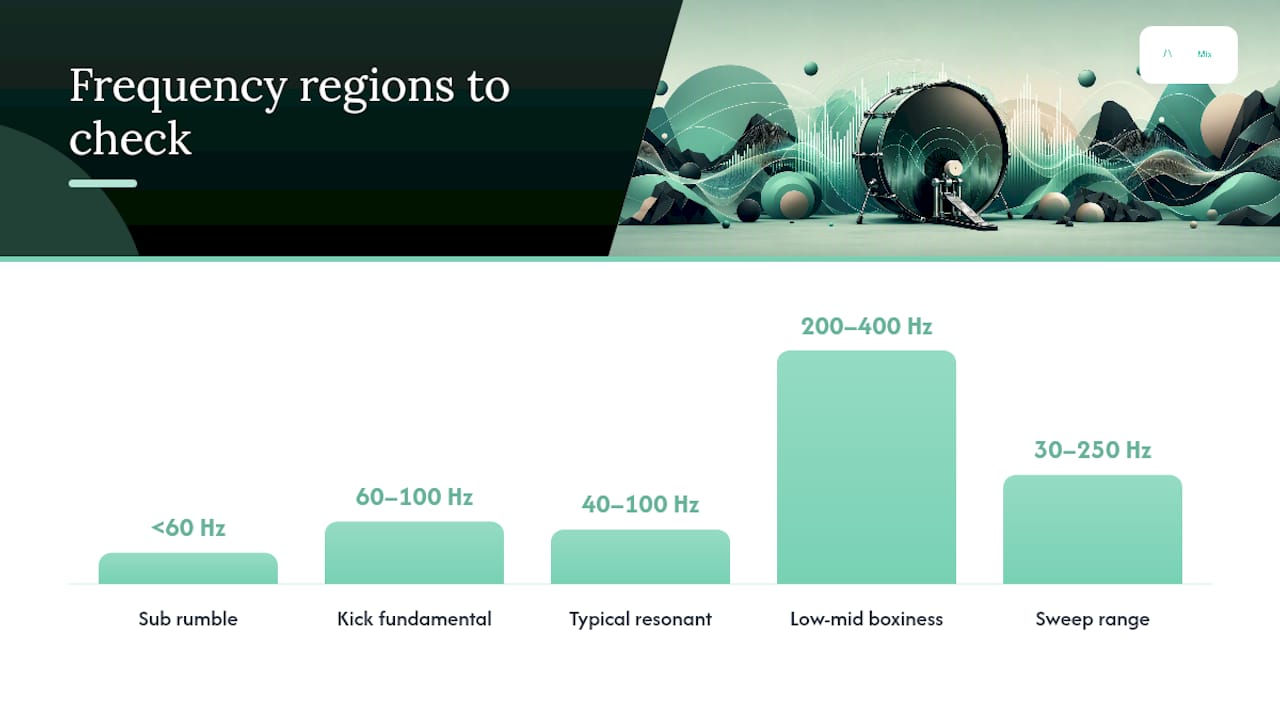
A spectrum analyser gives you the visual confirmation. Sub rumble shows up as a spike below 60 Hz that barely moves. Fundamental boom shows a tall, narrow peak in the 60 to 100 Hz zone. Low-mid boxiness lives higher, typically 200 to 400 Hz, and reads as a wider, duller hump rather than a sharp spike.
Here's the order worth following every time:
- Listen to the kick inside the full mix, at working level, before touching any controls.
- Run the mono collapse test on the kick and bass together.
- Sweep a narrow-Q boost from 30 Hz to 250 Hz to locate the resonant peak.
- Flip the polarity on the kick or bass channel and listen for which setting sounds fuller.
Quick EQ and filter fixes that keep the punch
Once you've found the offending frequency, resist the urge to nuke it. The goal is surgical removal, not amputation. Kicks lose their weight fast when producers get trigger-happy with wide cuts, so every move here should be small and checked by ear immediately after.
High-pass filtering is your first line of defence, but only if you place it correctly. Set the filter slightly below the fundamental frequency found in your sweep, generally by a small margin to remove sub rumble without affecting the main note. If your kick's resonant peak sits at 55 Hz, a high-pass filter starting around 35 to 40 Hz will remove sub rumble and rogue infrasonic energy without touching the note itself. Skip the high-pass filter entirely if your kick's fundamental sits very low (say, below 45 Hz) and the track needs that sub-heavy weight, as in a lot of trap or dubstep production. Cutting too aggressively there just thins the kick out.
The narrow notch does the heavy lifting for actual boom. Set your Q between 4 and 8, dial in an attenuation of 2 to 6 dB, and place it directly on the resonant frequency you found earlier. Go gently. A gentle boost to a kick's fundamental adds welcome weight, but the same logic runs in reverse. Pull too hard and you strip out the body along with the boom, according to Native Instruments.
The attack boost rebuilds what you might have lost. After trimming the low end, gently lift somewhere between 1 and 4 kHz to restore the click and definition that gives a kick its sense of punch. This is the frequency range your ear uses to judge "punchy" far more than it uses raw bass weight, which is why a kick can lose boom and gain clarity at the same time.
Try this sequence in order, checking after each step:
- Set your high-pass filter 10 to 20 Hz below the fundamental (skip if the track needs deep sub weight).
- Apply a narrow notch at the resonant frequency, Q around 4 to 8, cutting 2 to 6 dB.
- Bypass and compare. If the kick sounds thinner rather than cleaner, reduce the cut by half.
- Boost gently in the 1 to 4 kHz range if the kick feels like it lost its punch.
- Reference against the full mix again, not in solo.
Pro Tip: Automate a slightly deeper notch only on bars where the bass and kick actually overlap rhythmically. Static EQ treats every hit the same, but a boomy clash usually only happens on specific beats where both instruments land together.
Phase, transient shaping and kick length control
Sometimes the boom isn't a frequency problem at all. It's a timing problem. Two low-frequency waveforms that don't line up properly can reinforce each other in a lumpy, undefined way that reads as "boomy" even though no single frequency is actually too loud.
Start with the basics: nudge the kick sample's start point by a few milliseconds and listen for a fuller, tighter low end. Flip polarity on the kick or the bass and A/B both settings, because one will almost always sound noticeably rounder than the other. If neither manual fix does the job, a dedicated phase-alignment plugin will visually match waveforms and time-align them automatically, which is faster and more precise than nudging by ear, particularly on tracks with dense low-end layering, as Isotonik Studios points out.
Transient shaping tackles a different flavour of boom: the kind caused by too much sustain. A kick with a long, ringing tail keeps dumping low-frequency energy into the mix well after the initial hit, and that lingering tail is often what people mean when they say a kick sounds "boomy" rather than "punchy". Shortening that tail with a transient shaper or a tight envelope can solve the problem more naturally than aggressive EQ, and it frequently sounds less processed too, a point echoed in Phil Speiser's breakdown of kick and bass mixing.
A few practical moves worth trying:
- Pull down the "sustain" control on a transient shaper to shorten the tail without touching the initial attack.
- Use a fast-release gate keyed to the kick's own envelope if the tail is genuinely out of control.
- Try mid-side EQ if the boom sits mostly in the centre. Cut the low-mid band in the mid channel only, leaving the sides untouched, for a more surgical result than a standard stereo cut.
- Reach for a multiband compressor on the drum bus if a single kick sample keeps resonating unpredictably across a whole section, which several producers on forums cite as their fallback when EQ alone isn't cutting it, per discussion on r/audioengineering.
Pro Tip: If you're working with a recorded acoustic kick rather than a sample, check the resonant head tuning before reaching for a plugin at all. Drummers and engineers on forums like DrummerWorld regularly trace boom back to head tension rather than anything fixable at the mixing stage.
Keeping weight without adding boom to your kick drum sound design
The best kick drum samples don't need heroic EQ surgery, because the weight and the boom problem were separated at the source. That's the mindset shift worth making: stop treating "big" and "boomy" as the same thing.
Layer for control. Split your kick into a sub layer (a clean sine or triangle wave tuned to the fundamental) and a separate click or punch layer that carries the transient and mid-range detail. Align their phase carefully and blend the levels so the sub layer supplies weight while the click layer supplies definition. This approach lets you attenuate the sub layer surgically without touching the character of the transient at all, a technique Record, Mix & Master recommends specifically for keeping kick and bass out of each other's way.
Reach for saturation before you reach for a boost. Subtle harmonic saturation or excitation adds upper harmonics that trick the ear into perceiving more low-end weight than actually exists in the raw frequency content. It's a genuinely underused trick, and it sidesteps the entire boom problem because you're adding perceived size in a completely different frequency zone.
Tune your kick to the track. A kick whose fundamental clashes with the bassline's root note creates beating and dissonance that reads as mud or boom, even when the levels are perfectly sensible. Retuning the kick sample to match, or at least complement, the key of the track often removes a chunk of the perceived boominess without a single EQ move.
- Build a two-layer kick: sub for weight, click for definition, phase-aligned.
- Use saturation to imply size instead of boosting raw low frequencies.
- Retune resonant kick samples to the track's key to reduce beating.
- Browse sample libraries and study how different "boomy" kicks are voiced before you commit to one, since Sample Focus catalogues plenty of examples worth A/B testing against your own.
Owning the sub: frequency masking between kick and bass
Boom is often a turf war, and the fix is deciding who wins it before you touch a single EQ band. In most electronic genres, the kick owns the deep sub below roughly 60 Hz and the bass carries the melodic low end above it. In hip-hop and trap, it can flip the other way, with the 808 owning the sub and the kick contributing more midrange punch. Neither approach is wrong, but running both instruments loud in the same narrow band is what actually causes frequency masking and reads to the listener as generic boom.
Once you've picked an owner, carve complementary space with EQ: boost or preserve the winning instrument in the contested band and cut the other one there instead. Record, Mix & Master frames this as the single most effective fix for kick and bass conflicts, more reliable than chasing the problem with compression alone.
Sidechain compression handles what's left. A short attack (around 1 to 5 milliseconds), a release matched to the tempo, and a gentle 2 to 4 dB of ducking on the bass whenever the kick hits will carve rhythmic space without anyone consciously hearing the pumping effect.
Mono-summing the lowest frequencies is a common practice because stereo information in that range often does not translate well and can cause phase issues.
The order that avoids rework:
- Set proper gain staging first so you're not EQing against clipping or headroom problems.
- Decide which instrument owns the sub for this specific track.
- Carve complementary EQ space between kick and bass.
- Apply sidechain compression last, once the tonal balance is already correct, a sequence Violet Recording also recommends to avoid chasing your tail between EQ and dynamics.
Verification checklist: confirming the boom is actually gone
Fixing boom on your monitors proves nothing until you've stress-tested the result elsewhere. Run through this before calling it done:
- Level-match your before and after versions, then A/B them at identical loudness so you're judging tone, not volume.
- Collapse to mono again and confirm the low end holds together rather than thinning out.
- Play it on a laptop speaker or a phone speaker. If the kick still reads as boomy on tiny drivers, the fundamental is probably still too dominant.
- Check the spectrum analyser for a smoother curve around your target frequency, without a fresh spike appearing somewhere else.
- Export a render and listen fresh, away from your DAW, ideally on a different playback system entirely.
If boom creeps back in, don't reach straight for more EQ. Retest phase first, then consider swapping the sample layer, and only bring in transient shaping as a last resort if the tail is still the culprit.
How AubioMix helps when a boomy kick won't quit
Sometimes you've run every test here and the low end still feels off, and that's usually when a second, measured opinion earns its keep. Upload a mix to a mix analysis service and the report flags specific low-end peaks, points out masking between your kick and bass, and suggests notch ranges tailored to what it hears in your file, rather than generic advice. It also benchmarks your low end against real mixes in your genre, so you know whether your kick's weight actually matches the target, or just feels right in your room. Compare your results against the genre benchmark data to see where your fundamental and sub balance should realistically sit.
A mix engineer's short view on kick-boom traps
The mistake I see most often isn't a bad ear, it's bad process. Producers diagnose in solo, EQ aggressively on the first pass, and never check mono until mastering, by which point the fix costs far more than it should have. The one habit that solves most of this: always test in context, on small speakers, before you touch a single band. Boom rarely survives that combination undetected, and neither does an overcooked EQ move.
— AubioMix
Get a measured second opinion on your low end
There are other ways to chase down a stubborn boomy kick: forum threads, plugin manufacturer guides, trial and error with your own ears over several sessions. All of them work eventually, but they cost time you could spend finishing the track. Some mix analysis tools skip the guesswork by analysing your actual file and telling you where the low end is fighting itself, with suggested notch ranges instead of vague advice to "cut around 60 Hz somewhere."

A typical low-end report flags your kick's resonant peak, checks it against the bass for masking, and compares both to measured targets for your genre, whether that's the deep, sub-heavy low end expected in techno or the tighter punch typical of boom-bap. Upload your track, get the report back in minutes, and you'll know within one pass whether your fix actually worked or just moved the problem somewhere else. Start with the genre benchmarks to see what a clean low end looks like in your style before you upload.
Sources
- Kick drum EQ essentials: how to create punch and presence | Native Instruments Blog
- How to achieve perfect balance between kick drum and bass - Record, Mix & Master
- Fix kick & bass phase issues fast in Ableton Live | Isotonik Studios
- Let's never talk about mixing kick and bass again... | Phil Speiser Blog