
Your fastest routes to useful critique are a mix of subreddits like r/mixingmastering, Discord and Slack servers with dedicated critique channels, curated audio communities such as Audio Mix Club, and threaded forums where feedback stays searchable for years. But for consistent, actionable results, nothing beats pairing an active mix critique community with a structured feedback loop: submit properly, ask specific questions, and use standardised benchmarks to check what your ears (and your reviewers) tell you.
Here's the quick lay of the land:
- Subreddits and social forums: fast, high volume, variable quality
- Discord/Slack servers: real-time, intimate, great for building relationships
- Dedicated critique platforms: curated reviewers, higher signal-to-noise
- Closed groups and instructor circles: mentorship, accountability, slower pace
Stick around for the copyable submission template, the give-to-get rules that keep these spaces alive, and where benchmarked tools fit into the mix.
Key Takeaways
Consistent mixing improvement comes from combining active peer communities with structured submissions and at least one benchmarked, standards-based feedback source.
| Point | Details |
|---|---|
| Match community to goal | Use subreddits and Discords for speed, curated platforms and instructor circles for depth and mentorship. |
| Submit with full context | Share genre, references, target loudness, and one specific question to get sharper, more useful replies. |
| Protect your rights first | Use private or unlisted links and confirm co-writer clearance before posting unreleased work publicly. |
| Enforce give-to-get | Require reciprocal critiques and rotate moderation to keep quality high and avoid burnout. |
| Add a measurable checkpoint | Use AubioMix's benchmarked reports alongside peer critique to track real progress between sessions. |
Table of Contents
- Types of mix critique communities and what each one is good for
- What to include so reviewers can actually help you
- How to build a critique group that lasts longer than a month
- Etiquette and a template you can copy right now
- Sharing your mix without giving away more than you meant to
- Why benchmarked feedback closes the gap peer critique leaves open
- How AubioMix fills the gap between peer opinions and a finished master
- Frequently asked questions
- Sources
Types of mix critique communities and what each one is good for
Not all critique spaces serve the same purpose, and picking the wrong one wastes your best mixes on the wrong ears. Here's how the main formats stack up.
- Subreddits and social forums. Communities like r/mixingmastering and r/WeAreTheMusicMakers move fast and reach thousands of producers, but the feedback quality varies wildly. You'll get more useful replies if you ask a specific question ("does the low end translate on earbuds?") rather than a generic "thoughts?"
- Discord and Slack servers. These have exploded as the default hangout for producers because they combine live voice channels, dedicated critique threads, and a sense of ongoing relationship you don't get from a one-off forum post. Good servers separate casual chat from critique rooms, so your submission doesn't drown in memes within an hour.
- Dedicated audio communities and paid spaces. Platforms like Audio Mix Club and SoundGym's Mix Critiques space curate their reviewer pool, which means fewer drive-by comments and more producers who actually know what phase cancellation sounds like. Membership rules and structured spaces consistently produce a better signal-to-noise ratio than open social threads.
- Facebook groups and instructor/student circles. These lean classroom style, often tied to a course or a local scene, and work well if you want repeat feedback from the same handful of people who get to know your style over time.
- Traditional threaded forums. Long-running communities on sites like Gearspace still have real value: a mix critique thread from years ago is still searchable and still teaches something, which you don't get from a Discord message buried three scrolls back.
If you want speed, go social. If you want depth, go curated. If you want mentorship, go instructor-led. Most producers end up using two or three of these at once, which is exactly the right approach.
What to include so reviewers can actually help you
The biggest reason critique falls flat isn't lazy reviewers. It's incomplete submissions. Give people the context they need and the quality of replies jumps immediately.
Before you post, sort out your files:
- Export a full mix as a 44.1kHz/24bit WAV for general critique; only share stems if someone's specifically diagnosing an arrangement or masking problem.
- Avoid over-limiting your bounce. Reviewers need to hear your actual dynamics, not a brick-walled preview.
- State your genre and reference tracks. "Deep house, aiming for something between Black Coffee and Keinemusik" tells a reviewer far more than "electronic."
- Name your target loudness and listening environment. Mention if you've only checked it on studio monitors, because translation issues are often the whole point of asking.
- Ask a specific question. "Is the vocal sitting too far forward?" gets a sharper answer than "how does this sound?"
Explicit context like this measurably improves the quality of feedback you get, because reviewers stop guessing at your intentions and start responding to them.
Pro Tip: Post one clear question per submission. Reviewers will happily answer three or four separate posts about the same track, but they'll skim past a wall of ten questions bundled into one.
A good submission reads something like: "This is a retrowave track, aiming for a Kavinsky/Carpenter Brut energy. For tips on how to make your vocals sound professional, check out QuickRapReview's vocal evaluation guide." I'm unsure if the sidechain pumping on the bass is too aggressive, and whether the lead synth cuts through on phone speakers. Full mix attached, unmastered." That's the kind of post that gets a real answer within a day, not a thumbs-up emoji.

Standardised, benchmarked reports do the same job automatically. AubioMix's feedback delivery guidance shows how pairing community critique with measurable checkpoints, loudness targets, frequency balance, stereo width, cuts down on guesswork for both sides.
How to build a critique group that lasts longer than a month
Most critique groups die within weeks because nobody owns the schedule and nobody polices quality. Fix both of those and yours will outlast the enthusiasm phase.
- Pick a session format and stick to it. A weekly slot with three or four short submissions works better than an ambitious monthly deep dive that keeps getting rescheduled. The Joan Mitchell Foundation's guidance on sustaining critique groups points to a consistent host, a fixed schedule, and clear rules as the difference between a group that survives and one that quietly dissolves.
- Enforce give-to-get. Anyone submitting a track owes at least two thoughtful critiques back. This single rule does more to sustain quality than any moderation tool.
- Build reviewer tiers informally. Peers give quick sanity checks, mentors give deeper technical notes, and the odd curator or working engineer gives the occasional gut-check that reframes everything.
- Use a shared sign-up doc or a pinned thread for submissions each week, and rotate who moderates so no single person burns out running the show.
- Grow carefully. Once a group hits fifteen or twenty active members, split into smaller breakout rooms rather than letting every session turn into a scroll-fest.
Etiquette and a template you can copy right now
Good critique communities police tone as carefully as they police content. The core rules are simple: comment on the mix, never the mixer; back up every opinion with something concrete; and never leave feedback that's purely a vibe check with no next step attached.
The most reliable format, borrowed from wider critique communities, is Context → Observation → Suggestion:
- Tag your feedback type: technical, arrangement, or translation, so the artist knows how to triage.
- One concrete suggestion per comment, minimum.
- Watch for critique fatigue: if you're leaving five reviews in a row, take a break before your notes turn generic.
- Don't let a single outlier opinion send someone into a full remix. Look for patterns across multiple reviewers before making major changes.
Sharing your mix without giving away more than you meant to
Posting a track in a public forum means it's public, full stop, and that carries real risk if you're not careful about what you attach to it.
Use private or unlisted links where you can. SoundCloud and Bandcamp both support private or unlisted sharing, so only people with the direct link can hear your work, rather than it showing up in search or on your public profile before release. This matters most for unreleased material, remixes involving someone else's stems, or anything under a label agreement with a release embargo.
Watch what's in your metadata and file names. Stripping identifying client information or unreleased track titles before uploading to an open community avoids accidentally leaking a release date or a collaborator's name.

Understand what you're posting rights to. Uploading a track to a public forum for critique doesn't usually sign away your ownership, but read each platform's terms, some claim broad licences to display or distribute what you upload. If you're working with a sample, a feature vocalist, or a co-producer, get their sign-off before posting publicly, since you're not always the only rights holder.
Be extra careful with remixes and edits. Posting an unreleased remix of someone else's copyrighted track for critique in an open forum can trigger takedowns even when your intent was purely educational. Closed Discord servers and private links are the safer route for anything that isn't fully cleared.
Why benchmarked feedback closes the gap peer critique leaves open
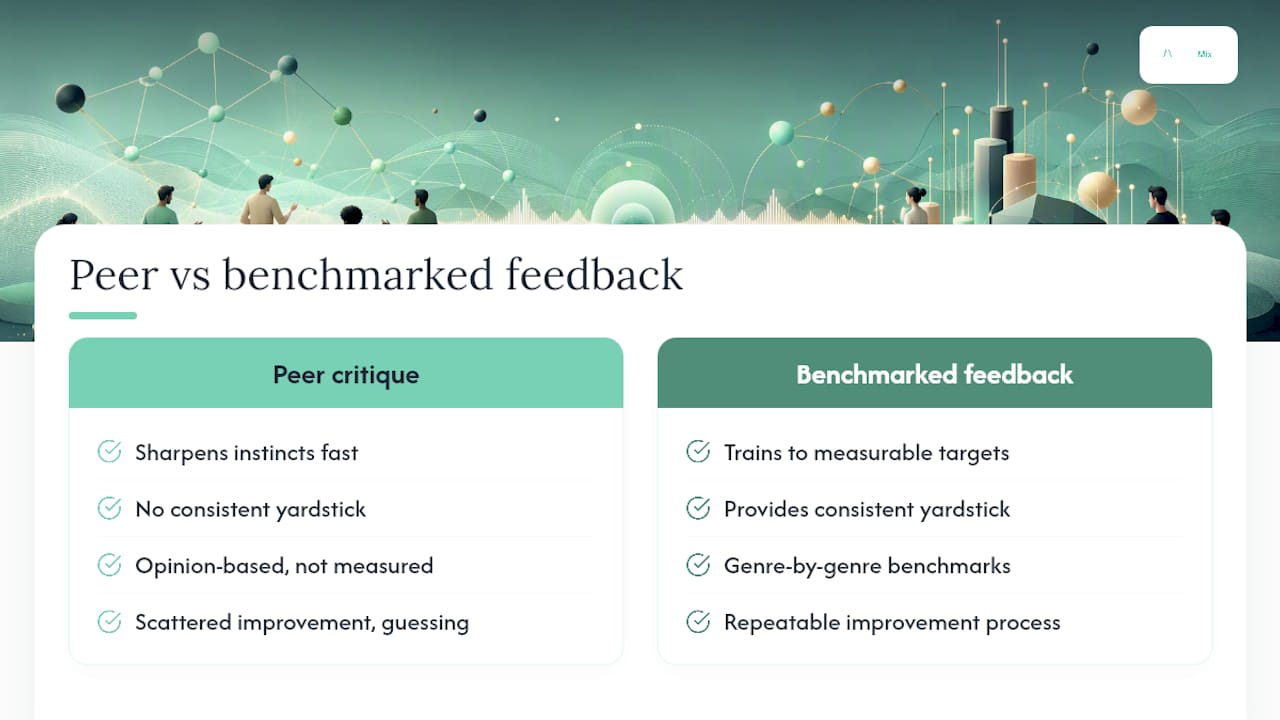
Peer critique teaches you to hear like other producers hear, which sharpens your instincts fast. What it can't give you is a consistent yardstick. Pairing community feedback with measurable benchmarks, genre by genre, is how you turn scattered opinions into a repeatable improvement process rather than a guessing game.
How AubioMix fills the gap between peer opinions and a finished master
AubioMix isn't a replacement for the communities above. It's what you turn to when you need a consistent, benchmarked second opinion faster than any group thread can deliver.

Where a Discord critique room gives you three or four differing opinions on your low end, AubioMix gives you a written and visual report measured against genre-specific benchmarks, so you know exactly where your mix sits against a defined target rather than one person's studio setup. Upload your track and you'll get specific, actionable steps across compression, EQ, frequency masking, stereo width, loudness, and mastering prep, alongside progress tracking so you can see whether your last three mixes are actually improving. It's the tool to reach for when your critique group is between sessions, when you need feedback at 2am, or when you want a measurable checkpoint before you post to a community at all. If you're working in deep house or techno, start with a genre-specific benchmark review and see exactly how your mix compares against the standard for your style.
Frequently asked questions
What is the best online community for mix critique? It depends on what you need. Subreddits and Discord servers are fastest for quick sanity checks, while curated spaces like Audio Mix Club or SoundGym's Mix Critiques area tend to deliver more consistent, technically grounded feedback because membership is more selective.
How do I ask for feedback without getting vague responses? Give context (genre, references, target loudness) and ask one specific question rather than a general "thoughts?" Reviewers respond to specificity, and a targeted question like "does the bass translate on phone speakers?" gets a far more useful answer than an open-ended one.
Do I need to share stems, or is a full mix enough? A full mix is enough for most general critique. Only share stems when someone is diagnosing a specific arrangement or masking issue and needs to isolate elements.
What does "give-to-get" mean in a critique community? It's the informal rule that anyone submitting a track for feedback owes at least one or two thoughtful critiques back to the community. It's what keeps active groups from collapsing under one-sided demand.
Is it safe to post an unreleased track for critique? Use private or unlisted links on SoundCloud or Bandcamp rather than fully public uploads, strip identifying metadata, and get sign-off from any co-writers or featured artists before sharing remixes or collaborative work.
Can community feedback replace a benchmarked mix review? Not entirely. Peer critique is excellent for training your ear and catching things you've grown deaf to, but it varies reviewer to reviewer. A benchmarked report, like the ones AubioMix generates, gives you a fixed standard to measure against so you can track real progress over time.
Sources
Audio Mix Club, SoundGym Mix Critiques, and AubioMix's feedback best-practice guide.
- Organizing and sustaining a supportive critique community — Joan Mitchell Foundation
- Audio Mix Club — Community, Music Production, Mixing Engineer
- Mix Critiques — SoundGym space
- Artwork