
A mix report is a prioritised, metric backed checklist that tells you exactly which mixing moves will improve clarity, balance and translation. It measures things like LUFS and true peak, flags masking and phase issues, and turns them into specific fixes rather than vague opinions. Grounded in real numbers, a good report from a service like AubioMix cuts down the guesswork and the revision cycles before you send a mix off for mastering.
TL;DR:
- Mix reports focus on precise metrics like LUFS, true peak, and frequency masking to identify specific issues impacting clarity and translation.
- Prioritized actionable steps include EQ cuts for masking, gentle bus compression, and selective stereo widening to optimize balance without overprocessing.
- Revisions should be implemented one at a time, with re-measuring after each change to ensure progress and avoid creating new problems.
- Submitting high-quality files with headroom, reference tracks, and clear target guidelines helps receive useful, tailored feedback.
- Using checkpointed reviews systematically reduces unnecessary revisions and improves the likelihood of a well-translation-ready mix.
Table of Contents
- What a mix report actually contains
- Key metrics in a mix report and how to read them
- Turning report notes into real mixing moves
- Turning a report into a repeatable revision workflow
- What to submit for a mix review
- How AubioMix structures its mix reports
- Using reports wisely without losing your ear
- Get a mix review and put this into practice
- Sources
- FAQ
What a mix report actually contains
Think of a mix report as a structured breakdown of your song, section by section, rather than a single verdict. Each part should give you something concrete to act on, not just a score.
A typical report covers:
- Spectral analysis: a visual spectrogram showing frequency buildup, muddiness or thin spots across the mix.
- Dynamics: how your mix breathes, including where compression is working and where it's flattening the life out of a performance.
- Frequency masking: notes on which instruments are fighting for the same space, often with suggested frequency ranges to cut or carve.
- Stereo and phase: checks for mono compatibility and phase cancellation between correlated tracks.
- Loudness values: your LUFS, true peak and RMS readings, usually compared against genre norms.
- Clipping and noise: any hard clips, DC offset or unwanted noise floor issues.
- Device translation: how the mix is likely to sound on phone speakers, earbuds and club systems.
- Prioritised actions: a ranked list of what to fix first, second, and so on.
The best reports pair this with visual assets, time stamped notes pointing to the exact second something happens, and a downloadable PDF you can keep alongside your project file for reference.
Key metrics in a mix report and how to read them
Numbers only help if you know what they're telling you. A few metrics show up in almost every mix report, and each one answers a different question.
Integrated LUFS measures the overall perceived loudness of the whole track, and it's the figure streaming platforms use for normalisation. Short-term and momentary LUFS track loudness over smaller windows, which is useful for spotting sections that swing too far from your average. For a deeper breakdown of how these interact, AubioMix's guide to LUFS and loudness is worth bookmarking.
True peak measures the highest level your signal could reach after digital-to-analogue conversion, including peaks that hide between samples. A commonly cited delivery target for livestreaming and translation across consumer devices is a peak-to-average ratio around 14 dB, or K-14 calibration, monitored through RMS and peak meters rather than peaks alone.
Statistic: targeting a 14 dB peak-to-average ratio helps a mix hold its punch and clarity when it's played back on smaller, less capable speakers.
Other figures worth knowing:
- RMS: the average signal level, useful for judging perceived density and energy.
- Peak: the single highest sample value, which tells you how much headroom is left.
- Loudness range (LRA): how much your track's loudness varies over time, a rough proxy for dynamic variety.
- Crest factor: the gap between peak and average, which shows how much punch survives compression.
Device translation checks tie all of this together. If a report flags weak low end on phone speakers or harsh top end on earbuds, it's usually pointing you towards specific spectral or balance changes rather than a wholesale remix. The audio metrics glossary is a handy reference if any of these terms still feel slippery.
Turning report notes into real mixing moves
A report is only useful once its notes become actions. Here's how the most common recommendations translate into practice:
- EQ: use surgical, narrow cuts to resolve masking between instruments, reserve boosts for small, broad lifts that add presence, and apply high-pass filtering sensibly to clear unnecessary low end rather than thinning everything out.
- Compression: treat individual track compression and master bus glue as separate jobs. Track compression shapes dynamics and tone, while bus compression should stay light and act more like glue than control. Multiband compression is a last resort, not a first move.
- Unmasking: before reaching for another EQ boost, try subtractive cuts, panning changes or automation to carve space, since soloed EQ decisions are one of the most common ways masking gets missed in the first place.
- Stereo and phase: widen only what benefits from it, usually pads, reverbs and doubled parts, and check for phase warnings by flipping to mono; if something disappears or thins out, that's your cue to investigate.
- Master bus: keep glue compression gentle, around 2:1 to 3:1 with roughly 2 to 5 dB of gain reduction, and avoid brickwall limiting that eats into the headroom mastering needs.
Pro Tip: Make one change at a time and re-check the full mix before moving to the next fix, since stacking several moves at once makes it impossible to know which one actually helped.
Turning a report into a repeatable revision workflow
Reading a report is the easy part. Acting on it without creating new problems takes a bit of discipline.
- Triage first: fix whatever affects clarity and translation before anything cosmetic, starting with vocal intelligibility, masking and headroom issues.
- Change, render, re-measure: implement one fix, bounce a new version, and check it against both the report's metrics and your reference tracks rather than trusting your ears alone.
- Use checkpoints: working through four checkpoints as you revise gives you a record of progress and makes regressions easy to spot before they compound.
- Avoid soloitis: always confirm a change works in the context of the full mix and on more than one playback device, since a fix that sounds great in isolation can vanish or clash once everything else is playing.
This loop, measure, adjust, re-measure, is far more reliable than chasing a "better" mix by feel alone.
What to submit for a mix review
The quality of feedback you get depends heavily on what you hand over. A rushed export with no context leads to generic notes, so a bit of preparation upfront saves a revision round later.
- Stereo mix bounce: export without limiting or dither, at your project's native sample rate and bit depth, plus stems if you have them.
- Reference tracks: one to three tracks with rough timecodes pointing to the moments you're trying to match.
- Headroom: leave peaks around −3 to −6 dBFS with average levels near −18 dBFS RMS, and keep the file true peak safe, ideally at or below −0.5 dBTP.
- A short brief: note your intended release format, target loudness, and any areas you already suspect are weak.
If you're missing usable reference material, sample packs such as Boom Bap Essentials 2 can give you stems and textures to compare tone and space against.
How AubioMix structures its mix reports
AubioMix works from an uploaded audio file and returns feedback across 15+ areas of mixing and mastering, including EQ, compression, frequency masking, stereo width, phase, loudness, noise and clipping, and device translation. Results come as both visual and written reports, with a downloadable PDF you can keep alongside your project.
Progress tracking runs through four checkpoints, so you can see whether a revision genuinely moved the needle rather than just feeling different. Reports are benchmarked against genre norms, and AubioMix's own mixing terms glossary helps translate the technical language into something you can act on straight away.

Using reports wisely without losing your ear

A mix report is a map, not a rulebook. It tells you where the problems are and roughly how big they are, but the final call on how a mix should feel is still yours.
Be sceptical of any advice that boils down to "just make it louder" or leans on a one-size-fits-all preset. Genres, arrangements and intent vary too much for blanket fixes to always apply. Test changes on a few different devices and come back with fresh ears the next day. Numbers confirm what you're hearing, they shouldn't replace it.
— AubioMix
Get a mix review and put this into practice
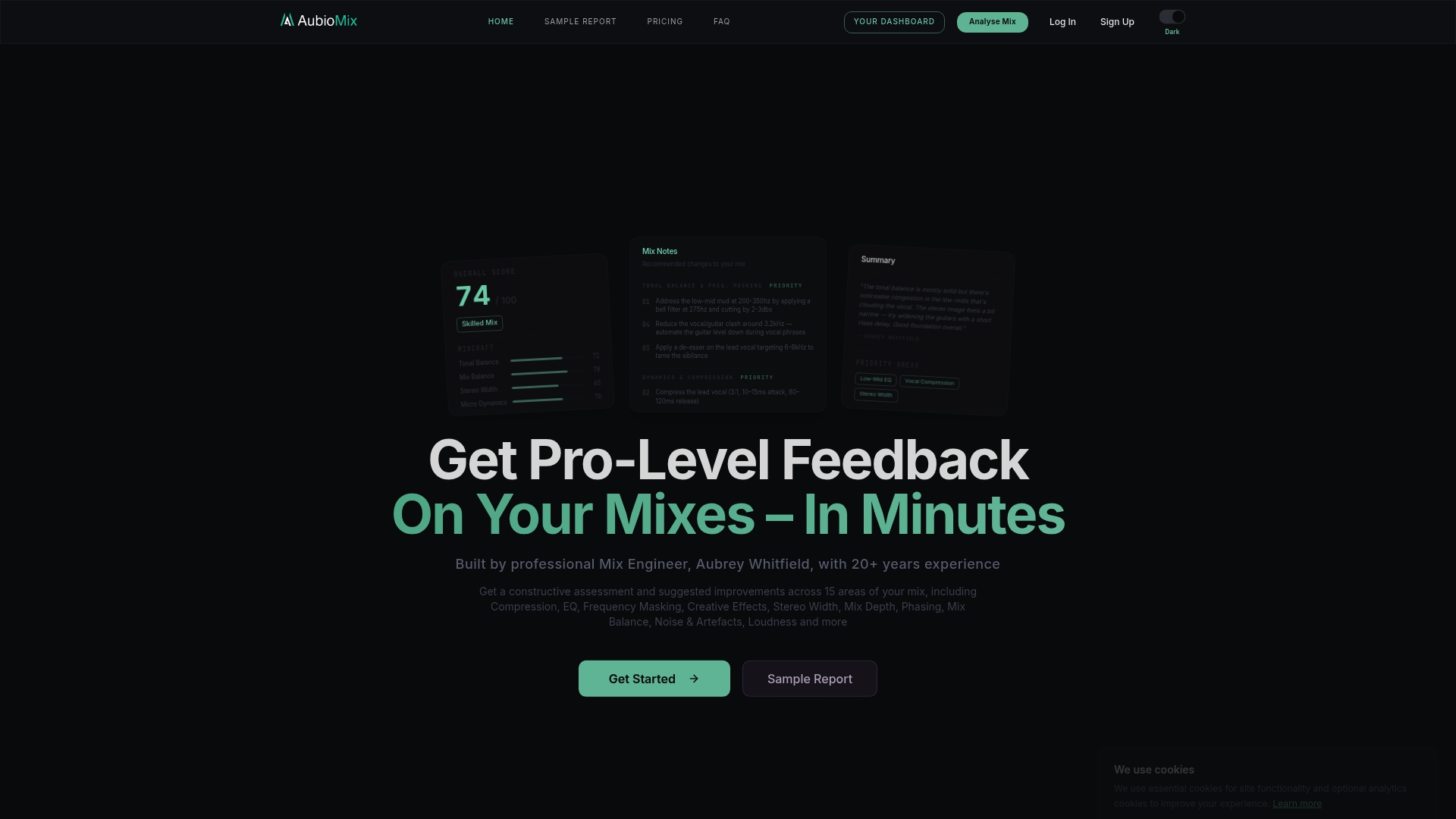
Reading about mix reports is useful, but nothing beats seeing one built from your own track. AubioMix turns an uploaded mix into a prioritised, checkpointed report you can work through section by section, exactly as described above.
Getting started is straightforward:
- Upload a stereo bounce of your mix, ideally with headroom left intact.
- Receive a written and visual report covering EQ, dynamics, masking, stereo, loudness and translation.
- Track your revisions across four checkpoints so you can see real progress, not just change.
A single Mix Review is available, along with a Reference Pass option for measuring your track against a chosen reference. Subscription plans that include multiple reviews are also offered. You can browse genre benchmarks or check pricing directly on the AubioMix pricing page. You can browse genre benchmarks or check pricing directly on the AubioMix pricing page.
Sources
- Master bus processing
- How not to over-process during mastering
- Creating professional audio for livestreaming
FAQ
What LUFS should I target before mastering?
Target loudness depends on genre and platform, so it's worth checking measured benchmarks for your style rather than using a single number across the board. As a general habit, mix with headroom intact and let the mastering stage handle final loudness rather than pushing integrated LUFS up yourself.
Should I mix into a limiter on my master bus?
A light limiter can help you gauge how a mix will sit once mastered, but it shouldn't be relied on to fix dynamics or hide clipping. Heavy limiting before mastering removes the headroom a mastering engineer needs, so keep any limiting conservative and bypass it for your final delivered file.
What files do I need to submit for a mix report?
At minimum, a full stereo mix bounce exported without limiting or dither, at your original sample rate and bit depth. Adding stems and one to three reference tracks with timecodes gives a report far more to work with, and a short note on your target format and known problem areas speeds things up further.
How is a mix report different from general mixing advice?
General advice tends to be broad and genre-agnostic, while a mix report measures your actual file and gives feedback specific to it. AubioMix's reports, for example, combine objective measurements like LUFS and true peak with prioritised, written recommendations tied to your track's own frequency balance and dynamics.
How many revision rounds does a mix report usually save?
There's no fixed number, since it depends on how far off the original mix was, but working through prioritised fixes one at a time and re-measuring against the report tends to catch problems earlier than guessing by ear alone. Using checkpoints to track each revision helps you see whether a change actually improved translation before you move on to the next one.