

If a frequency rings out on every take, reach for static EQ and cut a narrow notch. If it only flares up on certain notes or vowels, you need dynamic EQ or a spectral resonance suppressor instead. Diagnose the behaviour of the resonance before you touch a single plugin, and this article gives you the settings, the order, and the DAW considerations to make that call fast.
TL;DR:
- Resonances that ring on every take typically require static EQ cuts, while those that vary with pitch or vowels benefit from spectral resonance suppressors.
- Accurate diagnosis involves sweeping with a narrow bell boost, confirming with spectrum analysis, and checking across multiple playback systems.
- Fixed resonances suggest room modes or cabinet issues and respond well to static EQ; shifting resonances track pitch changes and need dynamic or spectral tools.
- Combining static, dynamic, and spectral resonances suppression in a layered workflow prevents over-processing and ensures natural tone preservation.
- Automated tools can identify problematic frequencies quickly, prioritizing where to apply static, dynamic, or spectral treatment for efficient resonance control.
Table of Contents
- How to find resonant frequencies in your mix
- Static EQ, dynamic EQ and spectral suppressors: what each one actually does
- Building a layered resonance control workflow
- Parameter starting points that actually work
- Latency, FFT windows and monitoring while you mix
- Three quick examples: vocal, guitar and hi-hat
- How automated mix feedback speeds up resonance hunting
- Advanced techniques: multiband dynamics and transient shaping
- Perspective: less processing, better results
- Get a focused mix review to catch resonances you might have missed
- Sources
- FAQ
How to find resonant frequencies in your mix
Resonances hide until you go looking, and the fastest way to find one is the sweep. Grab a bell boost on any parametric EQ, push it up 8 to 12 dB, narrow the Q to around 8 to 10, and slide it slowly across the spectrum. When you hit the offending frequency, it will jump out at you, sometimes uncomfortably so. Flip that boost into a notch, back off the gain until the ringing settles, and you've got your starting point.
Trust your ears first, then let a spectrum analyser confirm what you heard. A spectral view or FFT display with a window size around 2048 to 4096 samples gives a good balance of frequency precision and time resolution for spotting a sustained peak without smearing transient detail.
- Sweep with a narrow bell boost to locate the peak by ear.
- Confirm the peak on a spectrum analyser across several bars, not just one hit.
- Check the same frequency shows up at different playback levels and on at least two monitoring sources.
- Ask whether the peak sits still or moves with pitch and vowel changes.
That last question is the one that decides your whole workflow. A fixed resonance appears at the same frequency regardless of what note is playing, which usually points to a room mode, a boxy mic proximity effect, or a cabinet resonance. A shifting resonance tracks the pitch or vowel, which is typical of vocal formants or a guitar's harmonic stack moving with the chord.
Pro Tip: Check your findings on headphones and on speakers before committing to a fix. A peak that sounds aggressive in headphones can vanish on nearfields, and vice versa, especially in the 2 to 5 kHz range where ear canal resonance plays tricks on you.
Static EQ, dynamic EQ and spectral suppressors: what each one actually does
Once you know whether the resonance is fixed or shifting, the tool choice becomes straightforward rather than trial and error.
- Static EQ applies a constant cut regardless of signal level, has zero added latency, and is the right call for a resonance that behaves the same way on every take, such as a room mode or a cabinet peak.
- Dynamic EQ only engages once the signal crosses a threshold, staying out of the way during quiet passages and clamping down only when the offending frequency spikes. That makes it near-zero latency and surgical for intermittent harshness, like a vocal that gets nasal only on louder phrases.
- Spectral or dynamic resonance suppressors analyse the full spectrum in far greater resolution, comparing each frequency bin's magnitude against a smoothed spectral floor and attenuating only the bins that stand out. This is what makes them suited to resonances that move with pitch or vowel, because they don't need you to tell them where to look.
- Multiband compression works on entire frequency bands rather than individual peaks, which makes it too blunt for surgical resonance removal but genuinely useful for taming a whole region of a mix that's generally too energetic, like an overly present low mid on a bass-heavy track.
The trade-off with spectral suppressors is latency, since the higher analysis resolution that lets them catch a moving target comes from a larger FFT window, and that window takes time to compute. Reach for a spectral processor when the problem genuinely moves. Reach for dynamic EQ when it's intermittent but sits at a fixed frequency. Save multiband compression for broad tonal shaping, not resonance hunting.
Building a layered resonance control workflow
Diagnosis first, then processing, in an order that respects both CPU load and audio quality. A layered approach reduces artefacts because each stage only has to handle what the previous stage left behind, and the spectral processor at the end works on a far calmer signal than it would if it went first.
- Diagnose the resonance as fixed or shifting using the sweep and spectrum method above.
- Static notch any fixed peaks first. This is zero latency and removes the biggest, most predictable offenders before anything else touches the signal.
- Dynamic EQ next, targeting one or two intermittent frequencies that only misbehave under certain dynamics.
- Spectral suppressor last, as a gentle finishing pass that mops up shifting or residual resonant build-up across the whole track or bus.
Combining tools this way lets you keep each processor set conservatively rather than asking one plugin to do all the work with an aggressive setting that flattens the natural tone.
Know when to stop. If you're still sweeping for problems after the third pass, you've probably over-processed rather than under-diagnosed. Bypass the whole chain, level-match the two versions so loudness doesn't fool your ears, and A/B at your normal listening volume.
Pro Tip: Always level-match before A/Bing. A quieter version will almost always sound "smoother" even when it isn't actually cleaner, and that trap catches experienced engineers as often as beginners.
Parameter starting points that actually work
Numbers give you a place to start, not a rule to follow blindly, but they save hours of guesswork.
- Static notch: Q of 6 to 12, cut of 2 to 6 dB. Narrower Q for a sharp room mode, wider for a broad honk.
- Dynamic EQ: threshold set so the band only triggers on the loudest 20 to 30% of passages, ratio around 2:1 to 4:1, attack fast (1 to 5 ms), release moderate (80 to 150 ms) so it doesn't pump.
- Spectral suppressor: moderate sensitivity to start, since these processors already use frequency-dependent time constants, reacting faster above roughly 5 kHz and slower below 200 Hz, which keeps transients intact while smoothing sustained peaks.
For vocals, the trouble frequently sits in the 2 to 5 kHz range, where sibilance and formant resonance overlap. For distorted guitars, look at 1 to 3 kHz, where harmonic stacking from the amp or cabinet creates a honky cluster. For hi-hats and cymbals, the culprit usually lives at 6 to 12 kHz, where metallic ring builds up fastest.
Roughly a third of harshness complaints in mix feedback trace back to exactly these three zones, which is why they're worth checking first regardless of genre. Start with the ranges above, sweep within them to find the exact peak, then dial your notch or threshold to taste rather than trusting a preset outright.

Latency, FFT windows and monitoring while you mix
Spectral suppressors need time to analyse the signal, and that time shows up as latency you need to manage.
- Typical FFT windows on spectral resonance suppressors introduce 23 to 93 ms of latency, which your DAW's plugin delay compensation absorbs automatically during mixing, so it's rarely a problem once you're past the tracking stage.
- During live tracking, switch to a low-latency mode if your plugin offers one, or route the suppressor onto a parallel bus and blend it in rather than inserting it directly on the input path.
- Use dynamic EQ instead of a spectral suppressor for any pass that happens while a performer is monitoring themselves, since dynamic EQ's near-zero latency won't throw off their timing.
- On stereo material, route resonance control through mid/side processing when the peak sits mainly in the centre image, so you're not thinning the width by cutting the sides unnecessarily.
Pro Tip: Place your lowest-latency tools earliest in the chain and your spectral processor last. It genuinely sees fewer extreme peaks that way, and your CPU meter will thank you too.
Three quick examples: vocal, guitar and hi-hat
Vocal, shifting resonance: A pop vocal rings harder on "ee" and "ay" vowels than anywhere else, moving with pitch across a verse. A spectral suppressor set to moderate sensitivity catches most of it automatically. A single stubborn node around 3.2 kHz that survives the pass gets its own dynamic EQ band, threshold tuned so it only bites on the loudest phrases.
- Run a light spectral suppressor pass across the whole vocal take first.
- Sweep for any frequency that still spikes on specific words.
- Add a narrow dynamic EQ band on that exact frequency with a fast attack.
Distorted guitar, stacked resonance: A rhythm guitar honks around 1.4 kHz and 2.1 kHz simultaneously, a classic cabinet and amp interaction. Two static notches, Q around 8, 3 dB each, clean up the fixed peaks. A gentle spectral pass afterwards on the guitar bus catches any remaining harshness the notches missed.
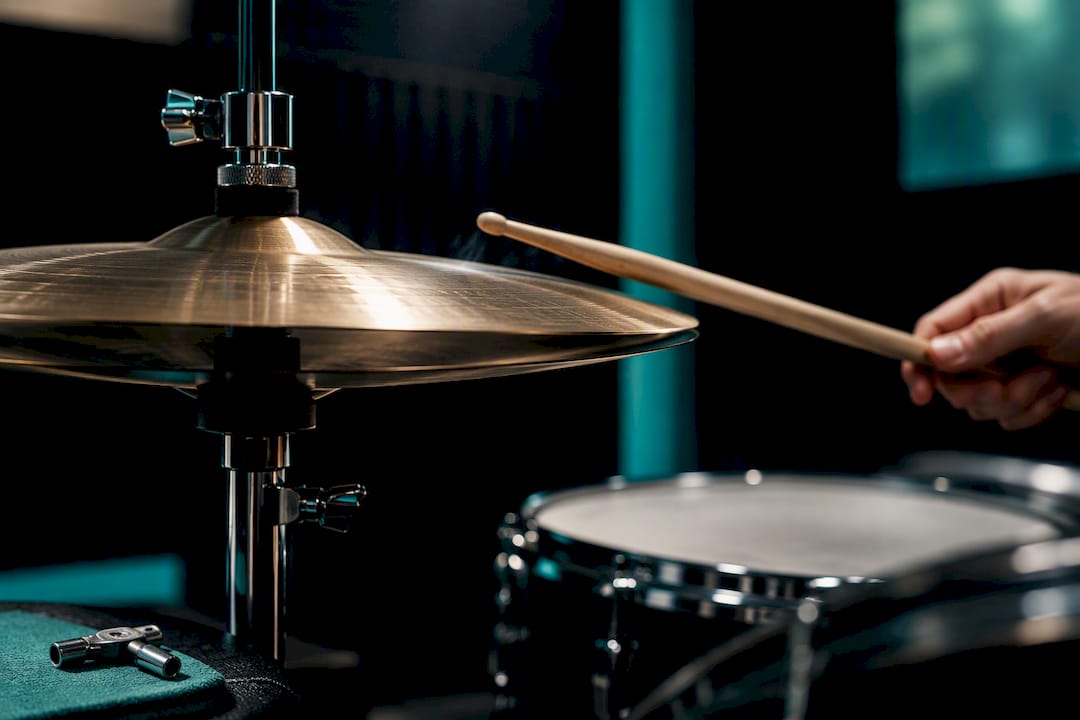
Percussion, hi-hat brittleness: A hi-hat sounds fine on individual hits but turns brittle across a busy pattern, meaning the resonance builds cumulatively rather than sitting still. A spectral suppressor with a fast attack (under 5 ms) and narrow bandwidth around 8 kHz, paired with quick release timing, tames the build-up without dulling the transient snap.
How automated mix feedback speeds up resonance hunting
Manually sweeping every track for resonant peaks works, but it takes time, and time is exactly what a deadline doesn't give you. AubioMix's evaluation framework runs automated detection across frequency masking, resonant build-up and a dozen other mixing areas, flagging which tracks are carrying problem frequencies before you've opened a single EQ plugin.
That kind of report doesn't replace the sweep-and-diagnose process outlined above, it accelerates it. Instead of auditioning twenty tracks in a session one at a time, you get a prioritised list of where resonant energy is actually building up, so your first static notch or dynamic EQ band goes exactly where it matters. Once you've applied treatment, running the mix back through gives you a way to check whether the fix actually improved translation, rather than just sounding different on your own monitors.
Human judgement still decides how aggressive a cut should be and whether a "problem" is actually part of an instrument's character worth keeping. The report narrows down where to look. Your ears still decide what to do about it.
Advanced techniques: multiband dynamics and transient shaping
Once the basics are handled, two more advanced tools earn a place in a resonance-conscious mixing chain.
Multiband dynamic processing goes beyond simple multiband compression by applying different compression ratios and timings to narrow bands independently, which lets you tame a resonant region's dynamics without flattening the whole track. Set the crossover points tightly around the resonant zone you identified during diagnosis, rather than using generic low/mid/high splits, and keep the ratio modest, around 2:1, so the band still breathes.
Transient shaping attacks a different part of the problem. A lot of perceived harshness isn't the sustained resonance itself but an overly sharp transient exciting that frequency on every hit, which is common with hi-hats, snares, and picked guitar. Pulling back the attack stage of a transient shaper by a small amount, often just a few percent, softens that excitation without touching the frequency content at all, and it pairs well with a spectral suppressor handling the sustain.
Used together, these two techniques target the two halves of the same problem: the sustained resonant energy and the transient spike that triggers it. Neither replaces static or dynamic EQ, but both belong in the toolkit once the obvious fixed and intermittent peaks are already under control, giving you a way to address resonant character that's baked into the source performance rather than the frequency response.
Perspective: less processing, better results
The instinct to reach for one aggressive plugin and let it handle everything is understandable, but it's usually the wrong call. Aubiomix's view, built from watching how resonance problems actually behave across genres, is that the least processing which solves the problem beats the most powerful processing that happens to be available.
Layer conservative tools rather than lean on a single one. Test every decision on more than one monitoring source, because a fix that sounds perfect on your main speakers can fall apart on a phone speaker or a pair of earbuds, and checking translation across playback systems catches that before a listener does. Resonance control done well should be almost invisible in the final mix, not audibly "fixed."
— AubioMix
Get a focused mix review to catch resonances you might have missed
Sweeping every track by ear works, but it's slow, and it's easy to miss a resonant build-up buried under a busy arrangement. A 1 Mix Review from Aubiomix gives you an actionable report flagging exactly where resonant energy, frequency masking, and a dozen other mix issues are showing up in your track, so you know which frequencies to treat before you touch an EQ.

The report is built to complement the workflow in this article rather than replace it. You still make the tonal decisions, but you stop guessing which track needs attention first. If you want a second opinion against a specific reference track, add a Reference Pass for £2.99 to compare your mix directly against it. For producers running reviews regularly, the Professional plan at £19.99 per month includes a set number of mix reviews each month rather than paying per upload. Head to the pricing page to pick the option that fits how often you mix.
Sources
- What is a Dynamic Resonance Suppressor? How to Fix Harsh Frequencies In Your Mix | Baby Audio
- Best resonance suppressor plugins (House of Loop)
FAQ
What Is Resonance Control?
Resonance control is the process of identifying frequencies that ring out unnaturally in a mix, whether from a room mode, an instrument's body, or a vocal formant, and reducing them with static EQ, dynamic EQ, or a spectral resonance suppressor. The goal is to remove the ringing without dulling the natural tone of the source.
Which Frequencies Should I Cut When Mixing?
There's no universal frequency to cut, since resonances depend entirely on the instrument and the room. Vocals commonly ring in the 2 to 5 kHz range, distorted guitars around 1 to 3 kHz, and hi-hats or cymbals near 6 to 12 kHz, but always sweep to confirm the exact peak rather than cutting blindly at a preset frequency.
What Happens To Materials At Their Resonant Frequency?
Any physical object, including a room, a speaker cabinet, or an instrument body, vibrates most strongly at its natural resonant frequency, amplifying that frequency far more than others around it. In a mix, this shows up as an unnatural peak that sounds louder or harsher than the surrounding frequencies, which is exactly what resonance control aims to tame.
Can AubioMix Help Me Spot Resonance Problems?
Yes. AubioMix's automated mix analysis flags resonant build-up and frequency masking across your track, giving you a prioritised report on where to focus treatment before you start EQing by ear. A single Mix Review costs £4.99, with subscription plans available for producers who need reviews regularly.