
If your low end sounds thin, the culprit is almost always phase cancellation or frequency masking, not a lack of bass. Run a mono-sum test and export the mix to your phone speaker right now. If the bass shrinks in mono, you've got a phase problem; if it just sounds cluttered on the phone, you're dealing with masking. Both are fixable in one session. The full diagnostic checklist below tells you exactly where to look next.
TL;DR:
- Phase cancellation from stereo-widened tracks or inverted polarity is the most common cause of a thin low end and is easily fixed by polarity flipping or timing adjustments.
- Masking in the 60 to 120 Hz range often creates a perceived weak low end, which can be identified with spectrum analysis and addressed by careful EQ cuts on competing instruments.
- Using mono summing and listening on phone or Bluetooth speakers regularly helps reveal phase issues and frequency masking that kill low-frequency power across various playback systems.
- Applying conservative high-pass filters to non-essential tracks and separating kick and bass into distinct frequency zones improves clarity and punch in the low end.
- Adding harmonic content through saturation or octave doubling can boost perceived bass depth on small speakers, but arrangement and proper EQ separation are what truly fix weak low end issues.
Table of Contents
- How do I diagnose a weak low end?
- What EQ and mono-bass rules actually fix a thin low end?
- Is phase cancellation killing your bass, and how do you fix it?
- Can saturation make small speakers hear more bass?
- Which instruments are stealing your low end, and how do you clean it up?
- What monitoring habits confirm your low end is actually fixed?
- What's the fastest workflow to repair a weak low end in one session?
- What does an AubioMix report actually flag in a weak low end?
- Why weak low end keeps coming back
- Get a mix review built around exactly this problem
- Sources
- FAQ
How do I diagnose a weak low end?
Before you touch a single EQ knob, work out what's actually broken. A weak low end has three usual suspects: phase cancellation, arrangement clutter, or a mix bus that's already out of headroom. Guessing which one it is wastes hours. Testing takes minutes.
Start here, in order:
- Sum the mix to mono. Flip your master bus (or a mono utility plugin) to mono and listen specifically to the bass and kick. If the low end noticeably shrinks or disappears, you're looking at phase cancellation somewhere below 150 Hz, usually from a stereo-widened bass, layered DI and amp tracks that aren't time aligned, or a kick sample with an inverted polarity against the bass.
- Play the mix on a phone speaker, then a laptop, then a cheap Bluetooth speaker. Note exactly what vanishes. If the bass note disappears entirely but the kick's click survives, your fundamentals are too far down to translate and you need harmonic content, not more sub.
- Open a spectrum analyser (Fab Filter Pro Q3, Voxengo SPAN, or your DAW's built in analyser all work fine) and look at where energy actually clusters. A weak low end often shows a hole around 60 to 120 Hz even though there's plenty of sub below it, which is a classic masking signature.
- Scroll through your session and count how many tracks have meaningful energy below 200 Hz. Guitars, synth pads, vocals with proximity effect, and reverb returns all quietly steal room from the kick and bass without anyone noticing.
- Check your mix bus headroom. If a limiter or heavy bus compressor is already working hard before you've finished balancing, it will squash exactly the transient energy that makes bass feel powerful. Pull back the bus processing and see if the low end returns.
Most weak low ends turn out to be a combination of the first two. Fix those and everything downstream gets easier.
What EQ and mono-bass rules actually fix a thin low end?
Once you know what's wrong, the fixes are mostly small and boring, in a good way. Aggressive EQ moves are rarely the answer; disciplined, conservative ones are.
High-pass everything that doesn't need to be down there. Guitars, most vocals, pads, and cymbal-heavy overheads can usually take a high-pass filter somewhere between 80 and 120 Hz without losing any perceived weight, because the ear associates their character with higher harmonics, not the fundamental. Sweep the filter upward slowly while soloing against the full mix, and stop the moment you hear the track thin out. That point is your cutoff. Non-essential low end is the single biggest source of masking in amateur mixes.
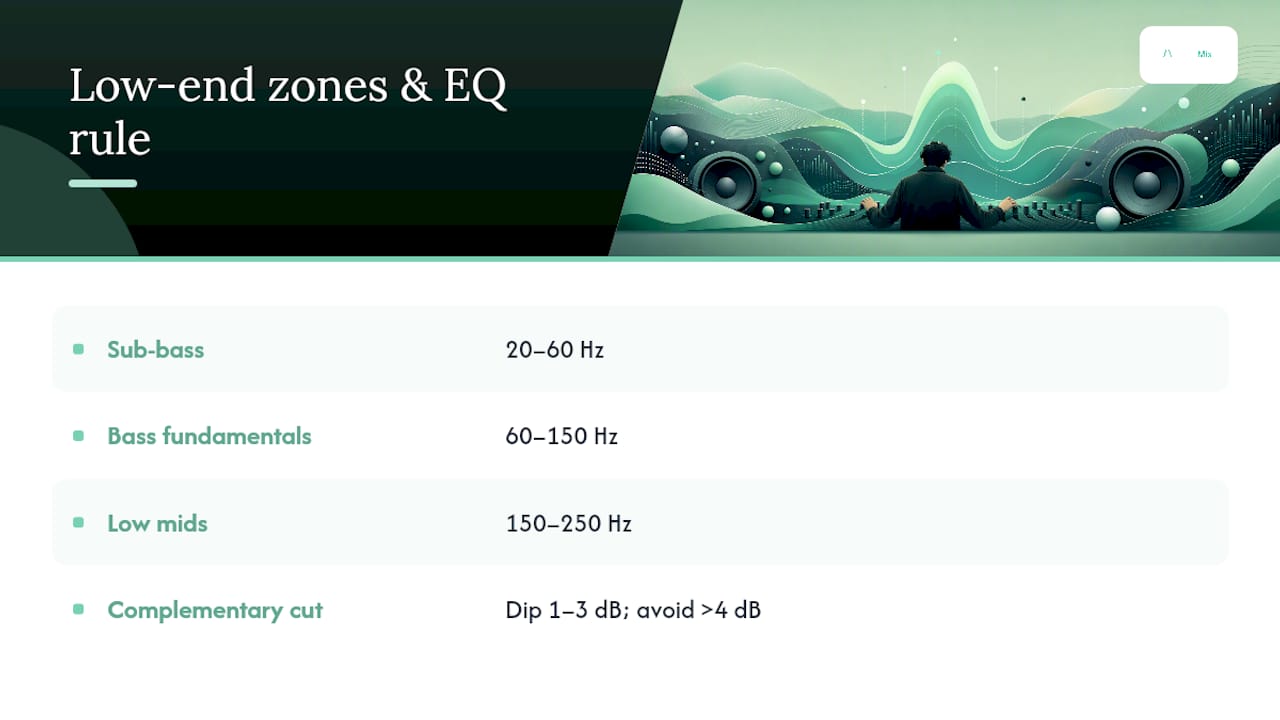
Give the kick and bass separate territory. A reliable structure splits the low end into sub-bass (20 to 60 Hz), bass fundamentals (60 to 150 Hz), and low mids (150 to 250 Hz). Decide which instrument owns which zone, then use complementary EQ: if the kick's punch lives at 80 Hz, dip the bass by 1 to 3 dB there and let it breathe higher up instead. These moves should be modest. Anything past 4 dB usually means you're fighting the arrangement, not the EQ.
Sum everything below 100 to 150 Hz to mono. Stereo information at those wavelengths rarely reproduces cleanly and often cancels the moment a listener's system sums to mono, which is most Bluetooth speakers and a fair few club systems. A mono-maker or an elliptical EQ on the master bus handles this without you needing to touch individual tracks.
Pro Tip: Before you boost anything, try cutting the competing track first. A weak kick usually isn't asking for more low end; it's asking for less low end from everything around it.
Prefer narrow, surgical cuts on problem frequencies and broader, gentler curves on boosts. Cuts fix specific clashes; boosts, if you need them at all, should feel like a tilt rather than a spike.
Is phase cancellation killing your bass, and how do you fix it?
Phase problems sound like weak low end but behave differently under testing, which is exactly why the mono-sum check matters so much. If flipping to mono causes a sudden volume drop specifically in the bass and kick, you've confirmed it.
Common causes and fixes:
- Layered kick samples or DI plus amp bass tracks recorded or bounced with opposite polarity. Flip the polarity switch on one track and listen for the bass to suddenly feel fuller. This takes ten seconds and fixes more mixes than people expect.
- Micro-timing offsets between layered low tracks, even a few milliseconds apart, cause comb filtering that eats specific frequencies. Nudge one track by small increments until the mono sum stops thinning out.
- Stereo wideners or reverb applied to bass and kick, which push low-frequency content out of phase between the left and right channels. Pull the width control back below 150 Hz or apply a dedicated low-band mono tool.
- Excessive stereo imaging on anything sharing the low band, including pads and synth bass. Flatten stereo width below your chosen crossover point rather than across the whole track.
Sidechain compression gets blamed for weak low end more often than it deserves, but timing matters. Conservative starting points sit around 3 to 4 dB of gain reduction, a fast attack of 1 to 3 ms, and a release tuned to the track's tempo, typically 30 to 60 ms. If the kick and bass are already sitting in different frequency pockets thanks to complementary EQ, you may not need sidechain at all. Reach for timing fixes and EQ separation first; use sidechain compression when the two instruments genuinely occupy the same space rhythmically and something has to duck.
Pro Tip: If sidechain ducking is audible as pumping rather than felt as groove, your release is too slow for the tempo. Halve it and listen again before touching the ratio.
Can saturation make small speakers hear more bass?
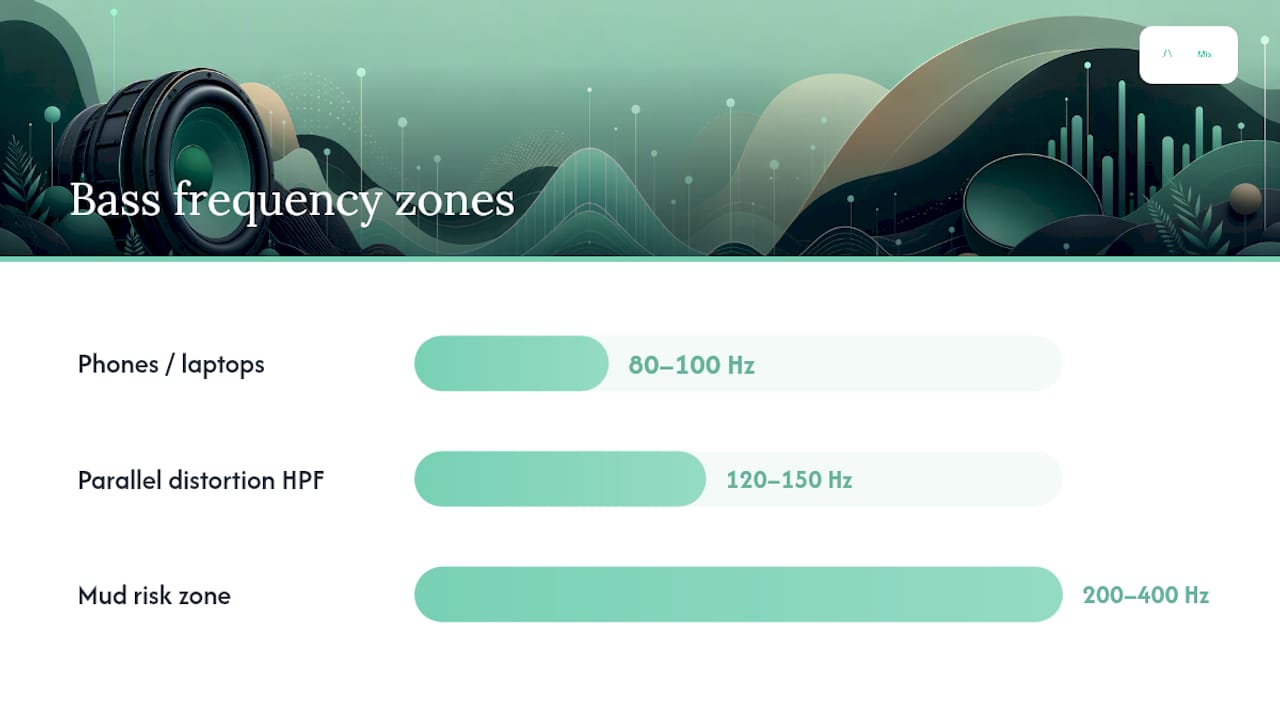
Yes, and this is the trick most home producers skip. Phones and laptop speakers physically cannot reproduce true sub-bass, often anything below 80 to 100 Hz simply doesn't exist on that hardware. Generating harmonics above the fundamental gives the ear enough information to imply the missing note, even though the speaker never actually moves at that frequency.
A few practical ways to do this without turning your low end to mud:
- Light saturation across the bus, dialled in until you can just barely hear a change in character rather than an obvious crunch.
- Parallel distortion, high-passed above 120 to 150 Hz, blended in underneath the clean signal so you get the harmonic lift without smearing the fundamental itself.
- A synth octave-up layer or a bass sample doubled an octave higher, automated in only where the phone-speaker test shows the note disappearing.
Watch the 200 to 400 Hz region closely while you do this. It's the area where accumulated harmonics turn into audible mud, and it's also where most muddy low-mid complaints actually originate. Automate the saturation amount rather than leaving it static across the whole track, and bring it in gradually so the effect stays a translation aid rather than a tone.
Which instruments are stealing your low end, and how do you clean it up?
A lot of weak low end has nothing to do with processing at all. It's an arrangement problem wearing an EQ costume, and no amount of plugin tweaking fixes a track where four instruments are all fighting for the same 100 Hz.
Decide who owns the low end and commit to it. In most electronic genres, that's the bass and kick, full stop, with everything else high-passed clear of the fight. In a rock mix, the bass guitar and kick share the space but with the kick usually taking the punch below 80 Hz and the bass filling in above it. In a hip-hop beat built around an 808, the 808 often IS the bass and the kick, which changes your whole approach to EQ separation.
- High-pass guitars, keys, and most vocals starting around 100 Hz; be more conservative with anything carrying real warmth, like a Rhodes or a cello.
- Shorten overly long bass or synth decays that ring into the next note and smear the low end into a wall of noise.
- Edit overlapping low parts in the arrangement itself rather than trying to EQ your way out of a collision.
- If two instruments are simply doing the same job, mute one or replace it. That's often faster and cleaner than any plugin chain.
What monitoring habits confirm your low end is actually fixed?
Fixing the mix on your main monitors means nothing if it collapses everywhere else. Confirming the fix takes a short, repeatable checklist.
- Mix at a moderate volume. Loud monitoring flatters the low end and hides real problems; a moderate level exposes exactly how much bass is actually there.
- Match loudness against a commercial reference track in your genre and listen for whether your bass feels proportionate, not louder or thinner, at matched volume.
- Check the mix on a minimum set of systems: phone speaker, laptop speaker, a cheap Bluetooth speaker, and a car if you can. Each one exposes a different weakness, and translation across all of them is the real test.
- Do the mono-sum check again, every single time, even after you think you've fixed it. It's the fastest way to catch a phase issue that crept back in during a later revision.
- Back up your ears with a spectrum analyser and a LUFS/true-peak meter. Subjective checks catch what you feel; the meters confirm what's objectively happening on the master bus.
Pro Tip: Keep the same three or four reference tracks across every project. Switching references constantly makes it impossible to build an ear for what "right" actually sounds like in your genre.
What's the fastest workflow to repair a weak low end in one session?
Here's the order that gets you from diagnosis to a translating mix without wasted moves.
- Scope the problem. Mono-sum the mix and export a rough bounce to your phone. Note exactly what changes.
- Sweep high-pass filters across every non-essential track, starting around 80 to 120 Hz, removing rumble and low-end clutter that was never doing any musical work.
- Find the fundamentals. Pull up a spectrum analyser, identify where the kick and bass actually sit, and apply complementary EQ moves of 1 to 4 dB to give each its own space.
- Fix timing and phase. Check polarity, nudge any misaligned low layers, and apply conservative sidechain settings only if the kick and bass still clash rhythmically after EQ separation.
- Add harmonic content, check headroom, and reference. Bring in light saturation or a parallel distortion layer for phone translation, confirm the mix bus still has headroom, and A/B against your reference tracks before calling it done.
| Step | Goal | Typical tools |
|---|---|---|
| 1. Scope | Confirm phase vs. masking | Mono utility, phone export |
| 2. High-pass | Remove non-essential low energy | HPF, spectrum analyser |
| 3. Complementary EQ | Separate kick and bass fundamentals | Parametric EQ |
| 4. Timing and sidechain | Remove cancellation and clashes | Polarity switch, compressor |
| 5. Harmonic layer and check | Improve translation, confirm headroom | Saturation, LUFS meter |
Run this in order and resist the urge to skip straight to step 5. Adding harmonics to a mix that still has an unresolved phase problem just gives you a louder version of the same thin sound. If your session's guitar and synth arrangement is part of the clutter, it's also worth revisiting how those parts were composed in the first place using production and composition tools built for exactly that kind of arrangement decision.
What does an AubioMix report actually flag in a weak low end?
AubioMix analyses an uploaded mix and returns a written and visual report covering phase relationships, frequency masking, dynamics, and how the track is likely to translate across different playback devices. For a weak low end specifically, that typically means the report calls out:
- Where a mono sum is losing energy, pointing straight at the phase issue from the diagnostic checklist above.
- Which tracks are masking the kick and bass fundamentals in the 60 to 150 Hz range.
- Whether mix bus dynamics are already limiting the transient punch the low end needs.
- How the mix is likely to perform on small-speaker and phone playback, the same check you'd otherwise do by ear.
Each finding maps directly onto a step in the repair workflow above, so a report essentially hands you the diagnosis before you've opened a single plugin.
Why weak low end keeps coming back
Most engineers treat a weak low end as an EQ problem and reach for a boost. That's backwards. Subtraction and arrangement decisions fix more low ends than any amount of additive processing ever will, because the real issue is usually competition for space, not an absence of bass.
Build the mono check and the phone-speaker check into your workflow early, not as a final quality pass, and mix at moderate volumes with the same reference tracks every time. Consistency in monitoring teaches your ear what "translating" actually sounds like. When a mix still won't behave after you've worked through every step here, an external set of ears, or a report built from thousands of real mixes, often catches what fatigue hides from you.
— AubioMix
Get a mix review built around exactly this problem
A single Mix Review from AubioMix runs your track through phase, EQ, masking, and device translation checks, then returns a visual and written report with specific action points rather than a vague score. That's the same diagnostic ground covered in this guide, done automatically and backed by an evaluation framework that's kept current with genre standards, combined with feedback shaped by the founder's own mixing background. If you've run the mono-sum test and the phone check and you're still not sure what's causing the thin low end, upload the track and let the report point you straight at the fix.
Sources
- Tips for fixing phase problems in your mix — Waves
- How to mix the low end — Violet Recording
- Why your low end doesn't translate — Pro Audio Plug
- Low end mixing guide — LordReverb
FAQ
What does "low end" mean in a mix?
Low end refers to the frequencies roughly between 20 and 250 Hz, covering sub-bass, bass fundamentals, and the lower part of the low-mid range where kick and bass energy live.
What does "low end" mean in slang?
Outside audio, "low end" describes the cheapest or most basic tier of a product range, the entry-level version rather than the premium one, which is where terms like budget audio equipment and entry-level tech come from.
What's the difference between high end and low end?
In mixing, low end is the bass and sub-bass frequencies below roughly 250 Hz, while high end refers to treble and air frequencies; a balanced mix needs clarity across both without either masking the midrange.
What is low, mid, and high EQ?
Low EQ typically shapes 20 to 250 Hz, mid EQ covers 250 Hz to around 4 kHz where most instrument character and vocal presence sit, and high EQ shapes everything above that, controlling brightness and air.
Can AubioMix diagnose a weak low end automatically?
Yes. AubioMix's mix analysis reports flag phase issues, frequency masking, and device-translation problems, the same faults behind most weak low ends, and map them to specific fixes you can act on immediately.