

A mix revision is a targeted adjustment to an existing audio mix based on your feedback, aimed at fine-tuning the sound rather than restarting the whole process. Think of it less like sending a dish back to the kitchen and more like asking the chef to add a touch more seasoning. The mix is already there; you're just shaping it into exactly what you heard in your head.
What does a mix revision actually involve?
A mix revision is a specific set of changes made inside the original mixing session, based on your notes after hearing the first delivered mix. It covers adjustments like level balancing, EQ tweaks, reverb amounts, compression settings, and stereo placement. What it does not cover is adding new tracks, replacing audio files, or restructuring the song entirely. Those requests fall outside the revision scope and typically require a separate agreement.
Typical changes included in a mix revision:
- Level adjustments: Bringing a vocal up or pushing a bass guitar back in the mix
- EQ changes: Making a guitar brighter, taming harsh frequencies on a snare
- Effects tweaks: Reducing reverb on a lead vocal, shortening delay decay on a synth
- Stereo balance: Widening a pad, narrowing a drum room sound
- Compression adjustments: Tightening a punchy kick, smoothing out a dynamic vocal
What a revision does not include:
- Adding new recorded tracks or stems
- Changing the song's arrangement or structure
- Replacing original audio files with new recordings
- Any request that effectively asks for a new creative direction
The distinction matters. A revision refines what exists; a new creative direction requires a fresh conversation and, usually, additional fees.
How many revision rounds should you expect?

The industry standard sits at two to three included revision rounds. Beyond that, most engineers charge hourly for additional changes, which encourages producers to consolidate their feedback rather than drip-feeding small requests over days. It is a boundary that protects both parties.
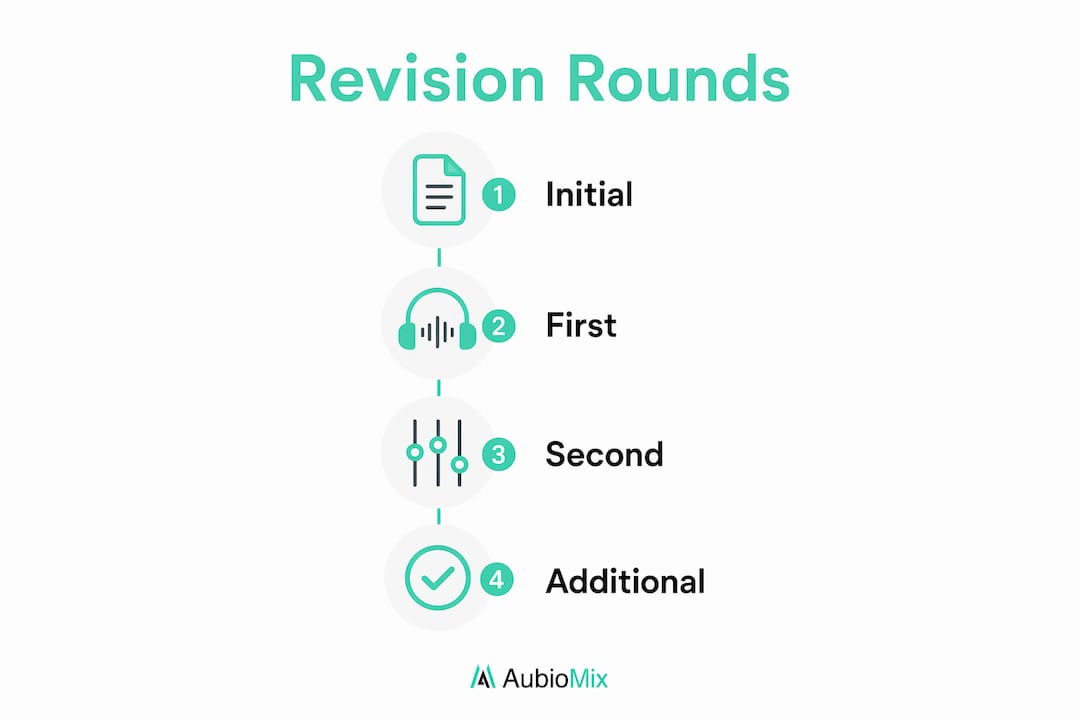
Turnaround times for each round vary depending on the engineer's workload and the complexity of the notes, with straightforward requests generally completed more quickly than more comprehensive adjustments.
Key things to know about revision rounds:
- Each round counts as one consolidated batch of feedback, not individual messages
- Sending scattered notes across email, text, and voice memos often triggers an extra round unintentionally
- Agreeing on revision limits upfront prevents misunderstandings and keeps the project moving
Pro Tip: Ask your engineer to confirm the revision limit and turnaround time in writing before the project starts. A quick message at the beginning saves a lot of awkward conversations later.
How to write revision notes that actually get results
Specific, timestamped notes are the single biggest factor in reducing the number of rounds you need. A note like "the mix sounds a bit off" gives an engineer almost nothing to work with. A note like "1:23, lead vocal, increase clarity, feels muffled in the second verse" tells them exactly where to go, what to touch, and what result you want.
Effective revision notes follow a simple three-part format:
- Timestamp: Where in the track the issue occurs (e.g., "0:45")
- Instrument or element: What needs changing (e.g., "snare drum," "lead vocal," "synth pad")
- Desired change: What you want to happen (e.g., "reduce reverb tail," "add more presence around 3kHz")
Examples of good versus vague revision requests:
| Vague | Specific |
|---|---|
| "The vocals feel weird." | "Lead vocal sounds muffled, try boosting around 3kHz." |
| "The drums need work." | "Kick drum is getting lost under the bass." |
| "There's too much reverb." | "Backing vocals, shorten the reverb tail, it's bleeding into the next phrase." |
Send all your notes in one consolidated list per round, not as a series of follow-up messages. Grouping by instrument or song section makes it easier for the engineer to work through your feedback methodically.
Pro Tip: Waveform annotation tools let you drop comments directly onto the audio timeline at the exact moment you hear an issue. This removes ambiguity entirely and tends to cut revision rounds down noticeably.
How to listen to a mix before giving feedback
Rushing your feedback is one of the most common ways producers waste revision rounds. Before you write a single note, listen to the mix at least twice all the way through without stopping to jot anything down. Let your ears adjust and your emotional reaction settle.
Then listen again on multiple devices: studio monitors, headphones, earbuds, and even a phone speaker or car stereo. Each playback environment reveals something different. A low end that sounds balanced on monitors might be overwhelming in a car, and a vocal that cuts through headphones might disappear on a Bluetooth speaker.
Best practices for assessing a mix before revising:
- Listen on at least three different playback systems before forming conclusions
- Take timestamped notes on your second or third listen, not your first
- Separate emotional reactions ("I don't like this song today") from technical observations ("the hi-hat is too bright at 1:45")
- Sleep on it if you can. Fresh ears catch things tired ones miss
Pro Tip: Use a reference track to calibrate your ears before listening. Pick a commercially released song in a similar genre with a mix you admire, and play it first. This gives your brain a sonic benchmark, making it much easier to identify where your mix diverges from your goal.
Managing the revision workflow to avoid confusion
A clear workflow prevents the dreaded revision spiral, where a two-round project quietly becomes ten rounds because feedback keeps arriving in fragments. The fix is straightforward: agree on the process before the first mix lands in your inbox.
Practical workflow habits that keep revisions on track:
- Set revision limits in the contract: Two to three rounds is standard; know what happens if you exceed them
- Use a single feedback channel: Pick one method (email, a feedback tool, a shared document) and stick to it. Scattered messages across platforms create confusion and missed notes
- Name your versions clearly: Use a consistent naming convention like "SongTitle_Mix_v1," "SongTitle_Mix_v2" so neither party accidentally works from an old file
- Build revision windows into your timeline: If the track needs to be finished by Friday, plan for the first mix to arrive Monday, feedback by Wednesday, and the revised mix Thursday
- Address minor changes promptly, discuss major ones: If an engineer disagrees with a big creative call, have a conversation rather than just sending the note. Often the real issue is a communication gap, not a mixing problem
For bands or groups, nominate one person to compile all feedback before it goes to the engineer. Five people sending separate opinions about the snare is a recipe for a revision spiral.
Why mix revisions must be finished before mastering starts
Mastering and mixing solve completely different problems, and mixing revisions must be finalised before mastering begins. Mastering enhances a finished mix: it adds loudness, polish, and consistency across playback formats. It cannot fix a vocal that is buried in the mix or a low end that is out of balance. Attempting mix changes after mastering has started means the mastering engineer has to redo their work, which costs time and money.
Mix revision tasks versus mastering tasks:
| Mix revision | Mastering |
|---|---|
| Adjust vocal level in the chorus | Set overall loudness to streaming standards |
| Reduce reverb on the snare | Apply final limiting and peak control |
| Balance stereo width of a pad | Ensure consistency across the full release |
| EQ a guitar to sit better in the mix | Add subtle harmonic enhancement to the full track |
| Fix a harsh frequency on a synth | Prepare files for distribution formats |
Once mastering begins, the mix is locked. Any mix-level changes after that point require going back to the mixing session, which effectively restarts the mastering stage. Getting your revisions right before that handoff is one of the most practical things you can do to protect your budget and your deadline.
Common challenges and pitfalls during mix revisions
Most revision problems are workflow problems, not mixing problems. The most frequent pitfall is vague feedback: notes like "it doesn't feel right" or "make it sound bigger" give an engineer no clear direction, which leads to guesswork, missed expectations, and more rounds than necessary.
Another common trap is revision creep, where each round introduces new requests rather than addressing the original notes. If you find yourself asking for something in round three that you never mentioned in round one, that is a sign the feedback process broke down early. The solution is to listen thoroughly before round one and capture everything in a single, complete list.
A subtler issue is emotional listening. Hearing your own music after weeks of work can trigger strong reactions that have nothing to do with the mix quality. Separating "I'm tired of this song" from "the snare is too loud" takes practice, but it saves revision rounds.
Finally, misaligned expectations about what a revision covers cause friction. Asking for a new vocal take or a restructured arrangement mid-revision is asking for a new project. Knowing the scope of a revision upfront prevents those conversations from turning awkward.
What do typical mix revision requests actually look like?
Real-world revision requests tend to cluster around a handful of common areas. Typical requests include increasing vocal clarity, adjusting drum levels, altering reverb amounts, and refining stereo placement. Here is what those look like in practice:
- "Lead vocal feels buried in the chorus. Can you bring it up and add a touch more presence?"
- "The kick drum is getting lost under the bass. Try a small boost around 60–80Hz or pull back the bass slightly."
- "The reverb on the snare feels too washy. Shorten the decay and reduce the wet level."
- "The acoustic guitar is too bright and is clashing with the vocal. Try rolling off some of the top end above 8kHz."
- "The backing vocals feel too wide. Narrow the stereo image so they sit closer to centre."
- "The bridge feels too dense. Can you pull back the synth pads slightly to give the vocal more space?"
Notice that each of these is specific, references a particular element, and describes a clear outcome. That level of detail is what separates a one-round revision from a four-round one.
How communication style shapes the revision outcome
The way you communicate with your engineer shapes the entire revision experience, often more than the technical content of your notes. Engineers work best when they understand not just what you want changed, but why it feels wrong to you. "The vocal sounds muffled" is useful; "the vocal sounds muffled and I want it to cut through the way it does on this reference track" is far more useful.
Tone matters too. A collaborative, conversational approach ("I was wondering if we could try...") tends to produce better results than a list of demands, because it invites the engineer's expertise into the solution. They may know a better way to achieve what you are hearing than the specific fix you suggested.
For producers working with client communication in mind, the same principle applies in reverse. When an engineer pushes back on a note, it is usually because they can hear a technical reason why the change would hurt the mix. That conversation is worth having rather than bypassing. The professional audio standards that govern mixing workflows exist precisely because structured, respectful dialogue produces better tracks than either party working in isolation.
Key takeaways
A mix revision is a targeted fine-tuning of an existing mix based on specific feedback, and getting it right depends on clear notes, structured workflow, and finishing all revisions before mastering begins.
| Point | Details |
|---|---|
| Definition of a mix revision | Targeted adjustments inside the original mix session, covering levels, EQ, effects, and stereo balance, not new tracks or arrangement changes. |
| Standard revision rounds | Industry standard is 2–3 included rounds; additional rounds are typically billed hourly to encourage consolidated feedback. |
| Effective revision notes | Use a timestamp, instrument name, and desired change for every note; send all feedback in one consolidated list per round. |
| Revisions before mastering | All mix revisions must be finalised before mastering starts, as mastering cannot fix balance or tonal issues in the mix. |
| Workflow and communication | Agree on revision limits, use a single feedback channel, and name versions clearly to prevent revision spirals and missed files. |
Get detailed feedback on your mix before you revise

Knowing what to revise is only half the challenge. Knowing why something sounds off is where most producers get stuck. Aubiomix gives you detailed, pro-level feedback on your mix in minutes, breaking down exactly what needs attention across levels, EQ, dynamics, and stereo width. Upload your track, get a structured report, and walk into your revision conversation with your engineer knowing precisely what to ask for. Try the evaluation framework and see what your mix is telling you.