
Mixing at low volumes means working at a reduced playback level to improve the accuracy of your balance decisions and reduce ear fatigue during audio production. This practice is grounded in psychoacoustics, specifically the principle of equal-loudness contours, which explains how human hearing perceives different frequencies at different volumes. When you mix quietly, your ears reveal the true midrange relationships in your tracks, making it far easier to judge vocals, snare, and guitars with confidence. The result is a mix that translates well across phones, laptops, and earbuds, which is where most listeners actually hear your music.
Why mix at low volumes: the science behind it
Human hearing does not respond to all frequencies equally at every volume level. ISO 226 defines the modern equal-loudness contours, showing that perceived loudness varies significantly with frequency and sound pressure level (SPL). Two sounds at completely different SPLs can feel equally loud depending on their frequency content. This is the foundation of why volume-dependent frequency perception matters so much in mixing.
At quieter listening levels, your sensitivity to bass and treble drops noticeably, while the midrange becomes the dominant region your ears focus on. This is not a flaw in your hearing. It is actually a useful tool. Midrange frequencies dominate at around 60 dB SPL, which is roughly conversation level, making this the ideal reference point for critical balance decisions. At this volume, the vocal-to-snare relationship, the presence of guitars, and the clarity of synth leads all become much easier to judge accurately.
Here is what this means practically for your sessions:
- Vocals and snare sit in the midrange band (roughly 1 kHz to 5 kHz), so they are the most truthfully represented at low volumes.
- Bass and sub-bass become harder to hear directly, which is actually a useful signal that you need to support them with harmonics rather than raw level.
- High-frequency air and shimmer recede at low SPL, preventing you from over-brightening a mix just because it sounds dull at low levels.
- Room acoustics have less influence at lower SPL, so your speakers and room are less "excited," giving you a cleaner window into the actual mix balance.
"Mixing loud acts like a temporary EQ on your hearing, which can deceive your judgement. Quiet monitoring exposes the true midrange relationships." — Mastering.com
A practical home studio target sits between 76 and 79 dB SPL for general mixing, with conversation-level listening at around 60 dB used specifically for critical balance checks. Understanding this distinction changes how you approach every session.
What are the real benefits of mixing at quieter levels?
The benefits of low volume mixing go well beyond comfort. They directly affect the quality of your decisions and the longevity of your career.
-
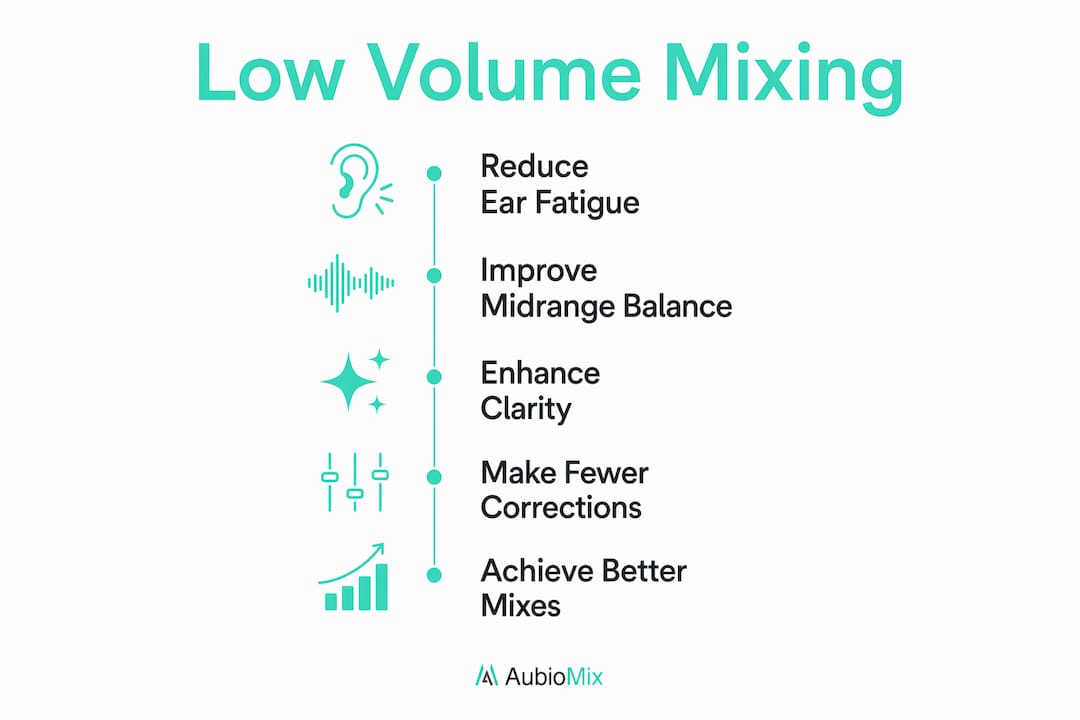
Reduced ear fatigue. Ear fatigue from loud mixing blurs high-frequency perception and leads to poor decisions, such as unnecessary EQ boosts that sound right in the moment but destroy the mix on other systems. Mixing quietly preserves accurate hearing across longer sessions.
-
Clearer balance judgements. Low-volume mixing reveals balance problems that loud listening masks. A vocal buried under guitars, a snare that disappears in the chorus, or a synth pad swamping the midrange all become obvious at lower levels.
-
Better translation across playback systems. Most listeners hear music on phones, earbuds, and laptop speakers, none of which reproduce loud, full-range sound. Mixing at quieter levels naturally aligns your decisions with the conditions your audience actually uses.
-
Long-term hearing health. Lower volumes reduce the risk of auditory damage and support sustained mixing sessions without hearing decline. This is not a minor point. Your ears are your most important tool, and protecting them is a professional responsibility.
-
Avoidance of loudness-induced compensation. When you mix loud, your brain perceives the mix as fuller and more balanced than it actually is. Turning down strips that illusion away and forces you to build genuine balance into the arrangement.
Pro Tip: If you find yourself reaching for a high-shelf boost to add "air" to a mix, check whether you are monitoring too loudly. That dullness you are hearing is often just the equal-loudness effect at work, not a real problem in the mix.
The combination of these advantages means you spend less time second-guessing decisions, make fewer corrective moves, and arrive at a finished mix faster. That is a genuine workflow improvement, not just a comfort preference.
Common misconceptions about low-volume mixing
The biggest misconception is that mixing quietly means you cannot judge your low end. This is partially true, but it misses the point entirely.
- Bass is harder to hear directly at low volumes. This is accurate. Sub-bass frequencies below 60 Hz become almost inaudible at conversation-level SPL. However, the solution is not to turn up. Instead, you evaluate bass through its midrange harmonics and pitch, using saturation or parallel distortion to give bass instruments presence on smaller speakers.
- Low-volume mixing is not the only level you should use. It is the primary reference point for balance decisions, not a replacement for all other monitoring levels. Periodic louder checks are necessary to confirm that your low end has impact and that the mix retains power on larger systems.
- Mixing exclusively quietly creates its own problems. You may under-serve the low end, miss transient impact issues, or misjudge the emotional weight of a section. The goal is a hybrid approach, not a single-level dogma.
Here is a quick comparison of what each monitoring level reveals and where it falls short:
| Monitoring level | What it reveals well | What it hides |
|---|---|---|
| ~60 dB (conversation level) | Midrange balance, vocal clarity, snare presence | Sub-bass power, transient impact |
| ~76 to 79 dB (home studio reference) | General tonal balance, stereo width | Subtle masking issues, ear fatigue risk increases |
| 85 dB and above | Low-end impact, emotional weight, dynamics | Midrange detail, accurate EQ decisions, ear health |
The takeaway is clear. No single monitoring level tells you everything. But the most reliable primary reference for balance decisions is the quieter end of that range, with louder checks used sparingly and purposefully.
How to implement low-volume mixing in your workflow
Putting this into practice requires a few deliberate habits. Here is how to build a reliable low-volume mixing workflow from the ground up.
-
Set a consistent monitoring level and mark it. Choose a reference level, ideally around 60 to 79 dB SPL depending on your room and monitors, and physically mark that position on your monitor controller. Consistency and repeatability are the most critical factors. Your ears need to learn what a balanced mix sounds like at that specific level before the technique becomes reliable.
-
Use conversation-level listening for critical decisions. When you are making balance calls on vocals, snare, guitars, or synth leads, drop to around 60 dB. This is where the midrange is most truthfully represented and where you will catch problems fastest. Think of it as your diagnostic mode.
-
Support bass with harmonics, not just level. At low volumes, sub-bass disappears. Add a touch of saturation or parallel distortion to your bass and kick to give them harmonic content that remains audible on small speakers. Plugins like FabFilter Saturn 2, Soundtoys Decapitator, or even a simple tape saturation emulator work well for this. You can read more about balancing levels effectively to understand how this fits into the broader mix structure.
-
Alternate between low and louder levels deliberately. Do your primary mixing work quietly. Then, every 30 to 45 minutes, push the volume up to your louder reference level for a short check. Listen specifically for low-end impact, transient punch, and emotional weight. Then return to your quiet reference and adjust accordingly.
-
Use reference tracks at the same volume. When comparing your mix to a commercial reference, match the playback level as closely as possible. Louder always sounds better, so a fair comparison requires equal levels. Reference tracks are most useful when they expose real tonal differences rather than just volume gaps.
Pro Tip: Use a free SPL meter app on your phone, such as NIOSH SLM or Decibel X, to measure your actual monitoring level. Most engineers are surprised to discover they are mixing 10 to 15 dB louder than they think.
Building these habits into your mixing session structure takes a few weeks of conscious effort, but the improvement in mix quality and decision speed is noticeable from the very first session.
Key takeaways
Mixing at low volumes is the most reliable method for accurate midrange balance, reduced ear fatigue, and mixes that translate across all playback systems.
| Point | Details |
|---|---|
| Use ~60 dB for critical decisions | Conversation-level listening reveals midrange balance most accurately and reduces ear fatigue. |
| Support bass with harmonics | Add saturation or distortion to bass and kick so they translate on small speakers at low volumes. |
| Mark your monitor level | Consistency is the key factor. Mark your reference position and return to it every session. |
| Alternate monitoring levels | Use quiet levels for balance work and louder checks for low-end impact and emotional weight. |
| Protect your hearing | Lower SPL reduces auditory damage risk and extends the quality of your mixing sessions over time. |
My honest take on mixing quietly
I have worked with a lot of producers who resist turning down because they feel like they are missing something. That feeling is real, but it is also exactly the problem. When the room is loud, the mix feels exciting and full, and it is very easy to convince yourself that everything sounds great. Turn it down and suddenly the vocal is buried, the snare has no presence, and the guitars are fighting everything in the 2 kHz range.
The shift that changed my approach was understanding that equal-loudness contours are not just a textbook concept. They are actively shaping every decision you make at the console or in your DAW. Once I started treating 60 to 70 dB as my primary working level, my mixes started translating on the first listen rather than the fifth revision.
The other thing I would say is that this technique rewards patience. Your ears need time to recalibrate to what "balanced" sounds like at a lower level. The first week feels uncomfortable. By the third week, you will wonder how you ever mixed any other way. The mixes that come out of a disciplined low-volume workflow are cleaner, more defined, and far more consistent across playback systems, from a Bluetooth speaker in a kitchen to studio monitors in a treated room.
— AubioMix
Get objective feedback on your mixes with Aubiomix
Knowing the theory behind low-volume mixing is one thing. Knowing whether your actual mix is balanced, clear, and ready for release is another.
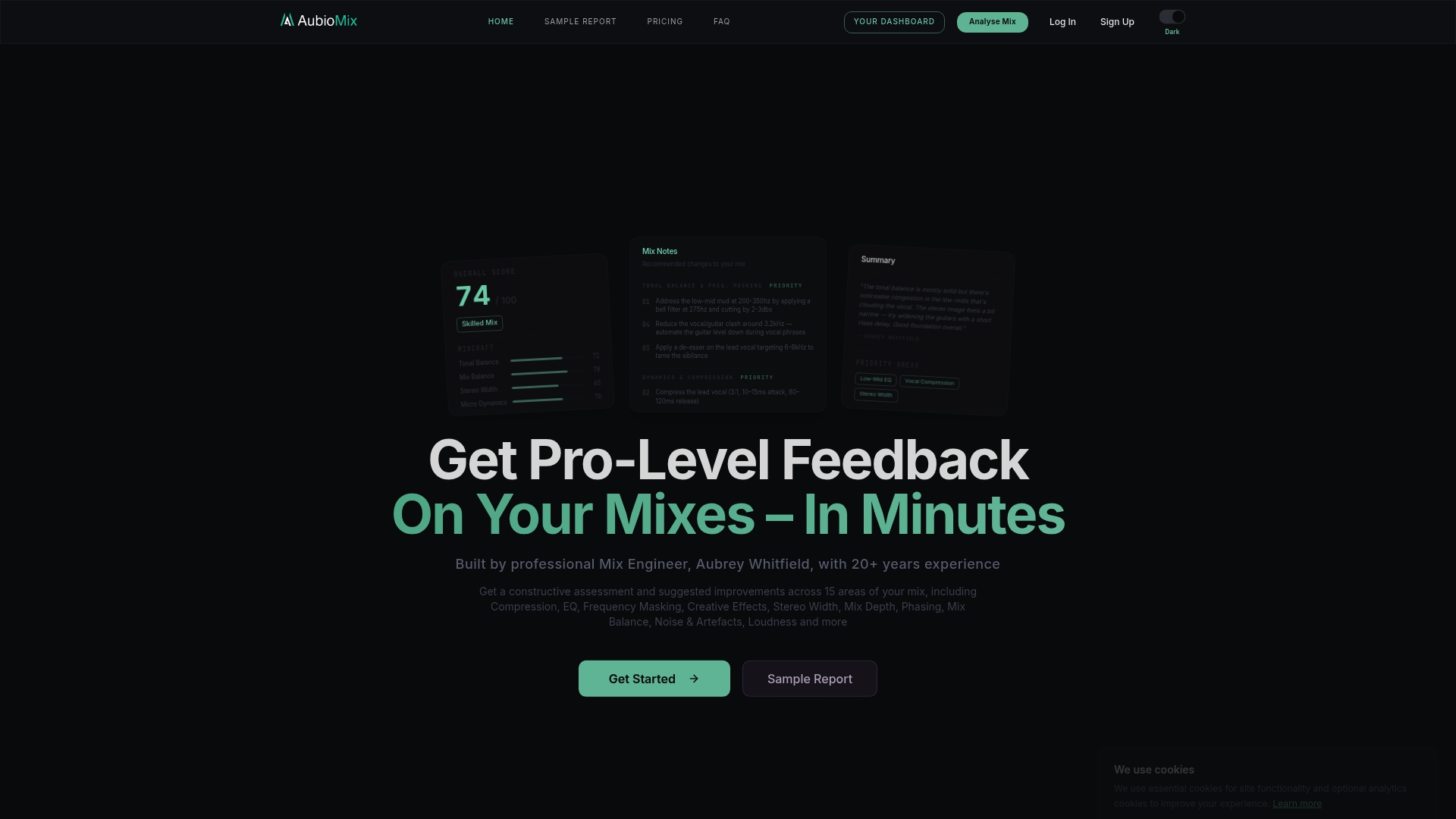
Aubiomix lets you upload your track and receive detailed, pro-level feedback on your mix and master in minutes. The Aubiomix Evaluation Framework assesses your mix across frequency balance, dynamics, clarity, and translation, giving you specific, actionable steps rather than vague suggestions. Whether you want to validate your low-volume mixing decisions or identify what is still off after a long session, Aubiomix gives you a clear, objective second opinion. Upload your mix and find out exactly where it stands.
FAQ
What volume should I mix at?
A practical target for most home studios is between 60 and 79 dB SPL. Use around 60 dB for critical balance decisions and 76 to 79 dB for general mixing work, with occasional louder checks to confirm low-end impact.
Does mixing quietly affect how I hear bass?
Yes. Sub-bass frequencies become harder to hear directly at low volumes due to equal-loudness contours. The solution is to add saturation or harmonic distortion to bass instruments so they remain audible through their midrange harmonics on smaller speakers.
How do I know if I am mixing too loudly?
If you find yourself making frequent high-frequency boosts or your mixes sound dull on other systems after a session, you are likely monitoring too loudly. Use a free SPL meter app to measure your actual level and compare it to your intended reference.
Is low-volume mixing suitable for all genres?
Yes, though the approach adapts slightly. Bass-heavy genres like hip-hop and electronic music require more deliberate harmonic support at low volumes, but the core principle of using quiet levels for midrange balance decisions applies universally across all styles.
Should I ever mix at loud volumes?
Periodic loud checks are a necessary part of a complete workflow. Use them to verify low-end power, transient impact, and emotional weight, but keep them brief to protect your hearing and avoid the compensatory EQ decisions that loud monitoring encourages.