
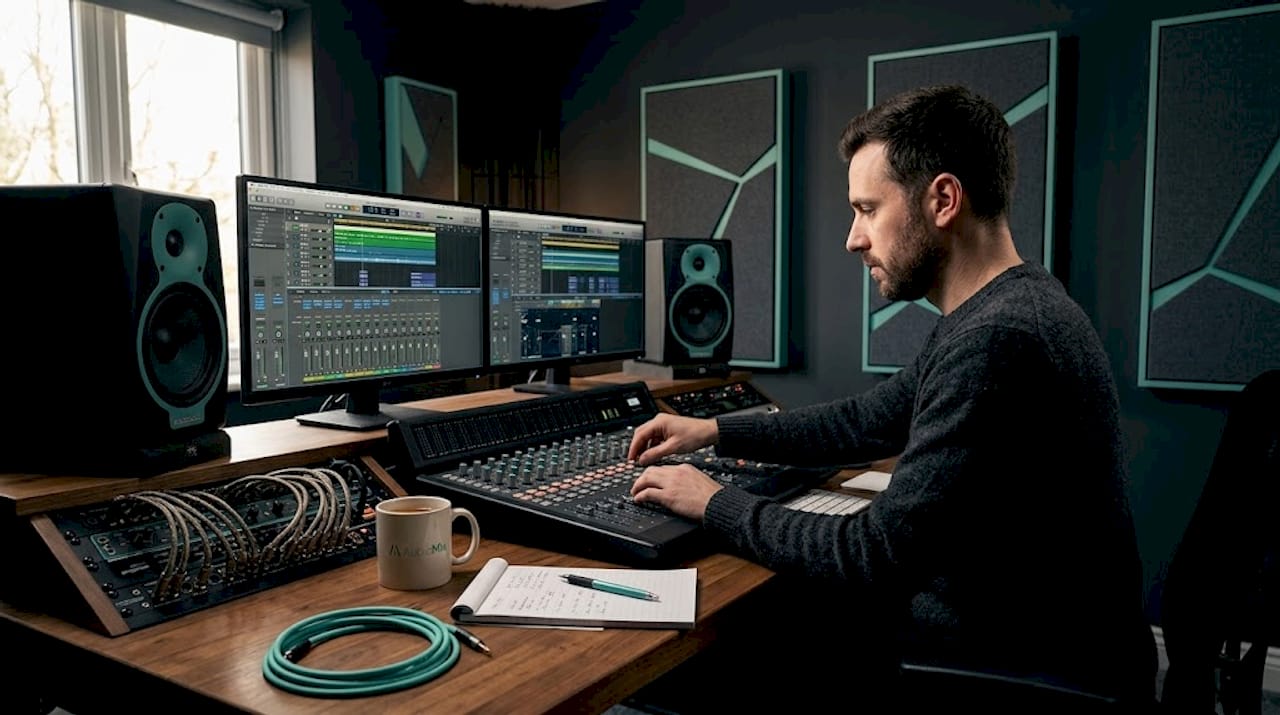
If you've ever searched "what is static mix" and ended up reading about chemical engineering, you're not alone. The term pulls in two very different worlds: industrial fluid mixing devices and informal music production vocabulary. For producers and mix engineers, that confusion is genuinely frustrating, especially when you're trying to understand whether a static mix approach is helping or hurting your tracks. This guide cuts through the noise, explains exactly what each interpretation means, and shows you how understanding the concept can sharpen your mixing workflow from the ground up.
Table of Contents
- Key takeaways
- What a static mixer actually is (and why it's not about music)
- How music mixing actually works
- Static mix decisions: fixed settings versus automation
- Static noise removal: a completely different meaning
- Comparing the three meanings of "static" in audio contexts
- My take on static versus dynamic mixing
- Sharpen your mix with Aubiomix
- FAQ
Key takeaways
| Point | Details |
|---|---|
| Two very different meanings | "Static mix" refers to industrial fluid devices AND informal music production decisions, so context matters enormously. |
| Not a formal audio term | There is no widely accepted definition of "static mix" in professional music production, which causes widespread confusion. |
| Fixed fader decisions | In practice, a static mix means setting faders, pan, and EQ without automation and leaving them unchanged throughout the track. |
| Automation completes the picture | Relying solely on fixed settings risks imbalance across song sections; dynamic automation fills the gaps static decisions leave behind. |
| Static denoising is separate | Static noise removal tools target constant hiss or hum and are entirely unrelated to mixing balance or workflow. |
What a static mixer actually is (and why it's not about music)
Let's start with the original meaning, because it comes up more often in search results than producers expect. A static mixer is an industrial device with no moving parts that blends fluids together using pressure loss and a series of fixed internal elements, typically helical in shape, housed inside a pipe.
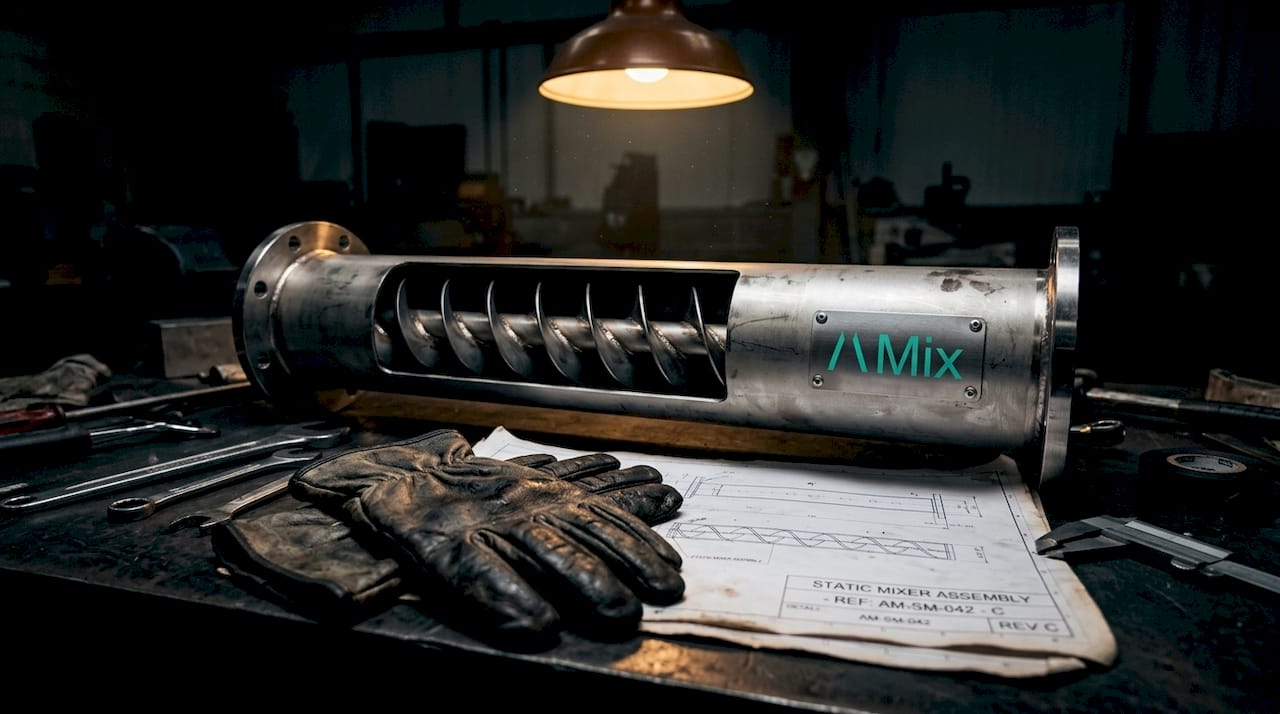
There is no motor, no rotating blade, and no external power source driving the mixing action. Instead, the fluid is pushed through by pressure, and the fixed geometry of the elements forces it to split, rotate, and recombine repeatedly until a uniform mixture is achieved. This process, known as flow division and recombination, works effectively in both laminar and turbulent flow conditions.
Common static mixer applications include:
- Chemical processing: Blending reactive compounds in a controlled, consistent ratio without contamination
- Water treatment: Dosing chemicals like chlorine or pH correctors directly into a water supply line
- Food and beverage production: Homogenising liquids such as sauces, dairy products, or carbonated drinks
- Pharmaceutical manufacturing: Achieving precise compound ratios without introducing mechanical wear or heat
- Polymer and plastics industries: Mixing resins and catalysts before moulding or extrusion
The static mixer design is valued precisely because it produces consistent results with minimal maintenance. There are no parts to lubricate or replace, and the mixing quality depends entirely on the geometry of the elements and the flow rate, not on any external energy source.
Now here is the critical point for producers: this concept has essentially no analogy in audio mixing. Sound does not behave like a fluid under pressure, and the industrial analogy should be approached with real caution when applied to audio workflows, because the mechanisms and goals differ fundamentally. When someone in music production uses the phrase "static mix," they are almost certainly not talking about helical elements in a pipe.
How music mixing actually works
Before we can properly define what "static" means in a production context, we need to be clear on what a standard mix involves. At its core, mixing resolves frequency conflicts, balances sources against one another, and creates a spatial image that feels coherent and intentional to the listener.
A mix engineer handles a remarkable number of variables simultaneously. These typically include:
- Level balancing: Setting the relative volume of every track so that no single element overwhelms or disappears behind the others
- Panning: Placing instruments and vocals across the stereo field to create width, depth, and a sense of physical space
- EQ: Sculpting the tonal character of each track and carving out space so elements don't clash in the same frequency range
- Compression and dynamics processing: Controlling the transient behaviour and sustain of instruments to achieve consistency and punch
- Effects: Adding reverb, delay, chorus, saturation, and other treatments to shape the emotional and spatial character of the mix
What makes mixing genuinely dynamic by nature is automation. A good mix engineer will ride faders, adjust sends, duck effects, and change EQ settings at specific moments throughout the track to serve the song's arrangement. The verse sounds different from the chorus. The bridge breathes differently from the drop. Mixing is, at its heart, a time-based craft.
Interestingly, "static mix" does not appear as a formally defined term in professional audio production literature. It's an informal phrase that producers and engineers use in different ways, which is exactly why searches for it tend to produce confusing or conflicting results.
Static mix decisions: fixed settings versus automation
Here is where the term becomes genuinely useful for producers. In practical mixing vocabulary, a static mix refers to the approach of setting your faders, pan positions, and EQ without automation, leaving those parameters fixed throughout the entire track. Think of it as your mix's starting point or skeleton: the foundational balance you establish before you start sculpting for emotional impact.
Understanding how fixed fader decisions contrast with dynamic automation helps you use both tools more deliberately. Here is a step-by-step way to think about building a static mix before adding automation:
- Rough balance first. Set all your fader levels with no plugins active. Just get the raw balance feeling musical before touching anything else. This is your static foundation.
- Static EQ decisions. Make broad tonal corrections on each track: cut mud, remove harshness, add air. These decisions can often remain fixed for the whole track.
- Static panning. Place your instruments in the stereo field. Lead vocals centre, rhythm guitars spread wide, synth pads somewhere in between. Most panning decisions stay consistent throughout.
- Static compression settings. Apply your compressors for character and control, dialling in attack, release, and ratio for the general feel of each track.
- Review across all sections. Play the whole track from top to bottom. Notice where the static balance breaks down. A chorus that suddenly feels too loud, a verse where the vocal gets buried, a breakdown where the low end becomes overwhelming. These are the moments that automation needs to fix.
The contrast with dynamic automation is stark and important. Static mix decisions cannot adapt to varying song dynamics on their own. A snare that sits perfectly in the verse might feel thin and distant in a dense chorus without a volume automation push. A reverb send that sounds gorgeous on a sparse section might wash everything out when the arrangement thickens.
Pro Tip: Build your static mix at the section of your track that is most densely arranged, usually the main chorus or drop. If your balance works there, it will be far easier to make it work everywhere else with minor automation adjustments.
The risk of relying entirely on a static mix approach is that you end up with a track that sounds acceptable throughout but exceptional nowhere. The real artistry in mixing comes from dynamic contrast, that push and pull between sections that gives a track its emotional arc and sense of movement.
Static noise removal: a completely different meaning
There is a third usage of the word "static" in audio production that confuses matters further, and it is worth understanding clearly so you don't conflate it with mixing decisions or industrial equipment.
Static noise, in audio post-production, refers to constant background interference: the hiss of a tape machine, the hum of a poorly grounded guitar, the air conditioning drone captured by an open microphone during a recording session. Static denoisers are tools specifically designed to target and remove this kind of persistent, steady-state noise while leaving the musical content and natural ambience intact.
Key characteristics of static denoising tools:
- They analyse a noise profile from a section of audio that contains only the unwanted noise, no music or vocals
- They apply frequency-specific attenuation to suppress only those spectral components that match the noise profile
- They are designed to preserve musical transients, stereo character, and spatial information that broad noise reduction can easily damage
"Stationary noise removal must preserve musical transients and stereo character, which broad noise reduction can damage." This is precisely why modern static denoiser tools use targeted, frequency-aware processing rather than applying blanket attenuation across the entire signal.
Tools like Auphonic's Static Denoiser target constant hiss and hum specifically, working to remove interference without pulling the warmth and texture from the recorded sound underneath. This kind of processing is common in podcast production, film audio post, and location recording cleanup.
The point here is simple: static denoising is a recording cleanup process, not a mixing technique. It happens earlier in the signal chain, usually before the mix even begins, and it has nothing to do with fader positions or automation.
Comparing the three meanings of "static" in audio contexts
Given how much ground we've covered, it's worth laying out the three interpretations side by side so you can reference the right one for your work.
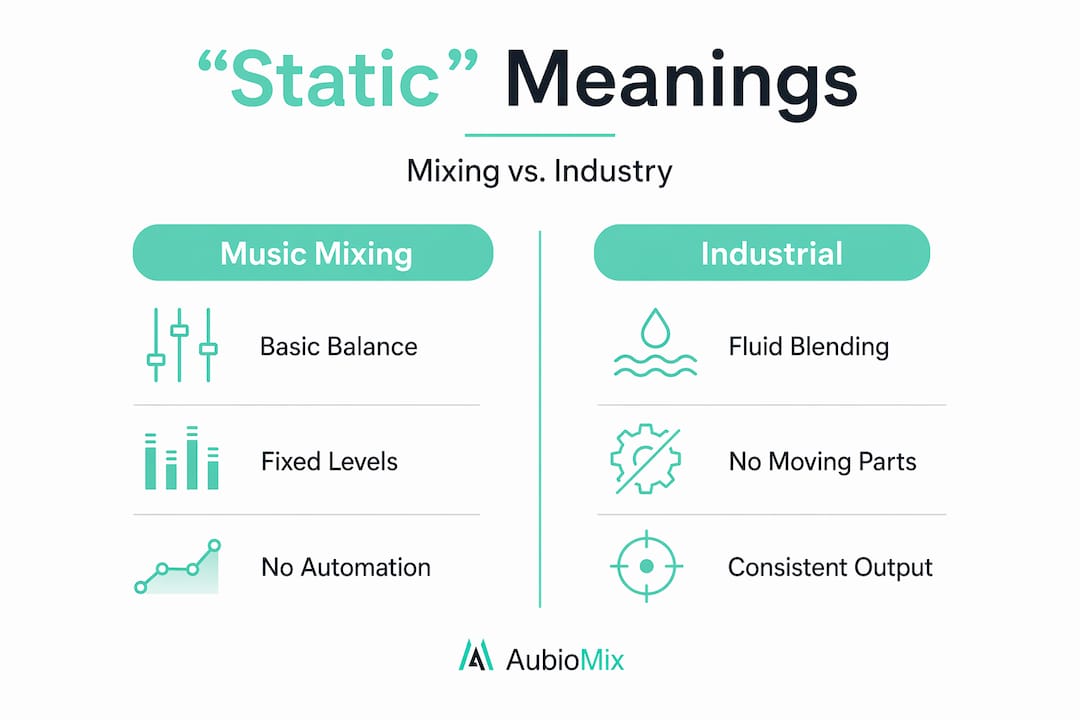
| Context | What "static" means | Typical usage | Key characteristic |
|---|---|---|---|
| Industrial engineering | A device with no moving parts that blends fluids | Chemical, food, and pharmaceutical processing | Passive mixing through fixed internal geometry |
| Music production workflow | Fixed fader, pan, and EQ settings with no automation | Foundational mix balance before automation is applied | Set-and-forget starting point for the mix |
| Audio post-production | Constant background noise targeted for removal | Podcast, film audio, location recording cleanup | Frequency-specific attenuation preserving musical content |
Most searches for "static mix" by music producers are actually looking for the second meaning, fixed mix decisions as opposed to automated ones. The confusion arises because the word "static" carries such different implications depending on which industry or workflow you are working in. Context, as always, is everything.
A quick rule of thumb: if you're building a mix in a DAW and thinking about whether to automate, you're in the second column. If you're cleaning up a field recording with background hiss, you're in the third. If you're designing a chemical plant, you're in the first.
My take on static versus dynamic mixing
I've seen a lot of producers fall into the trap of treating a polished static mix as a finished mix. They get the balance sounding great on a single loop of the chorus, feel satisfied, and export. Then they wonder why the track feels flat and lifeless when played from start to finish.
In my experience, the static mix is the foundation, not the finished structure. You absolutely need it. Without a solid static balance, your automation has nothing to build on, and you end up riding faders to compensate for poor initial decisions rather than to serve the emotional arc of the song. But excessive reliance on static settings without automation leads to masking and loudness competition that fixed settings simply cannot resolve.
What I've found actually works is treating the static mix as your first creative decision and automation as your second. Get the balance right. Then ask yourself what each section of the track needs to feel alive. A louder vocal in the final chorus. A tighter, more present kick in the verse. A reverb tail that blooms on the last note. Those are automation decisions, and they are what separate a technically competent mix from one that genuinely moves people.
The producers who understand level balancing fundamentals deeply tend to build better static mixes because they trust the process. They know where to start and why, which makes the automation stage feel creative rather than corrective.
— AubioMix
Sharpen your mix with Aubiomix
Understanding the difference between static and dynamic mixing decisions is genuinely half the battle. The other half is knowing whether your mix is actually working.

Aubiomix is an online app built for producers and mix engineers who want professional-grade feedback on their mixes without waiting weeks for studio time. Upload your track, and you'll receive detailed, pro-level mix evaluation covering everything from your static balance and tonal decisions to your automation and spatial imaging. The Aubiomix evaluation framework is designed to reflect how professional mixes are assessed in the real world, giving you the clarity to know exactly where your static foundation is solid and where your automation needs to do more work.
FAQ
What is a static mix in music production?
In music production, a static mix refers to the foundational balance of faders, panning, and EQ settings that remain fixed throughout a track without any automation applied. It serves as the starting point before dynamic adjustments are made.
Is "static mix" an official audio production term?
No. "Static mix" is an informal phrase used by producers and engineers. It does not appear as a formally defined term in professional audio production literature, which is why searches for it often return inconsistent or conflicting results.
How does a static mix differ from automation?
A static mix uses fixed settings that do not change over time, while automation adjusts parameters like volume, pan, and effects at specific moments to serve different sections of a track. Both are needed for a professional-sounding result.
What is a static mixer in industrial terms?
An industrial static mixer is a device with no moving parts that blends fluids together using pressure and fixed internal helical elements inside a pipe. It has no meaningful connection to music mixing or audio production.
What is static noise removal in audio?
Static noise removal, or static denoising, is the process of identifying and suppressing constant background interference such as hiss or hum from a recording. It is a post-recording cleanup technique and is entirely separate from mixing balance decisions.