
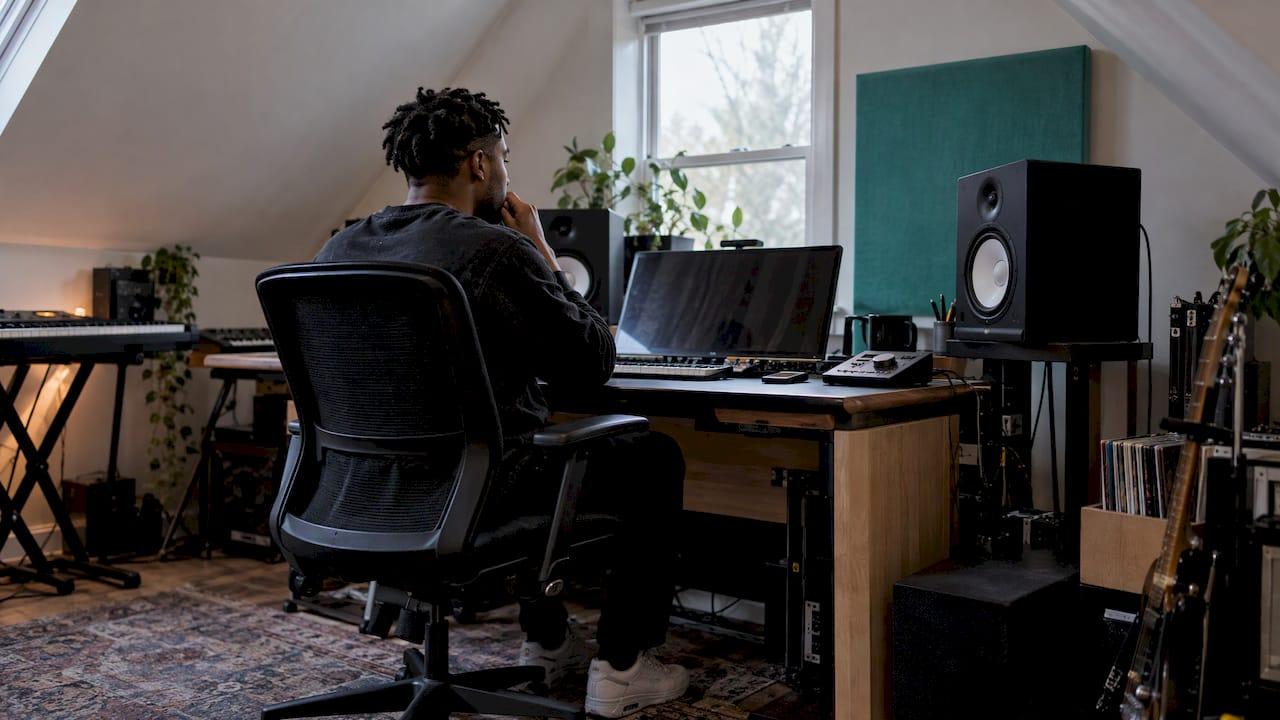
A mix analysis is a structured listen that describes what is happening in a mix: balance, low end, stereo image, dynamics, effects. It does not judge the mix. The best way to learn it is through examples, so below are seven you can run on your own track today, what each one tells you, and where it tends to go wrong. If you want those answers across 15+ areas in one report, we built AubioMix to do exactly that from an uploaded file.
TL;DR
- Mix analysis describes what is in the mix. Critique judges whether it works. You need both, in that order.
- The most useful examples are level-matched A/B against a reference, mid/side listening, frequency-band listening, a mono fold and a multi-system translation check.
- Write findings as specific notes: the problem, the timestamp, a possible fix.
- Change one thing at a time, starting with the loudest elements and the faders.
- An uploaded-file report from AubioMix covers these checks together, with written and visual results you can work through.
Table of Contents
- Mix analysis vs mix critique
- What a mix analysis can actually cover
- Seven mix analysis examples
- Setting up so the analysis is trustworthy
- Turning findings into notes you can act on
- What to change first
- Get all of this in one report
- Our perspective
- FAQ
- Sources
Mix analysis vs mix critique
The two words get swapped constantly, and the difference changes how you work.
In music scholarship, analysis generally describes rather than judges, aiming at objectivity through definable elements, while criticism leans on the critic's intuitive response and experience. Translate that to a mix: "the vocal sits about 4 dB above the snare in the chorus" is analysis. "The vocal feels too far forward for this genre" is critique.
The same source notes the two overlap: criticism is usually analytical in its attention to detail, and analysis carries a position, even if only by implication. In practice you want a loop. Describe first, so you are arguing from facts. Then judge against what the song is trying to do. Then pick a change.
That is why vague notes fail. The Los Angeles Film School's critique framework starts by asking about intent, then describes observations without judgment, then names what works and what gets in the way. It suggests swapping "the mix feels muddy" for something like "the vocal is getting buried by the bass frequencies in the chorus." Same ear, far more useful.

What a mix analysis can actually cover
Before the examples, here is the territory. A thorough review looks at headroom, balance, low end, frequency spectrum, clarity and separation, stereo image, transients, compression and dynamics, vocals, automation, effects, phase and mono compatibility. That is the breakdown in Warren Huart's mix review checklist, which also suggests peaks around -6 dBFS if the mix is going to mastering.
Sound on Sound's Sam Inglis says the most common problem he meets is an unbalanced frequency spectrum, often down to a poor monitoring setup, headphone-only monitoring, or not referencing against good mixes in the genre. Keep that in mind: several of the examples below exist to catch precisely this.
Seven mix analysis examples
Example 1: Level-matched A/B against a reference
What you do: import your mix and a commercial track in the same genre into one DAW project. Match their perceived loudness with the faders, loop a comparable section, and switch between them.
What it reveals: balance and tone differences you would otherwise blame on loudness. Sound on Sound's Mike Senior advises switching instantly between tracks to defeat the ear's adaptation, and matching subjective loudness to defeat loudness bias, since the louder one nearly always sounds better.
Where it goes wrong: comparing at different levels, or listening for minutes at a time. Gearnews suggests comparing short passes with one aspect at a time, applying what you hear, then checking again.
Worked finding: "At the first chorus my low mids (roughly 250 to 500 Hz) are denser than the reference, and my vocal sits lower." That is a description, and it points at two specific moves.
Example 2: Section-by-section energy comparison
What you do: instead of judging the whole song, compare verse to verse and chorus to chorus. Sonarworks' Dashiell Hawkins points out that levels, balance and dynamic range change across an arrangement, and that a chorus usually gains energy. The useful question is how the reference achieves that lift.
What it reveals: whether your chorus is bigger because of level alone, or because of added layers, width, brightness or automation.
Where it goes wrong: flat arrangements mixed to flat levels. If your verse and chorus measure and sound identical, the analysis shows there is no lift to preserve.
Example 3: Mid/side listening
What you do: listen to the Mid and Side signals separately. Audiofanzine's reference-analysis guide explains that the Mid signal reveals the mono mix, useful for hearing the vocal, while the Side signal often holds clues about reverbs and delays.
What it reveals: a famous published example is Mike Senior's note that soloing the Sides of Rihanna's "Umbrella" makes the lead vocal's delay pattern easier to hear. On your own mix, the Side signal shows whether reverb is washing out the edges, or whether anything essential has drifted out of the centre.
Where it goes wrong: wide-sounding sides built on out-of-phase tricks collapse when summed. Our guides on stereo imaging analysis and common mid-side mistakes go through the usual culprits.
Example 4: Listening by frequency band
What you do: put an EQ with steep high-pass and low-pass filters on the master and audition one band at a time. Audiofanzine describes using 48 dB/octave filters for this, for instance to hear where the kick's energy and attack sit relative to the bass.
What it reveals: masking. If the kick's thump and the bass's fullness live in the same slice, you will hear them fight once you isolate it.
Where it goes wrong: treating a reference's curve as a target to copy. Attack Magazine's dance music case studies found reference tracks differing by more than 5 dB at 5 kHz and over 10 dB at 15 kHz, even though all share a gentle overall roll-off. Genre norms are a range, not a line. Our genre benchmarks show measured ranges for exactly this reason.
Example 5: Taking a commercial mix apart
What you do: study a finished record's technique. Mike Senior's published examples include analysing the a cappella sections of Eminem's "Love The Way You Lie" to infer the vocal treatments, and phase-cancelling the first chorus of Kesha's "Tik Tok" against the second to expose hidden synth and vocal details.
What it reveals: what the effects chain and layering are actually doing, not what you assume they do.
Where it goes wrong: copying the trick without the context. You can read how we frame this for released records on pages such as our Mirror by Sigrid mix analysis and Beautiful Things by Benson Boone mix analysis.
Example 6: The mono fold
What you do: sum the master to mono and listen to the vocal, the bass and the lead. Anything that thins out or disappears is a phase or width problem.
What it reveals: whether the stereo image is real or borrowed. A mono check is also part of the routine in Huart's checklist (phase, polarity and mono compatibility sit next to each other).
Where it goes wrong: judging only by ear when a meter would settle it. Our stereo imaging guide pairs three meters with the mono check for that reason.
Example 7: Translation across systems
What you do: play the mix on a phone, earbuds, a car, a laptop and a Bluetooth speaker. SFCOfDance's guide recommends listening in a set order, lead element, low end, midrange, highs, overall shape, and testing on systems including monitors, headphones, earbuds, laptop speakers and cars.
What it reveals: which problems are in the mix and which are in your room. If the bass vanishes on a phone but is fine on monitors, you may need more harmonic content in the low end rather than more sub.
Where it goes wrong: fixing problems on the wrong system. Beat Kitchen's advice is to check alternates, then solve problems on your main monitors. It is also worth confirming your own computer is not colouring the sound: if you audition on a Windows machine, it helps to disable audio enhancements in Windows 11 first. For headphone-heavy workflows, see mixing on headphones so mixes translate.

Setting up so the analysis is trustworthy
Every example above rests on what you hear. SFCOfDance stresses that you cannot hear accurately in a poor monitoring environment, and that volume matters: very loud playback makes bass and treble seem more exciting than they are, while low volume can hide balance problems.
Some habits that keep findings honest:
- Match loudness before comparing anything.
- Loop one short section and listen in short bursts, not for ten minutes.
- Decide what you are listening for before you press play.
- Settle low end and stereo only after hearing at least two playback systems.
Turning findings into notes you can act on
An analysis only helps if it ends in a change. A strong note names the issue, the place and a possible move. Mixvisor's feedback guide gives a format built on timestamps, for example flagging that a snare feels buried under a pad at a specific point and suggesting pulling the pad back a couple of dB. Here is an original example in the same spirit:
| Weak note | Specific note |
|---|---|
| Low end is muddy | 0:45 to 1:15: kick and bass overlap around 80 to 100 Hz. Try a small cut on the bass near 90 Hz or sidechain it from the kick. |
| Vocal is too quiet | Chorus 1 (1:15): lead vocal sits under the double. Raise the lead 1 to 2 dB or automate the double down. |
| Too wide | Mono fold: the pad loses its body. Check the Side signal for out-of-phase widening and narrow it. |
| Harsh | Hi-hats and vocal both peak in the upper mids. Pull the hats back before touching the vocal EQ. |
The figures in the table are illustrations of format, not targets. Your own song and genre decide the right amount.
If you receive feedback from a collaborator, the same logic applies in reverse. SonicScoop's advice for artists is to stop saying the magic is gone and talk about specifics: is the new mix less punchy, full or exciting? That page also suggests asking which reference tracks are being used and what the priorities for the song are.
What to change first
With a list of findings, order matters. EDMProd argues that a mix is 90% in the volume faders, and that it is easiest to start with the loudest sounds and work back. So:
- Balance first. Fix levels and panning before reaching for processors.
- Low end and masking next. These affect everything above them.
- Dynamics and effects after that. Compression and reverb depend on the balance being right.
- Translation last. Re-check across systems and in mono after each major move.
Change one thing, listen again at matched level, and keep going. Beat Kitchen offers a handy stopping rule: a mix is done when it serves the song, when the emotion lands and the balance holds across systems, not when every plugin has been used. It also gives a tell for overprocessing: if the raw faders-only mix sounds more exciting than the processed one, you have gone too far.
If you want a step-by-step on running this yourself, our practical guide to analysing a mix and the upload-first analysis workflow lay it out.
Get all of this in one report
Running seven checks by ear takes time, and your ears fatigue. With AubioMix you upload an audio file and get detailed feedback with specific, actionable steps across 15+ areas of mixing and mastering, including compression, EQ, frequency masking, effects, stereo width, phase, loudness, noise and clipping, mastering prep and device translation. Reports come as visual and written results, with progress tracking, leaderboard comparison and downloadable PDF reports.
A single Mix Review costs £4.99, and a Reference Pass is £2.99. If you mix regularly, the Professional plan is £19.99 per month and Professional + is £34.99 per month, both with a fixed number of mix reviews.

Upload your next mix at aubiomix.com and work through the findings in order, balance first.
Our perspective
Analysis and critique are two halves of one habit. Analysis tells you what is there, critique tells you whether it serves the song, and a mix improves when you keep them apart long enough to trust each.
We built AubioMix around that idea. Our platform combines audio intelligence analysis with the practical experience of our founder, a multi-award winning mix engineer with 20+ years in the job. Every report gives both subjective guidance and objective measurement, so you get a measured fact and a musical suggestion side by side.
Our evaluation framework is regularly updated to reflect current genre standards, because a good low end for deep house is not a good low end for boom bap. That is why we publish genre benchmarks and analyses of released records: so you judge your mix against its own world, not a generic target.
The goal is never to match a reference exactly. It is to know precisely where your mix sits, what to change first, and when to stop.
AubioMix
FAQ
What is an example of a mix analysis?
A simple one: level-match your mix against a commercial track in the same genre, loop the chorus, and note the differences in low mids, vocal level and width. Write each as a specific observation with a timestamp. That list is your analysis, and it tells you what to test first.
What is the difference between mix analysis and mix critique?
Analysis describes what is in the mix using facts you can hear or measure. Critique judges whether those facts serve the song. Do the analysis first, so your critique is based on evidence rather than a general feeling.
How do I write a useful mix critique workflow?
Ask what the song is trying to achieve, describe what you hear without judging, name what works, name what gets in the way, then suggest a direction. Add timestamps and a possible fix, such as a small cut at a given frequency or a level change of a couple of dB.
Should I try to make my mix match a reference exactly?
No. A reference has different source recordings, arrangement decisions and a different engineer in a different room. Listen for qualities such as low-end balance, vocal level, width, brightness and dynamic range, and use them as a guide for your own choices.
How many playback systems should I check?
At least two before you decide anything about low end or stereo width. A phone, earbuds, a car and a mono fold cover the systems that most often break a mix. Fix what you find on your main monitors.
Sources
- Analysis, Grove Music Online (Bent Pople)
- How to Give a Critique That Actually Helps, The Los Angeles Film School
- Mix Review Checklist: The Basics, Produce Like A Pro
- 10 Essential Mix Checks, Sound on Sound
- Listen & Learn: Analysing Commercial Mixes, Sound on Sound
- Reference Track guide, Gearnews
- How To Use Reference Tracks To Improve Your Mixes, Sonarworks
- Get the Best Mix by Analyzing References, Audiofanzine
- How To Mix Dance Music: Five Case Studies, Attack Magazine
- How to Listen Critically to a Mix, SFCOfDance
- Referencing & Assessment, Beat Kitchen
- Curing Demoitis and Preserving the Magic, SonicScoop
- How To Analyze Music Using The 5-Point Technique, EDMProd
- How to Disable Audio Enhancements in Windows 11