
A custom mix in professional audio terms is a paid online mix-analysis service: you upload a stereo mix or stems, and receive a detailed diagnostic report covering measurable metrics such as LUFS, True Peak, and LRA, alongside timestamped notes and specific fix recommendations. Upload your mix to Aubiomix and your first analysis is ready in minutes.
Key takeaways
A custom mix analysis gives you measurable, timestamped, track-specific feedback across loudness, phase, frequency balance, and dynamics — the fastest way to close the gap between your current mix and a release-ready one.
| Point | Details |
|---|---|
| Upload with headroom | Export at –6 dBFS or lower so True Peak reads accurately before mastering. |
| Include a reference track | A same-genre commercial reference helps the report identify frequency imbalances specific to your mix. |
| Fix in order | Tackle arrangement and masking first, then loudness, then spatial/phase issues last. |
| Re-run after fixes | A second analysis confirms improvements rather than leaving you relying on ear fatigue. |
| Aubiomix for UK producers | Covers 15+ mix areas with timestamped comments, PDF reports, and both credit and subscription options. |
Table of Contents
- What does a custom mix analysis actually check?
- When should you get a mix review?
- How to prepare your files for the cleanest review
- What does the delivered report look like?
- How does pricing work for a mix-analysis service?
- How to turn a report into concrete mix fixes
- Sample report walkthrough: before and after
- How to choose the right mix-analysis service
- Why structured feedback beats guessing
- Aubiomix: upload your mix and get a professional report today
- Sources
What does a custom mix analysis actually check?
A thorough mix-analysis report covers more ground than most producers expect. DropCue's AI mix analysis describes a typical feature set that includes loudness, true peak, clipping, stereo field, mono compatibility, and a tonal balance read against genre references, with AI recommendations that name issues and suggest concrete fixes.
Metric definitions worth knowing:
LUFS (Loudness Units Full Scale) measures perceived loudness over time. Streaming platforms such as Spotify and Apple Music normalise to targets around –14 LUFS integrated, so knowing your number before mastering matters. True Peak measures the actual peak level of the waveform after digital-to-analogue conversion. Keeping True Peak below –1 dBTP prevents inter-sample clipping on streaming codecs. LRA (Loudness Range) describes dynamic variation across a track. A high LRA can signal an inconsistent mix; a very low one can indicate over-compression.
Aubiomix covers 15+ areas across a single upload, including:
- Loudness (integrated LUFS, short-term LUFS)
- True Peak and clipping detection
- Dynamic range and LRA
- Frequency balance and masking
- Stereo width, phase coherence, and mono compatibility
- Vocal level and presence
- Noise floor
- Metadata and mastering readiness
Reports arrive as visual graphs, annotated waveforms with timestamped comments, written recommendations, and a downloadable PDF. HOFA-College tutors, who have analysed thousands of student mixes, consistently flag muddy low end, harsh mid-high frequencies, and poor mono compatibility as the most common recurring flaws — exactly the areas a structured analysis catches before your track reaches a mastering engineer.
When should you get a mix review?
The best moment is when your rough mix is stable but mastering hasn't started. At that point, a review saves real time: structural problems are still cheap to fix, and you haven't committed to a master that will need to be redone.
Getting a review at the early-draft stage helps you confirm arrangement decisions, spot frequency masking between elements, and set a clear direction before you've spent hours fine-tuning. Near the pre-master stage, the focus shifts to loudness targets, translation across playback systems, and final stereo balance.
Pro Tip: One thing reviewers catch that producers often miss: an arrangement problem disguised as a mix problem. If your low end sounds muddy no matter how much you EQ it, the issue may be too many elements occupying the same frequency range simultaneously. A timestamped report can pinpoint exactly where that happens in the timeline, which is far more useful than a general note about "bass clarity."
A practical timeline: run an analysis on your first stable draft, implement structural fixes, then run a second analysis on your near-final mix before sending to mastering. Two reviews per track is a sensible habit for producers releasing regularly.
How to prepare your files for the cleanest review
Good preparation means the reviewer spends time on your music, not on decoding your session. Here's what to get right before you upload:
- Format: WAV or AIFF, 24-bit minimum, at your session's native sample rate (44.1 kHz or 48 kHz are both fine)
- Stereo mix: export with at least –6 dBFS of headroom so the analysis can read true peak accurately without hitting the ceiling
- Stems: if uploading stems, group logically (drums bus, bass bus, synths bus, vocals bus) and export at the same settings as your stereo mix
- File naming: use descriptive names —
TrackName_StereoMix_v3.wav, notExport_Final_FINAL2.wav - Session notes: include tempo, key, genre, and the specific element you want prioritised (e.g. "the low-mid build at 2:14 feels congested")
- Reference track: attach a commercial reference from the same genre; comparing against a reference helps identify over- or under-emphasis in frequency ranges
Timestamped waveform comments centralise feedback, visualise problem clusters, and make collaborative revisions faster and less error-prone — so if you have specific problem zones, note the timestamps in your session notes. The reviewer can then anchor their comments to the exact moments you've flagged.
Pro Tip: Include a short paragraph of context: what the track is for (sync, streaming release, DJ set), who the intended listener is, and what you've already tried. That context shapes the recommendations and stops the report from suggesting fixes you've already ruled out.
What does the delivered report look like?
A well-structured report opens with an at-a-glance summary: your integrated LUFS reading, True Peak value, LRA, and an overall mix-readiness score. From there it breaks into sections covering stereo width and phase correlation, frequency balance curve against a genre reference, and a clipping or noise-floor flag if either is present.
The most useful part for most producers is the timestamped comments layer. When timestamped feedback is integrated into the listening workflow, vague impressions become precise directions attached to exact moments in the track, which cuts revision cycles significantly. A comment at 1:42 that reads "kick and bass are phase-cancelling here — try flipping the bass polarity" is immediately actionable. "The low end needs work" is not.
Pro Tip: A good report is read-only: it diagnoses, it doesn't alter your file. Treat it as a second set of expert ears, not an automated fix. The decisions still belong to you.
Deliverables you should expect from a professional service:
- Downloadable PDF report with metric readouts and written recommendations
- Annotated waveform or timestamped comment log
- Frequency balance graph
- Stereo/phase correlation readout
- Follow-up review option once fixes are applied
Turnaround varies by service tier. Standard analysis typically completes within 3–7 working days; express options are faster. Some professional services offer single analyses from around €25 (approximately £21 at current rates), with turnaround in that standard 3–7 day window.
How does pricing work for a mix-analysis service?
Most services offer two models: pay-as-you-go credit packs and monthly or annual subscriptions.
| Pay-as-you-go credits | Monthly/annual subscription | |
|---|---|---|
| Best for | Occasional uploads, one-off projects | Regular uploaders, active release schedules |
| Cost per review | Higher per unit | Lower per unit at volume |
| Commitment | None | Monthly or annual |
| Extras | Express turnaround often available as add-on | Revisions and re-analyses often included |
Credit packs suit producers finishing one or two tracks a month. A subscription makes more sense once you're uploading four or more mixes per month, because the per-review cost drops and re-analysis after fixes is typically included. Aubiomix offers both models, so you can start with a single credit and move to a subscription once the workflow clicks.
How to turn a report into concrete mix fixes
Follow a short, ordered workflow: tackle structural and arrangement issues first, then loudness and tonal balance, then spatial and phase problems last. Trying to fix phase issues before you've sorted a cluttered arrangement is working in the wrong order.
- Triage the report — read all timestamped comments before touching a fader. Group issues by category: arrangement/frequency masking, level/loudness, spatial/phase.
- Fix structural issues first — if the report flags frequency masking between kick and bass, address that before worrying about overall LUFS. Heavy EQ or compression on a structural problem rarely solves it.
- Address loudness and tonal balance — once the arrangement is clean, bring your integrated LUFS to the target range and check your True Peak ceiling.
- Resolve spatial and phase issues — widen or narrow the stereo field, check mono compatibility, and fix any phase-cancellation flagged in the report.
- Re-run the analysis — upload the revised mix and verify the metrics have moved in the right direction. A second analysis confirms fixes rather than leaving you guessing.
Use mix feedback best practices to organise your revision notes so collaborators can follow your changes.
Pro Tip: If you find yourself reaching for heavy compression or a multiband limiter to fix a problem the report flagged, pause. Heavy, constant processing often signals a structural issue — too many layers, a poorly arranged low end — rather than a technical one. Strip back before you add more.
Sample report walkthrough: before and after
Here's a realistic scenario showing how a report maps to measurable improvement.

The problem: A producer uploads a dense electronic track. The report flags integrated loudness at –9.2 LUFS (too loud for streaming normalisation), True Peak at +0.3 dBTP (clipping on codec conversion), and a stereo correlation reading of 0.41 (phase issues narrowing the low end in mono).
Recommendations applied: Pull the master limiter ceiling to –1 dBTP, reduce the limiter's input gain to bring integrated LUFS to –13.8, and flip the polarity on the sub-bass layer to improve mono correlation.
The workflow from report to revised mix: receive PDF → read timestamped comments → triage by category → apply fixes in order → export revised mix → re-upload for verification.
How to choose the right mix-analysis service
A quick checklist before you commit:
- Depth of metrics: does the service cover LUFS, True Peak, LRA, stereo/phase, and frequency balance as a minimum?
- Sample reports: can you view a real example report before buying? Structured reports with priorities and action items reduce time wasted on non-essential tweaks.
- Reviewer credentials: is the feedback from experienced mix engineers or genre specialists?
- Turnaround SLA: is the standard window clearly stated, with an express option if you need it?
- Genre experience: does the service understand the specific demands of your genre (electronic, hip-hop, rock, etc.)?
For UK producers wanting fast, professional reports with timestamped comments and downloadable PDFs, Aubiomix is a strong starting point. Check what to look for in a mix-analysis service before you decide.
Red flags to avoid:
- Vague feedback with no timestamps or metric readings
- No sample report available to review before purchase
- Unclear deliverables or hidden revision costs
- Feedback that reads like generic advice rather than track-specific notes
Why structured feedback beats guessing
We've seen producers spend weeks in revision loops chasing a feeling they can't name. The mix sounds "off" but they can't say where, so they reach for more compression, more saturation, more processing — and the problem stays. Structured, timestamped analysis breaks that cycle. When a report tells you the stereo correlation drops to 0.41 at 1:42 and the kick and bass are phase-cancelling, you have a specific problem with a specific location and a testable fix.
Measurable outcomes follow: fewer revision rounds, clearer briefs for collaborators, and a mix that arrives at mastering in genuinely better shape. The producers we see getting the most from analysis are the ones who treat it as a repeatable part of their workflow, not a one-off rescue.
Aubiomix: upload your mix and get a professional report today
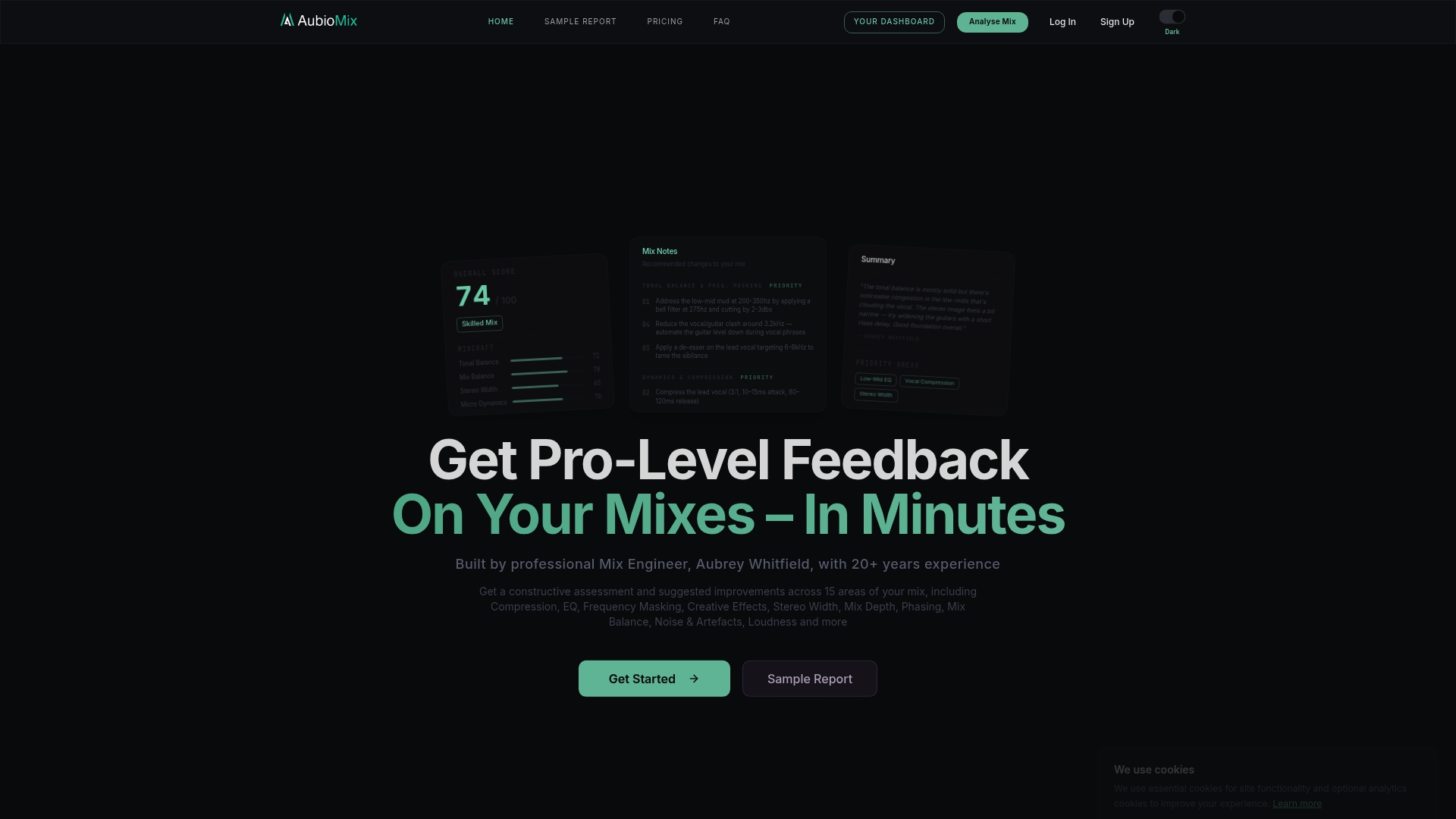
Aubiomix is built for UK producers and mix engineers who want professional, specific feedback without waiting days for a reply. Upload a stereo mix or stems, and your report covers 15+ areas including LUFS, True Peak, LRA, stereo width, phase coherence, frequency masking, and more — delivered as a visual report, timestamped comment log, and downloadable PDF.
Progress tracking and a leaderboard let you measure improvement across releases, not just track by track. Credit packs mean no long-term commitment to get started; a subscription drops the per-review cost once you're uploading regularly.
Start your first mix analysis or explore the audio metrics glossary to get familiar with LUFS, True Peak, and LRA before you upload.
Sources
- 5 Biggest Mixing Mistakes And How To Avoid Them!
- Timestamped Audio Comments: Why They Matter for Mix Feedback | Feedtracks Blog
- Professional mixing feedback: Mix analysis with report from €25
- Timestamped Music Feedback: Stop Vague Revisions | DropCue