

If you need a quicker, more technical alternative to RoastYourMix, here are several options worth your time as a UK producer:
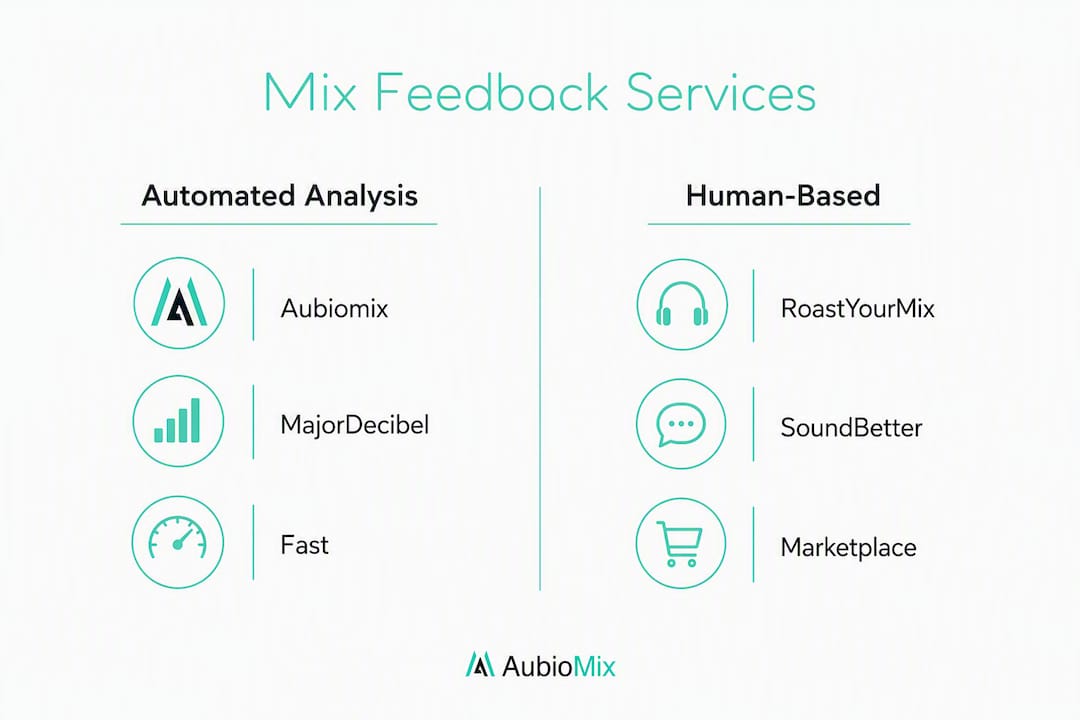
Aubiomix is the strongest pick for iterative pre-master analysis, covering multiple technical areas including frequency masking, phase correlation, loudness, and device translation, with downloadable PDF reports and progress tracking. SoundBetter suits engineers who want human critique from a vetted professional, though turnaround runs days rather than minutes. MajorDecibel focuses on loudness and dynamics checks for producers who need a quick pre-master sanity check. RoastYourMix itself remains a useful community-style feedback service, though its depth of automated diagnostics is limited compared to dedicated analysis platforms.
All four services accept standard WAV and MP3 files. Aubiomix and MajorDecibel work in GBP and are accessible to UK producers without currency conversion friction. SoundBetter prices in USD.

Table of Contents
- How do these RoastYourMix.com alternatives compare at a glance?
- What does each service actually do, and where does it fall short?
- What does mix feedback actually cost for UK producers?
- Which option fits your workflow?
- How do you choose a mix-feedback service without wasting money?
- Why Aubiomix is the recommended alternative for UK producers
- Why automated mix analysis matters more than ever
- Key takeaways
- The honest case for getting your mix diagnosed before mastering
- Get started with Aubiomix today
- Useful sources and further reading
How do these RoastYourMix.com alternatives compare at a glance?
| Service | Best for | Feedback type | Analysis depth | Pricing model | Turnaround | File types | UK suitability |
|---|---|---|---|---|---|---|---|
| Aubiomix | Iterative pre-master analysis | AI report | Masking, phase, LUFS, dynamics, device translation, 15+ areas | Credit packs / subscription | Instant | WAV, MP3, AIFF | GBP, VAT-compliant |
| RoastYourMix | Community-style feedback | Human critique | Balance, loudness, general mix notes | Per-submission | Days | WAV, MP3 | USD |
| SoundBetter | Hiring a mix engineer or getting pro critique | Human marketplace | Depends on engineer hired | Per-project / hourly | Days to weeks | WAV, stems | USD, international |
| MajorDecibel | Quick loudness and dynamics check | AI analysis | Loudness, dynamic range, basic spectrum | Free tier / per-track | Instant | WAV, MP3 | GBP-accessible |
Aubiomix at a glance:
- Covers masking detection, phase, per-track loudness, LUFS, stereo width, noise, clipping, and more
- Downloadable PDF reports and progress tracking across sessions
- Credit packs suit occasional users; subscriptions suit producers iterating weekly
RoastYourMix at a glance:
- Honest, plain-spoken human feedback with a community feel
- No automated per-track diagnostics or masking maps
- Turnaround depends on reviewer availability
SoundBetter at a glance:
- Access to professional mix engineers for full mix critiques or remixes
- Costs vary widely; no standardised diagnostic report format
- Not designed for rapid iteration before mastering
MajorDecibel at a glance:
- Good for a final loudness sanity check before export
- Limited to loudness and dynamics; no masking or phase diagnostics
- Free tier available with basic metering
UK producers should note that USD-priced services add a small currency conversion cost via most UK bank cards. Aubiomix invoices in GBP and is VAT-compliant for UK business users.
What does each service actually do, and where does it fall short?
Understanding the practical difference between these three categories, instant AI analysis, human marketplace critique, and automated mastering checks, saves you from buying the wrong tool for the job.
Aubiomix: deep automated analysis built for iteration
Aubiomix analyses your uploaded mix across various technical dimensions. Upload a WAV or MP3 and within seconds you receive a written and visual report covering frequency masking in specific mid and low frequency ranges, phase correlation, per-track loudness, dynamic range, stereo width, noise floor, clipping, compression behaviour, EQ balance, and device translation (how your mix translates on earbuds, laptop speakers, and club systems). The PDF export means you can annotate it, share it with a collaborator, or file it as a reference point before mastering.
What it doesn't do: it won't rewrite your arrangement or tell you a melody is weak. The feedback is technical and diagnostic, not creative. That's the point.
RoastYourMix: honest human ears, slower cycle
RoastYourMix connects you with human reviewers who listen and give plain-spoken feedback. The community ethos is genuine, and the notes on balance and loudness are often blunt in a useful way. The limitation is structural: most mix failures stem from masking and balance issues that a human listener describes subjectively ("the low-mids feel thick") rather than diagnosing precisely ("250Hz build-up is masking your snare attack"). You also wait days, which breaks any rapid iteration loop.
SoundBetter: a marketplace, not a diagnostic tool
SoundBetter is a platform for hiring mix engineers, not a feedback service in the traditional sense. The quality of critique depends entirely on which engineer you engage. There's no standardised report, no masking map, and no phase correlation score. For a full mix revision or stem-level rework, it's a legitimate route. For quick pre-master diagnostics, it's the wrong category of tool entirely.
MajorDecibel: loudness checks, nothing deeper
MajorDecibel handles loudness and dynamic range well. It's a useful final check before you export for streaming, confirming your integrated LUFS sits within Spotify or Apple Music targets. AI mastering services often raise loudness without diagnosing fundamental mixing issues such as frequency masking or phase problems, and MajorDecibel falls into a similar gap: it tells you the mix is loud enough, but not whether the low-end is masking your kick or your stereo field has phase cancellation. Use it as a complement, not a replacement, for deeper analysis.
What does mix feedback actually cost for UK producers?
Pricing shapes which tool fits your workflow. Here's how the options break down:
| Service | Free tier | Per-track cost | Subscription | Credit packs | VAT / invoicing |
|---|---|---|---|---|---|
| Aubiomix | Trial available | Credit-based | Monthly / annual | Yes | GBP, VAT invoices |
| RoastYourMix | Limited | Per-submission | Not listed publicly | No | USD |
| SoundBetter | Free to browse | Project-based (varies widely) | No | No | USD, international |
| MajorDecibel | Yes (basic metering) | Low per-track fee | Not listed publicly | No | GBP-accessible |
Budgeting for iterative feedback vs a single pre-master review:
- If you're iterating rapidly (two or three passes before mastering), a credit pack or subscription from Aubiomix is more cost-effective than paying per-submission on a human-review platform.
- A single final pre-master check from MajorDecibel's free tier costs nothing and takes seconds, making it a sensible last step before export.
- SoundBetter costs scale quickly for full mix critiques; budget at least £80–£200 per session depending on the engineer, and that's before currency conversion from USD.
- Most UK producers working on multiple tracks per month will find a subscription model cheaper than per-track fees once they're running multiple analyses monthly.
Practical notes for UK users: Aubiomix accepts standard UK payment methods and issues GBP invoices, which matters if you're claiming studio costs against tax. USD-priced services don't provide UK VAT receipts, which can complicate bookkeeping for sole traders and limited companies alike. File size limits vary by service; WAV files at 24-bit/44.1kHz are accepted across all four platforms listed here.
Which option fits your workflow?
Solo electronic producer iterating rapidly before mastering: Aubiomix is the natural fit. Upload your rough mix, get an instant report flagging low-end build-up or 250–500Hz masking, fix the issue in your DAW, and re-upload. Automated analysis that detects low-end build-up, frequency masking and per-track loudness lets you run two or three short iterations in an afternoon rather than waiting days for a human reviewer. Export as WAV at 24-bit for best results.
Band or live-room recording with phase concerns: Phase issues between close-mic and room-mic combinations, or between kick and bass DI, need a tool that actually measures phase correlation rather than describing the mix as "a bit muddy." Aubiomix's phase diagnostics flag these precisely. RoastYourMix's human reviewers may notice the symptom; they won't give you a phase correlation score.
Mix engineer preparing stems for a mastering session: Run a full-mix analysis in Aubiomix before handing off to your mastering engineer. The PDF report gives the mastering engineer a technical brief: where the masking sits, what the dynamic range looks like, and how the mix translates on small speakers. That's a professional handoff, not just a bounce.
Producers on a tight budget: Start with MajorDecibel's free tier for loudness checks, then invest in Aubiomix credits for the deeper masking and phase diagnostics that actually determine whether your mix is ready. Per-track loudness and masking detection are the practical metrics engineers want to confirm a mix is mastering-ready.
UK studio workflows typically export at WAV 24-bit/44.1kHz or 48kHz. All four services handle these formats. For VAT invoicing and GBP payment, Aubiomix is the only option in this shortlist that covers both.
How do you choose a mix-feedback service without wasting money?
Run through this checklist before you commit to any platform:
- Does it provide per-track loudness and masking diagnostics? If the answer is no, it's a loudness tool, not a mix analysis tool. Advanced mix analysis platforms include heuristics for per-track loudness, dynamic range assessment and masking detection — that's the baseline you should expect.
- What's the turnaround? If you're iterating before mastering, "days" is too slow. Instant AI analysis fits a same-session workflow; human critique fits a longer revision cycle.
- Does the pricing model match your output volume? Per-track fees suit occasional users; subscriptions suit producers running four or more analyses per month.
- Can you see a sample report before buying? Any credible service should show you what the output looks like. If the sample report is just a loudness meter and a single paragraph, it won't give you the diagnostic depth you need.
- Does it issue GBP invoices and accept UK payment methods? For UK sole traders and studios, this affects your bookkeeping and VAT reclaim.
Key questions to ask before buying: Does the report include a masking map or frequency-specific masking notes? Does it flag phase correlation issues? Does it break down per-track loudness rather than just integrated LUFS for the full mix?
Red flags: No per-track analysis. No masking or phase diagnostics. Pricing that's opaque until after sign-up. No sample report available. No refund or credit policy stated.
Why Aubiomix is the recommended alternative for UK producers
Aubiomix covers the technical ground that most audio mixing platforms skip. The analysis spans compression behaviour, EQ balance, frequency masking (with specific range identification), phase correlation, stereo width, per-track loudness, LUFS, noise floor, clipping, effects usage, and device translation across earbuds, laptop speakers, and larger playback systems. The written report pairs with visual displays so you can see exactly where the masking sits in the frequency spectrum, not just read that "the low-mids are busy."
The pricing model is built for iteration. Credit packs let you pay as you go if you're working on a single project; monthly and annual subscriptions suit producers who are constantly moving tracks through the mix-to-master pipeline. Both options issue GBP invoices, which is a practical advantage for UK producers managing studio expenses.
The progress tracking feature is genuinely useful: upload the same track across multiple sessions and Aubiomix shows you how the mix has improved across each analysis. The leaderboard comparison adds a useful benchmark against other mixes on the platform.
Pro Tip: Upload your mix at the loudest it sounds good before limiting. Running the analysis pre-limiter gives Aubiomix the clearest picture of your dynamic range and masking, so the diagnostics reflect your actual mix decisions rather than the limiter's gain reduction.
Why automated mix analysis matters more than ever
The shift towards browser-native and AI-native tools is changing how producers work. Browser multitrack editors let producers drop stems into a timeline and edit or bounce projects without installing a DAW, reducing setup friction and making it easier to test mix decisions quickly. AI-native DAWs and tools are being adopted by producers who want to avoid plugin-management issues and speed up decision cycles, and mix analysis fits naturally into that faster, lighter workflow.
The deeper reason this matters: most amateur mix failures stem from balance and masking rather than lack of mastering. Sending a mix with unresolved 300Hz build-up or phase cancellation between kick and bass to a mastering engineer doesn't fix the problem; it just makes it louder. Producers commonly confuse mixing with mastering, and mastering cannot reliably fix masking or phase issues. Catching these problems before the mastering session saves money, saves time, and produces a better result.
The practical workflow that works: run analysis, fix one technical issue (masking or low-end build-up), re-analyse. Two or three short iterations in a single session consistently outperform waiting days for a single human review. One-click mix analysis implementations that offer per-track loudness, masking detection, spectrum and dynamics meters alongside exportable reports make this loop fast enough to complete in a working afternoon.
The case for automated analysis in one sentence: a mastering engineer can't fix what they can't see, and neither can you without the right diagnostics.
Key takeaways
Aubiomix is the strongest RoastYourMix.com alternative for UK producers who need instant, technically deep mix feedback across masking, phase, LUFS, and device translation before mastering.
| Point | Details |
|---|---|
| Choose by diagnostic depth | Any credible mix-feedback service should provide masking detection, phase correlation, and per-track loudness, not just integrated LUFS. |
| Iteration beats single review | Two or three rapid analysis-and-fix cycles in one session outperform waiting days for a single human critique. |
| Budget for your output volume | Credit packs suit occasional users; a subscription becomes cost-effective above four or five analyses per month. |
| UK practicalities matter | GBP invoicing and VAT receipts are only available from Aubiomix in this shortlist, which matters for UK sole traders and studios. |
| Aubiomix as the recommended pick | Aubiomix covers numerous technical areas with instant AI reports, PDF exports, and progress tracking, making it the most complete option for pre-master iteration. |
The honest case for getting your mix diagnosed before mastering
There's a tendency in the production community to treat mastering as the fix-all final step, the moment a professional makes everything right. We've seen this assumption cost producers real money: a mastering session that reveals a 300Hz build-up masking the snare, or a phase cancellation between kick and bass that the engineer can't resolve without sending the mix back. Those are mixing problems, not mastering problems, and no amount of limiting or EQ at the mastering stage reliably solves them.
The tools in this shortlist exist precisely to catch those issues earlier. The ones that do it well, with actual masking maps, phase correlation scores, and per-track loudness breakdowns, give you the diagnostic language to fix problems yourself before they become expensive. The ones that don't, the loudness-only checkers and the general-impression human reviewers, are useful in their own right but shouldn't be confused with a proper pre-master diagnostic.
If we're being direct: the question isn't whether you need mix feedback. It's whether the feedback you're getting is specific enough to act on. "The low-mids feel thick" is a starting point. "250–500Hz is masking your vocal and snare attack" is a fix.
Get started with Aubiomix today
If you've been relying on RoastYourMix or similar services and want faster, more technically precise feedback, Aubiomix gives you instant diagnostics across 15+ mix areas, including the masking and phase checks that most audio mixing platforms skip entirely.
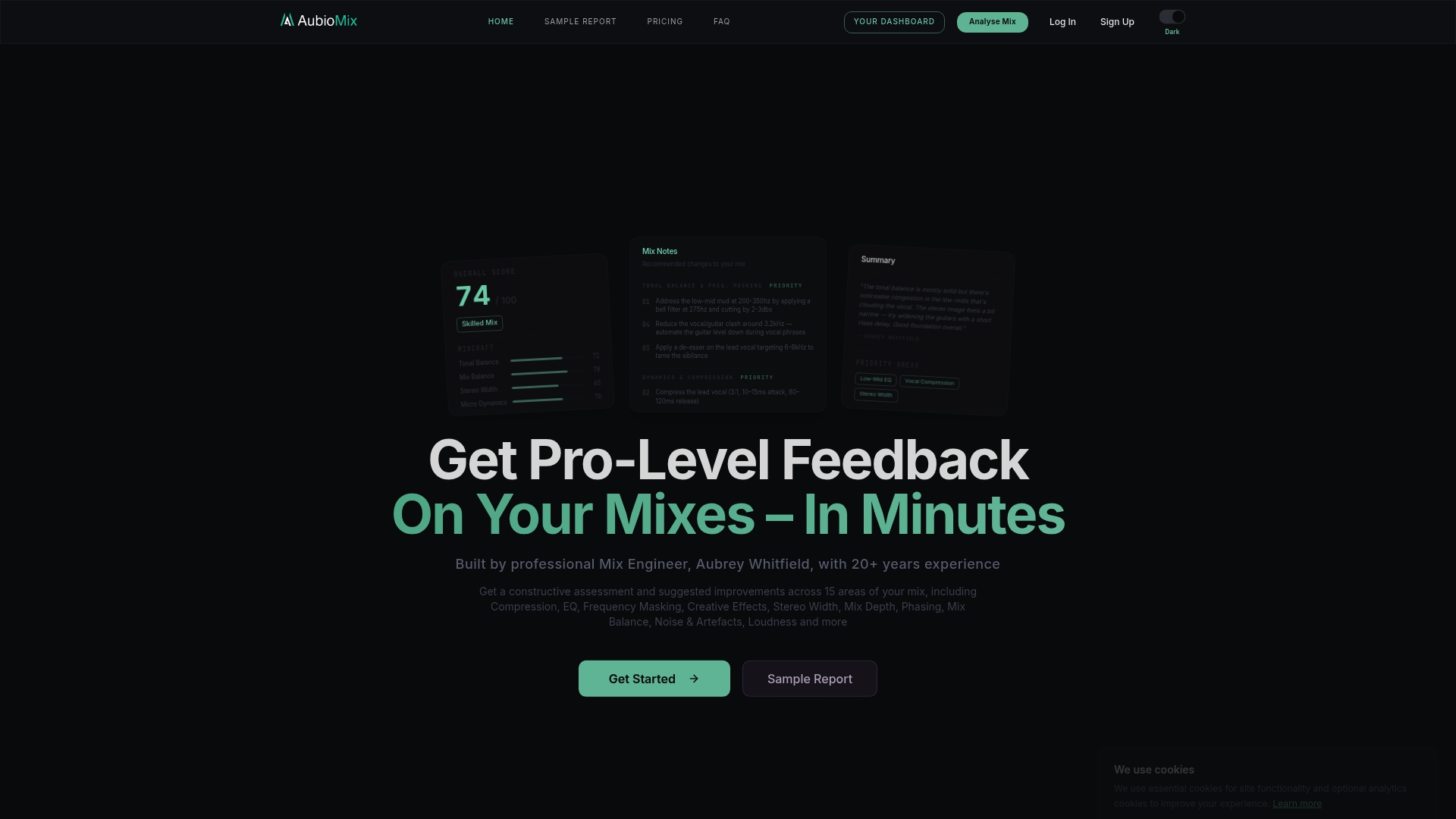
Getting started takes minutes. Upload a WAV or MP3 of your mix (pre-limiter for the most accurate diagnostics), and your report is ready instantly. Credit packs let you pay per analysis with no commitment; monthly and annual subscriptions suit producers running regular mix sessions. All plans invoice in GBP with VAT receipts for UK users.
Try Aubiomix now and see exactly what your mix needs before it goes to mastering. No plugins to install, no waiting for a reviewer, just clear, specific feedback you can act on today.
Useful sources and further reading
The research and reference sources below informed this article. They're worth bookmarking if you want to go deeper on mix analysis methodology, iterative workflows, and the technical metrics that separate a mastering-ready mix from one that needs more work.
- RoastYourMix Alternatives and Competitors — SaaSHub: a regularly updated listing of services in the mix-feedback category, useful for tracking which platforms focus on mastering, human critique, or instant AI diagnostics.
- MadeByVolt project notes on RoastYourMix: practitioner notes on what automated mix analysis should detect and why mastering can't substitute for proper mix diagnostics.
- MAGDA — AI-assisted music production: covers the heuristics behind per-track loudness, masking detection, and dynamic range metrics in modern AI analysis tools.
- dhun.io — AI DAW for Music Creators: context on the shift towards AI-native and browser-native production tools and what that means for iteration speed.
- Soundverse Multi-Track Editor: demonstrates how browser-based stem editing reduces setup friction for producers testing mix decisions without a full DAW.
- Frequency masking: a mix engineer's practical guide: Aubiomix's own deep-dive on masking detection, with practical fixes for the most common problem ranges.
- Electronic music mixing best practices: 2026 guide: export settings, iterative workflow advice, and technical best practices for electronic producers.
- The mix engineer workflow: a producer's guide: high-level workflow guidance to pair with your choice of mix-feedback service.