

Audio saturation is defined as a form of controlled, non-linear harmonic distortion that adds even and odd harmonics to a signal, increasing perceived loudness and warmth without raising peak levels. It is the process that gives analogue tape, valve amplifiers, and transformers their characteristic richness, and it is the single most misunderstood tool in a mix engineer's signal chain. Used well, saturation makes a digital mix feel alive. Used carelessly, it turns a clean recording into a brittle, fatiguing mess. This guide covers the types, the harmonic science, and the practical techniques you need to use it properly.
What is saturation in audio mixing?
Saturation is the addition of harmonic overtones to an audio signal through non-linear processing. Specifically, it introduces 2nd, 4th, and higher even harmonics alongside 3rd, 5th, and higher odd harmonics, increasing mix depth without changing the peak level. That distinction matters enormously. You get a louder, denser sound on playback without triggering a limiter or pushing your mix bus into the red. Think of it as adding colour to a photograph without increasing its exposure. The signal gains richness and presence, not volume.
The analogue world gave us saturation by accident. Tape machines, valve preamps, and transformer-coupled gear all introduced gentle harmonic distortion as a natural byproduct of their circuitry. Engineers noticed that recordings through this equipment sounded warmer and more cohesive than those that bypassed it. Digital audio, being mathematically perfect, produces none of this colouration on its own. Saturation plugins and hardware units recreate those analogue characteristics deliberately, giving you the same sonic benefits inside a fully digital session.
What types of saturation exist and how do they sound?
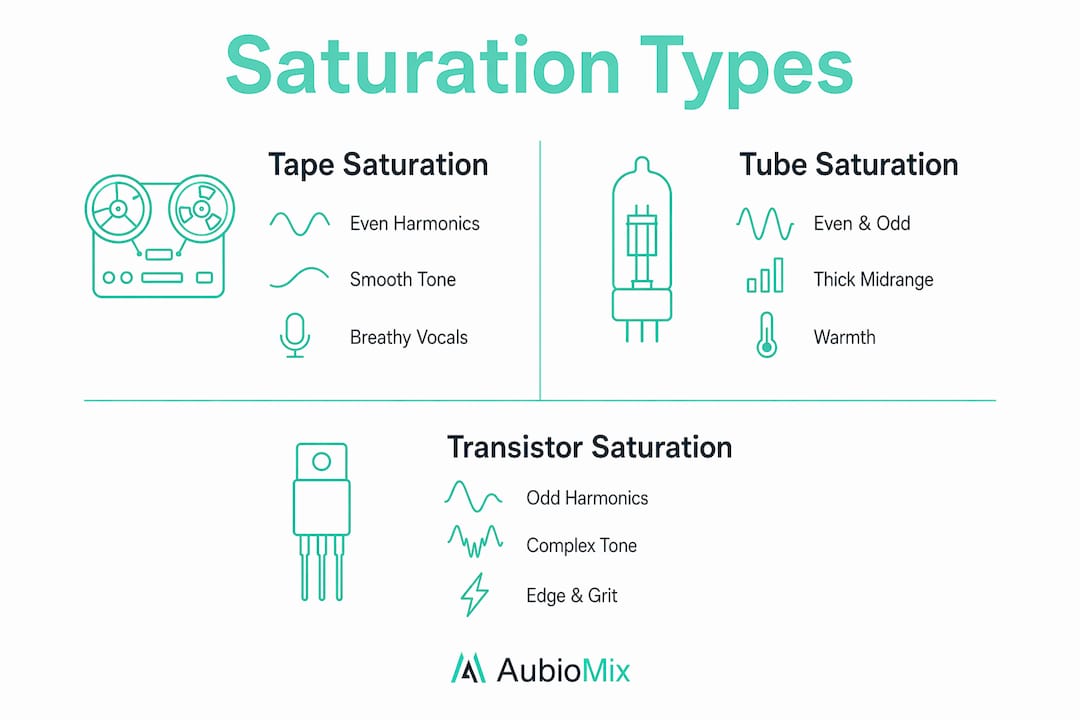
The three main categories of saturation are tape, tube (valve), and transistor. Each has a distinct harmonic profile and a different character in the mix.
Tape saturation is the gentlest of the three. It emphasises even-order harmonics, which relate to octave intervals and sit naturally within the harmonic series. The result is a smooth, gluing effect with a subtle high-frequency roll-off that tames harshness without dulling the mix. Tape is the go-to choice for mix bus processing precisely because it unifies elements without drawing attention to itself.
Tube saturation produces a richer blend of even and odd harmonics. The midrange thickens noticeably, which is why tube processing is so effective on vocals and bass. The harmonic complexity adds body and presence without the aggression you get from transistor circuits. If tape saturation is a light glaze, tube saturation is a warm coat.
Transistor saturation leans heavily on odd-order harmonics, which relate to more complex intervals like perfect fifths and major thirds. Those intervals sit further from the fundamental and create a harder, edgier character. Transistor saturation suits aggressive sound design, distorted guitars, and electronic music elements where you want grit rather than warmth.
| Saturation type | Dominant harmonics | Tonal character | Best application |
|---|---|---|---|
| Tape | Even-order (2nd, 4th) | Warm, smooth, cohesive | Mix bus, full drum bus |
| Tube | Even and odd mixed | Thick, rich midrange | Vocals, bass, acoustic instruments |
| Transistor | Odd-order (3rd, 5th) | Edgy, aggressive, gritty | Synths, distorted elements, sound design |
Pro Tip: Match the saturation type to the harmonic content of the source. A clean, breathy vocal benefits from tube warmth. A sub-heavy bass patch benefits from tape's gentle even harmonics. A lead synth that needs to cut through benefits from transistor grit.
How does harmonic distortion shape mix perception?
The musical consonance of even-order harmonics is the core reason tape and tube saturation sound pleasing rather than harsh. Even harmonics double the fundamental frequency, sitting in natural octave relationships that the ear accepts as part of the original tone. Odd harmonics, by contrast, create intervals that sit further from the fundamental, which the ear reads as tension. A small amount of that tension adds excitement. Too much creates fatigue.
Saturation is also dynamic in its behaviour. Louder transients produce richer harmonics, while quieter passages remain relatively clean. This is what separates musical saturation from static distortion. A snare hit gets a burst of harmonic density at its attack, then settles back. A sustained pad gets a gentle, consistent warmth. That dynamic response is what makes saturation feel organic rather than processed.
There is an important distinction between two types of saturation effect:
- Timbral saturation enhances the feel and character of an instrument. It makes a guitar sound warmer, a vocal sound more present, a piano sound more three-dimensional. The listener does not hear distortion. They hear a better-sounding instrument.
- Translational saturation improves how a mix translates to limited-range playback devices. Adding even harmonics to a sub-bass note, for example, creates audible upper harmonics that small speakers can reproduce. The listener hears the bass even when their speaker cannot physically move enough air to reproduce the fundamental.
Misuse of saturation produces inharmonic distortion and intermodulation artefacts. Intermodulation occurs when two frequencies combine inside a saturator and produce sum and difference tones that are not musically related to either source. The result is a muddy, undefined low end and a harsh, grating top end. Saturation is not just distortion. It is controlled, musical non-linear processing. The moment it stops being controlled, it stops being musical.
Pro Tip: If your mix sounds harsh after adding saturation, check for intermodulation in the low-mid range. High-pass the saturator's input at around 80–100 Hz and listen again. Removing the sub frequencies from the saturation circuit often resolves the problem immediately.
What are best practices for applying saturation in mixing?
Practical saturation technique comes down to four principles: frequency awareness, placement, gain-matching, and restraint.
-
Apply saturation in a frequency-dependent way. Uniform saturation across the full spectrum causes intermodulation distortion and aliasing. Apply more drive in the midrange, where harmonic addition is most musical, and reduce drive in the bass and high frequencies. This preserves low-end clarity and avoids adding noise to the air band.
-
Place saturation early in the signal chain. Saturation before EQ alters the frequency balance of the signal, which changes the EQ decisions you make afterwards. If you EQ first and saturate second, you may find yourself reaching for EQ again to correct the harmonic changes the saturator introduced. Saturate first, then shape the result with EQ and compression.
-
Use the gain-matched bypass test. If saturation is audible when bypassed, the level is too high. Match the output level of the saturated signal to the dry signal before making any judgement. Saturation adds perceived loudness, and the louder signal always sounds better to the ear. A fair comparison requires equal levels.
-
Keep total harmonic distortion subtle. Effective saturation typically generates 0.1–0.5% total harmonic distortion (THD). At that level, the effect is felt as cohesion and warmth rather than heard as distortion. Above that range, artefacts become audible and the mix loses clarity.
Mix bus saturation deserves special attention. When all elements of a mix pass through the same harmonic processing, they share a harmonic fingerprint that binds them together. Drums, bass, guitars, and vocals all pick up the same subtle colouration, which makes the mix feel like a single, unified performance rather than a collection of separate tracks. This is the glue effect that engineers talk about. It is not compression. It is shared harmonic identity.
Saturation and audio compression are often confused because both affect dynamics and perceived loudness. They are fundamentally different processes. Compression controls dynamic range by reducing the level of loud signals. Saturation adds harmonic content without changing the dynamic range. You can use them together, but they solve different problems.
What tools and techniques give you precise saturation control?
Modern saturation plugins have moved well beyond simple drive and output controls. The most capable units offer multi-band processing, dynamic response, and spectral-aware algorithms that give you surgical control over where and how harmonics are added.
Multi-band saturation is the most significant development in plugin design for this purpose. FabFilter Saturn 2 is a well-known example, offering independent frequency bands with separate distortion styles and modulation options per band. You can apply tape saturation to the low-mids, tube saturation to the upper-mids, and leave the bass and high frequencies clean. That level of control was previously only achievable with a rack of separate hardware units.
Dynamic saturation responds to the transient level of the incoming signal. Loud transients trigger heavier harmonic generation; quiet passages receive less processing. This mirrors the behaviour of real analogue hardware and produces a more natural, musical result than static saturation at a fixed drive level.
Spectral-aware algorithms analyse the frequency content of the signal before applying distortion, reducing the risk of intermodulation between closely spaced frequencies. This is particularly useful on complex, dense mixes where multiple instruments occupy the same frequency range.
| Plugin feature | What it does | Best use case |
|---|---|---|
| Multi-band drive | Independent saturation per frequency band | Full mix bus, drum bus |
| Dynamic response | Harmonic generation follows transient level | Vocals, acoustic instruments |
| Spectral-aware processing | Reduces intermodulation between close frequencies | Dense, complex arrangements |
| Distortion style selection | Choose tape, tube, or transistor per band | Matching character to source |
| Modulation options | LFO or envelope control of drive amount | Sound design, movement |
Pro Tip: When using multi-band saturation on a mix bus, start with all bands at zero drive and bring each one up individually while listening to the full mix. You will hear exactly where harmonic addition helps and where it creates problems, rather than guessing at a global setting.
For producers working in electronic music, frequency-selective saturation techniques are particularly critical because synthesised sounds often have very precise harmonic content that can be disrupted by poorly applied distortion. Matching the saturation type to the synthesis method, subtractive, FM, or wavetable, produces far more musical results than applying a single character across the board.
Key takeaways
Saturation is the most powerful tonal tool in mixing when applied with frequency awareness, correct placement, and restraint at 0.1–0.5% THD.
| Point | Details |
|---|---|
| Saturation adds harmonics, not volume | Even and odd harmonics increase perceived density without raising peak levels. |
| Match type to source | Use tape for mix bus cohesion, tube for vocals and bass, transistor for aggressive elements. |
| Frequency-dependent application | Apply more drive in the midrange and less in the bass and highs to avoid intermodulation. |
| Place saturation before EQ | Saturating first informs better EQ decisions and avoids double-processing artefacts. |
| Use the bypass test | If saturation is audible when bypassed at matched gain, the drive level is too high. |
Saturation and the art of restraint: my honest view
The biggest mistake I see from mix engineers, at every level, is treating saturation as a loudness tool. They push the drive until the meter moves and the track sounds bigger in the room. Then they wonder why the mix falls apart on headphones or small speakers. Saturation is not a loudness tool. It is a tonal tool. The moment you start using it to make things louder, you have lost the plot.
What I find genuinely exciting about saturation in 2026 is how far the digital emulations have come. The dynamic response of modern plugins is indistinguishable from hardware in many contexts. But that fidelity also means the mistakes are more convincing. You can now apply beautifully emulated intermodulation distortion at scale, and it will sound exactly as bad as the real thing.
The approach I keep coming back to is thinking of saturation like a carpenter thinks about glue. Apply it at the joints, not over the whole surface. Saturate the mix bus to bind elements together. Saturate individual instruments to enhance their character. Do not saturate everything at maximum drive and hope it coheres. It will not. Restraint is not timidity. It is craft.
The producers I admire most use saturation to give their mixes a harmonic identity. Every element passes through the same character, and the mix sounds like it was recorded in the same room on the same day. That is the goal. Not loudness. Not distortion. Shared harmonic identity.
— Aubiomix
Get pro-level feedback on your saturation decisions
Knowing the theory is one thing. Hearing how your saturation choices actually affect your mix is another.

Aubiomix lets you upload your track and receive detailed, pro-level mix feedback within minutes. The evaluation covers harmonic balance, tonal cohesion, and the specific areas where saturation is helping or hurting your mix. If you want to know whether your mix bus saturation is creating glue or creating mud, Aubiomix gives you a clear, specific answer. You can also review the full evaluation framework to understand exactly how harmonic content and mix cohesion are assessed. Upload your mix and find out where you actually stand.
FAQ
What is saturation in music production?
Saturation is a form of controlled harmonic distortion that adds even and odd harmonics to an audio signal, increasing perceived warmth and density without raising peak levels. It simulates the natural colouration of analogue tape, valve amplifiers, and transformer-coupled hardware.
What is the difference between tape and tube saturation?
Tape saturation emphasises even-order harmonics for a smooth, cohesive sound, while tube saturation produces a richer blend of even and odd harmonics that thickens the midrange. Tape suits mix bus processing; tube suits vocals and bass.
How much saturation is too much?
Effective saturation typically operates at 0.1–0.5% total harmonic distortion. If the effect is clearly audible when you bypass the plugin at a gain-matched level, the drive is too high and artefacts are likely present.
Where should saturation sit in the signal chain?
Saturation works best early in the processing chain, before EQ and compression. Applying it first means your subsequent EQ decisions account for the harmonic content the saturator has introduced, producing more accurate and musical results.
What is mix bus saturation?
Mix bus saturation applies a shared harmonic fingerprint to all elements of a mix simultaneously, creating a unified, glued sound. It works because every instrument picks up the same subtle colouration, making the mix feel like a single, cohesive performance.