
If you have ever wondered why your DAW mix sounds slightly flat compared to tracks produced on a large-format console, a summing mixer might be the piece of the puzzle you are missing. What is a summing mixer, exactly? At its core, it is a hardware device that takes multiple audio stems from your DAW and combines them into a final stereo output using analogue circuitry, adding a sonic character that purely digital summing simply cannot replicate. This guide covers how summing mixers work, what they sound like, how they compare to your audio interface, and how to integrate one into your studio.
Table of Contents
- Key takeaways
- What is a summing mixer and how does it work?
- The sonic benefits of analogue summing
- Summing mixer vs audio interface and digital summing
- Summing mixer setup guide for DAW-based studios
- Choosing the right summing mixer
- My honest take on summing mixers
- Take your mix evaluation further with Aubiomix
- FAQ
Key takeaways
| Point | Details |
|---|---|
| Dedicated hardware device | A summing mixer combines DAW stems into a stereo mix using analogue circuitry, not DAW algorithms. |
| Analogue character and warmth | Transformers and op-amps introduce harmonic coloration and spatial depth that digital summing lacks. |
| Distinct from audio interfaces | Summing mixers focus purely on analogue summation, not I/O conversion or level management. |
| Gain staging is critical | Consistent input gain across all stems is required to hear the true effect of your summing mixer. |
| Workflow integration matters | Treating the summing mixer as your last mixing stage encourages better stem discipline and commit decisions. |
What is a summing mixer and how does it work?
A summing mixer is an outboard device that combines multiple DAW stems into a single stereo output using analogue circuitry. You route your DAW's multiple outputs, typically organised as stems such as drums, bass, synths, and vocals, into the summing mixer's inputs. The unit adds those signals together in the analogue domain and delivers a stereo sum back to your audio interface for recording or monitoring.
The engine inside most summing mixers is the op-amp virtual earth summing amplifier. In this design, the inverting input acts as virtual ground, which means each input channel sums linearly and independently without interacting with the others. That stability is what makes analogue summing so consistent and controllable at scale.
Compare that with what happens when you hit the master fader in your DAW. Digital summing uses binary algorithms that combine tracks mathematically, which is clean and precise, but lacks the subtle harmonic variations that analogue circuits naturally produce. Those variations are not flaws; they are the texture that gives analogue mixes their character.
Here is a quick overview of the core components involved:
- Inputs: accepts multiple line-level signals from your DAW outputs (typically 8 to 32 channels)
- Summing bus: the analogue signal path where all inputs are combined
- Op-amps or transformers: the circuitry that imparts tonal character during summation
- Master output: the stereo sum, sent back to your interface for capture
Pro Tip: Route your DAW's stems at unity gain before they hit the summing mixer. Any fader automation or level balancing should happen inside the DAW before the signal leaves it, so you are feeding the summing mixer a properly balanced mix to work with.
The sonic benefits of analogue summing
This is where summing mixers earn their reputation. The benefits go well beyond simply moving the sum from software to hardware. Running tracks through analogue transformers and op-amps imparts subtle tonal coloration, giving more depth and cohesion to mixes in a way that feels organic rather than processed.
There are several specific sonic qualities you can expect:
- Harmonic saturation: transformers and op-amps introduce even-order harmonic distortion, adding warmth and body to otherwise thin-sounding digital tracks
- Improved headroom behaviour: analogue circuits compress and saturate in a way that feels musical and natural, especially on transient-heavy material like drums
- Stereo imaging: many engineers report a wider, more three-dimensional spatial separation when summing in the analogue domain, with individual elements feeling more distinctly placed in the mix
- Glue and cohesion: the subtle, shared saturation of an analogue bus pulls disparate elements together in a way that feels like they were recorded in the same room
"Summing mixers give hybrid studios the sonic hallmarks of classic analogue consoles without the size or cost." — Vintage King
It is worth noting that these benefits are not dramatic. A well-executed digital mix through a quality DAW is already excellent. What analogue summing offers is a refinement, an added dimension of richness and depth that matters most on professional-grade projects where that last 10% of sonic quality makes a real difference.
Pro Tip: Gain staging is everything here. If your input levels are inconsistent across stems, you are not hearing the summing mixer do its job. You are hearing level differences. Nail your stem gain structure before drawing any conclusions about the unit's character.
Summing mixer vs audio interface and digital summing
This is where terminology trips a lot of people up, so let us be clear about the distinctions.
| Device | Primary function | Includes summing? | Analogue character? |
|---|---|---|---|
| Audio interface | AD/DA conversion, I/O management | Sometimes (basic) | Minimal |
| Line mixer | Level and pan control of multiple sources | Yes, basic | Minimal |
| Summing mixer | Dedicated analogue summation of stems | Yes, specialised | Yes, intentional |
| Large-format console | Full mixing, routing, and processing | Yes, premium | Strong |
The key distinction in the summing mixer vs audio interface debate is purpose. An audio interface is designed for conversion quality and I/O flexibility. Some interfaces include a basic summing stage, but it is incidental to their core job. A summing mixer, by contrast, keeps summing as its primary purpose and everything in its circuit design serves that goal.
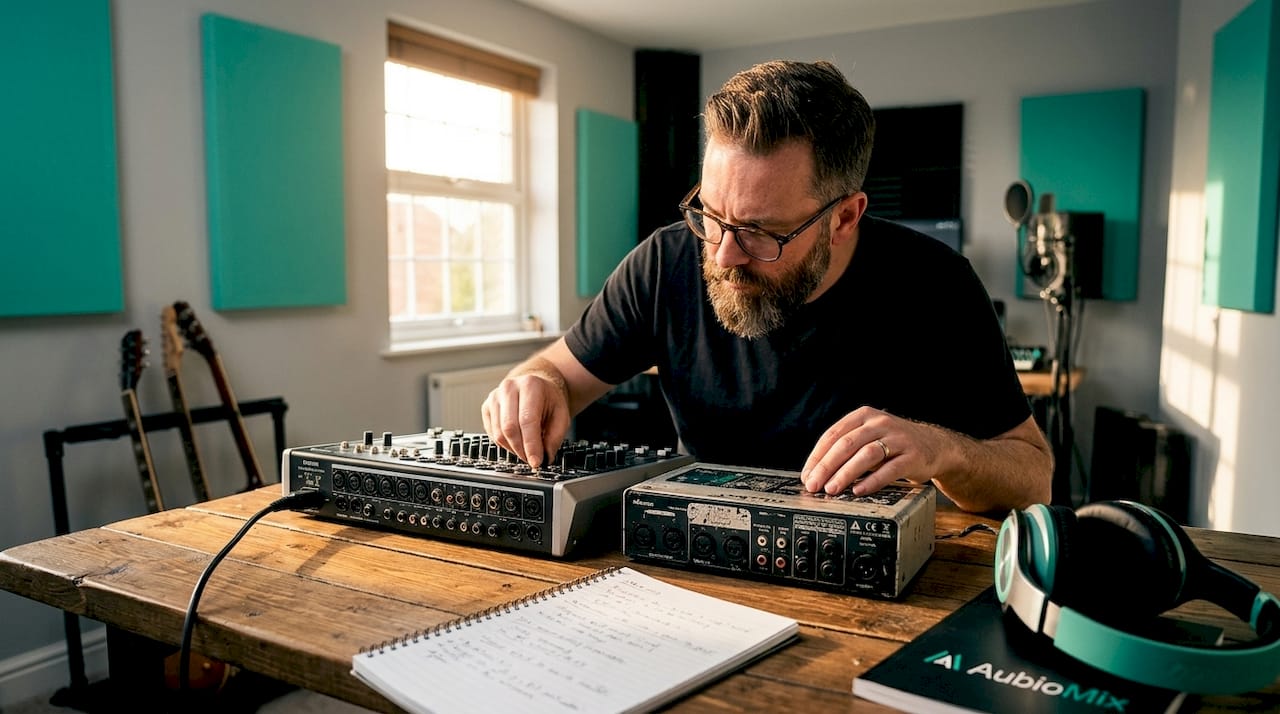
Summing mixers differ from line mixers in a similarly important way. A line mixer gives you level and pan control over multiple sources in a live or utility context. A dedicated summing mixer is built around the quality and character of the summing bus itself, not operational convenience.
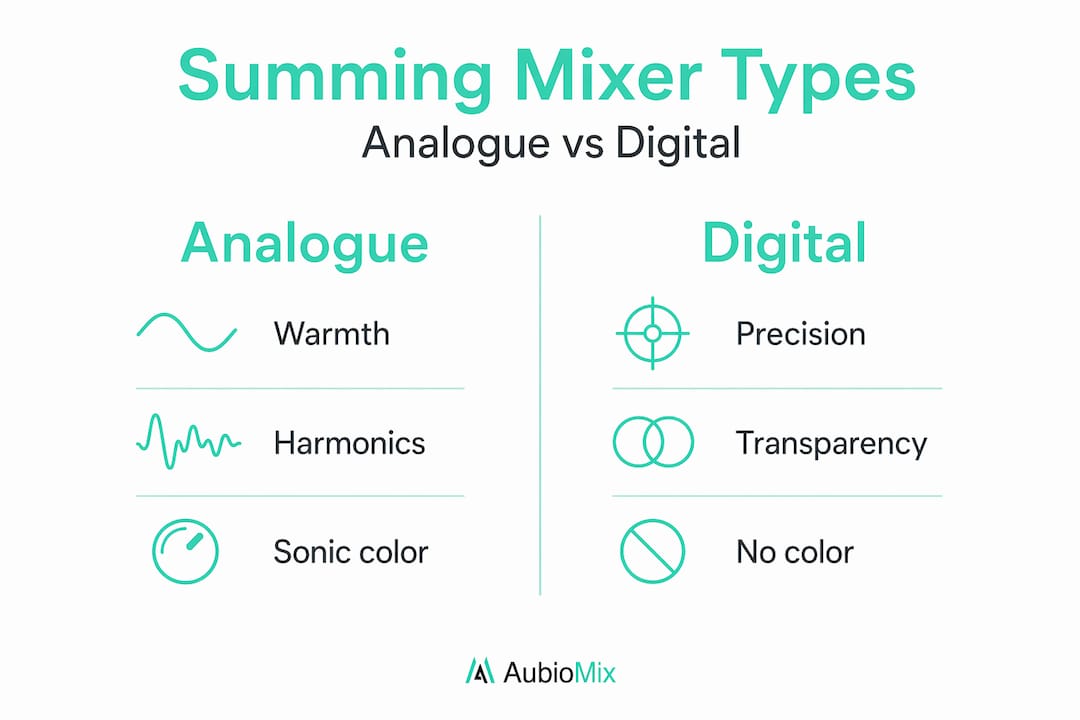
The honest answer on analogue versus digital summing is that the difference is real but subtle. Digital summing is transparent and accurate. Analogue summing is characterful and dimensional. Neither is objectively better; they are different tools with different results.
Summing mixer setup guide for DAW-based studios
Integrating a summing mixer into your existing studio workflow is more straightforward than it sounds. Here is a practical step-by-step approach that works reliably across most setups.
-
Organise your stems inside the DAW. Group your tracks into logical stems: drums, bass, guitars, synths, vocals, and so on. Each stem should be bussed to a dedicated output on your audio interface. This structure is the foundation of everything; commit to it before you touch any hardware.
-
Route DAW outputs to summing mixer inputs. Connect each DAW output to a corresponding input on your summing mixer using balanced TRS or XLR cables, depending on your unit. Most eight-channel and sixteen-channel summing mixers connect cleanly to a multi-output interface.
-
Set consistent input gain. This step is critical. Commit to a clear stem structure and appropriate gain staging before evaluating the summing mixer's effect. All stems should hit the summing mixer at a consistent, healthy level, typically around minus 18 dBFS on average.
-
Return the stereo output to your interface. The summing mixer's stereo output feeds back into a stereo input on your audio interface for capture. This is your final mix bus, recorded as a stereo file.
-
Add outboard processing on the return. This is where the fun starts. Insert a stereo bus compressor or EQ between the summing mixer's output and your interface's input. Units like a classic VCA compressor on the stereo return can add that coveted mix bus glue that ties everything together beautifully.
-
Bypass any colouration modes if transparency is needed. Some summing mixers offer additional processing or tonal modes. If you want to evaluate the pure summing effect, units with additional processing need a transparent mode so that any added colour does not muddy your assessment.
Pro Tip: Treat the summing mixer as your committed mix stage. Once stems leave the DAW, resist the temptation to go back and tweak individual tracks. This discipline forces you to make stronger decisions inside the DAW and makes the final analogue sum more intentional.
Choosing the right summing mixer
The market for summing mixers is surprisingly varied, ranging from compact desktop units to console-style racks. Here is what to consider as you weigh your options.
- Channel count: smaller eight-channel units work well for stem-based workflows, while sixteen-channel and thirty-two-channel units suit more complex, individual-track routing
- Circuitry type: transformer-based designs (think API, Neve-style) offer more colour and saturation; op-amp-only designs tend to be cleaner and more transparent; passive units are highly transparent but require gain makeup
- Insert points and master processing: some units include insert points on the stereo bus, which is useful for hardware bus compression; others keep it minimal and pure
- Calibration quality: resistor network values and feedback loop precision directly influence stereo balance and channel accuracy, so reputable builds matter
Price broadly maps to character and build quality. Entry-level units from around £300 to £600 offer clean summing with minimal colour. Mid-range units from £600 to £1,500 begin to introduce meaningful tonal character from quality transformers. At the top end, units costing £2,000 and above often include boutique circuitry, custom transformers, and extensive routing options that approach true console-like performance.
The right unit depends entirely on your goals. If you want transparent analogue summing without heavy colouration, a clean op-amp design will serve you well. If you are chasing that warm, rich, console-like character, invest in a transformer-based unit and enjoy the ride.
My honest take on summing mixers
I have worked with summing mixers across a range of studio setups, from modest home studios to professionally equipped rooms, and my view is that the value they provide is real but often misunderstood.
The most common trap I see producers fall into is buying a summing mixer expecting it to fix a rough mix. It will not. What analogue summing does is take a well-prepared, well-balanced mix and add an extra dimension of warmth, cohesion, and depth. It rewards discipline. If your stems are sloppy, your gain staging is off, or your mix decisions are unresolved, the summing mixer will just make all of that louder and more present.
What I love about working with a summing mixer is the workflow shift it creates. Committing your stems to the analogue domain forces you to make real decisions, which is a skill that improves your mixing across the board. You start thinking in terms of what the mixing chain best practices demand rather than endlessly tweaking inside the box.
My practical advice: start with a transparent, clean summing mixer before chasing heavy colouration. Understand what the process does to your mixes before you add tonal variables. The discipline you develop will serve every project you take on, whether you use analogue summing or not.
— AubioMix
Take your mix evaluation further with Aubiomix
Once you have your summing mixer dialled in and your hybrid workflow running smoothly, the next question is whether your mix is actually performing at its best. That is exactly where Aubiomix comes in.

Aubiomix is an online app that lets you upload your audio file and receive detailed, professional feedback on your mix and master. Whether you are running a fully analogue summing setup or working in the box, the tool analyses your track and gives you specific, actionable steps to improve clarity, balance, depth, and loudness. You can check the evaluation framework to see exactly how your mix is assessed. For producers and engineers who want a second opinion grounded in real mixing expertise, Aubiomix is the most efficient way to get it.
FAQ
What is a summing mixer used for?
A summing mixer combines multiple DAW stems into a single stereo output using analogue circuitry, adding warmth, harmonic coloration, and spatial depth that digital summing cannot provide.
How does a summing mixer differ from an audio interface?
An audio interface handles AD/DA conversion and I/O routing, while a summing mixer's sole purpose is analogue summation of stems, with circuit design focused entirely on summing quality and tonal character.
What is an analogue summing mixer?
An analogue summing mixer is a hardware device that uses op-amp or transformer-based analogue circuitry to combine multiple audio signals into a stereo mix, imparting subtle harmonic distortion and cohesion in the process.
Do I need to change my DAW workflow to use a summing mixer?
Yes, in a useful way. You need to organise your mix into stems, route each stem to a dedicated DAW output, and commit to your level balancing inside the DAW before the signal reaches the summing mixer.
Does a summing mixer replace a mixing console?
Not exactly. A summing mixer handles the summing stage of a console without the full routing, monitoring, and processing capabilities. It is best understood as the summing bus portion of a console extracted into a standalone unit.