
For UK mix engineers who need fast, technically deep, and genuinely actionable feedback, Aubiomix is the most practical audialyze.com alternative available right now. It covers 15+ areas of mixing and mastering, from LUFS and True Peak to frequency masking, stereo phase, and crest factor, and delivers written reports you can actually work from rather than a dashboard of numbers with no context.
Here is a quick shortlist of the four viable categories, so you can match your workflow before reading further:
- Professional SaaS with hybrid or human review (e.g. Aubiomix): best for engineers who want specific, mix-level recommendations with downloadable PDF reports and progress tracking. Turnaround is typically fast; pricing is per-credit or subscription.
- Automated advanced analytics platforms: good for high-volume batch checking of loudness and peak compliance. Feedback is fast but tends to stop at measurement without telling you what to do about it.
- Licensable research engines and REST APIs: suited to studios or developers who need bulk processing or DAW pipeline integration. Fraunhofer IDMT's SoundsLike is a representative example, available as a REST API or C++ library with annual licensing.
- Open-source toolkits and local CLI apps: free and transparent, with waveform and spectrogram comparison. Useful for technical auditing, but FOSS tools rarely provide the constructive, genre-aware recommendations that professional engineers actually need.
Table of Contents
- How do these audialyze.com alternatives compare at a glance?
- Profiles of Aubiomix and the main alternative categories
- How do you choose the right mix-analysis service?
- How were these alternatives evaluated?
- Key takeaways
- What actually matters when you pick a mix-analysis tool
- Aubiomix: detailed mix feedback without the wait
- Useful sources and further reading
How do these audialyze.com alternatives compare at a glance?
| Dimension | Aubiomix | Automated analytics platforms | Licensable research APIs | Open-source toolkits |
|---|---|---|---|---|
| Best for | Freelance and studio engineers needing actionable mix feedback | Loudness/peak compliance checking at volume | Developers and studios needing pipeline integration | Technical auditing, local control |
| Pricing model | Pay-per-credit or monthly/annual subscription | Typically subscription or per-call API | Annual licence fee | Free |
| UK pricing | Publicly listed in GBP | Varies; often USD-denominated | Quoted on request | N/A |
| Turnaround | Fast (minutes per upload) | Near-instant | Depends on integration | Instant (local) |
| Feedback depth | Hybrid: automated metrics + written recommendations | Automated metrics only | Automated metrics; no mix advice | Automated metrics only |
| Technical metrics | LUFS, True Peak, LRA, stereo phase, frequency masking, dynamic range, crest factor | LUFS, True Peak, LRA | Annotation, similarity, timbre | Waveform, spectrogram, correlation |
| File formats | WAV, AIFF, MP3 | WAV, MP3 (varies) | Varies by API | WAV, AIFF, MP3 (varies) |
| Exportable reports | PDF, visual spectrograms, correlation meters | CSV/JSON data exports | JSON/API responses | Visual only |
| Data handling | Documented audio content policy | Varies; check vendor policy | Contractual; on-site or cloud | Local; no upload |
| Free trial / sample | Sample report available | Varies | Demo on request | Always free |
A quick note on "hybrid" versus "automated" feedback: automated tools measure signals accurately, but they stop there. A hybrid service maps those measurements to concrete mix actions, such as which frequency band to cut, how much gain reduction to apply, or where phase cancellation is occurring. That interpretive layer is what separates a useful report from a spreadsheet.
Pro Tip: Before committing to any service, download or request a sample report. If the report shows LUFS and True Peak but offers no suggested fix, it is an analytics tool, not a mix-feedback service.
Profiles of Aubiomix and the main alternative categories
Aubiomix
Aubiomix accepts WAV, AIFF, and MP3 uploads and analyses your mix across 15+ technical areas: compression, EQ balance, frequency masking, effects use, stereo width, phase coherence, loudness (LUFS, True Peak, LRA), noise and clipping, mastering preparation, and device translation. Reports are written and visual, downloadable as PDF, and include a progress tracker and leaderboard so you can benchmark your mixes over time.
Pros: Covers a genuinely broad set of mix-specific metrics; written recommendations tell you what to fix, not just what the numbers say; PDF reports are shareable with clients; progress tracking is useful for engineers working across multiple projects.
Cons: Requires an internet connection and file upload; not suited to bulk API processing; no offline mode.
Best for: Freelance mix engineers and in-house studio teams who want professional-grade, written feedback on individual tracks before release.
UK availability: Pricing is publicly listed; subscription and pay-per-credit options are both available. Check the Aubiomix homepage for current GBP pricing.
Professional SaaS with human or hybrid review
Services in this category, including checkmymix.com and audiomixr.com, combine automated measurement with some degree of human or AI-assisted interpretation. The quality of feedback varies considerably. The strongest services in this group report LUFS, True Peak, and stereo correlation, then layer in written commentary. Turnaround is typically within minutes to a few hours. For a deeper look at how these platforms differ, the CheckMyMix.com alternatives comparison is worth reading alongside this one.

Automated advanced analytics platforms
Mix-checker.com and mixcheckstudio.roexaudio.com sit in this category. They are fast and accurate at measuring loudness and peak compliance, which makes them genuinely useful for mastering engineers checking final deliverables against streaming platform targets. Where they fall short is interpretation: acoustic-measurement engines provide the raw signals but do not replace genre-aware, actionable mixing advice. If you already know what LUFS-I of -14 LUFS means for your genre and you just need confirmation, these tools work well. If you need to know why your low-mids are masking your kick and what to do about it, they will not help. See the mix-checker.com alternatives post for a broader list in this space.
Licensable research engines and APIs
Fraunhofer IDMT's SoundsLike is the clearest example here: a licensable REST API and C++ library covering annotation and similarity, available with on-site or cloud hosting and annual licence fees. This category suits developers building custom analysis pipelines or large studios processing catalogues at scale. It is not designed for the engineer who wants to upload a single mix and read a report. Integration support and customisation are typically included in the licence, which is the main practical advantage over consumer platforms.
Open-source toolkits and local CLI apps
Tools like AudioAuditor offer stacked, overlay, and wipe comparison modes alongside waveform and spectrogram visualisation. The soundalike project uses an acoustic DSP engine and a learned neural embedding that runs locally as a web app or CLI. Both are free and give you full control over your audio. The trade-off is that FOSS tools are excellent for technical auditing but rarely provide the constructive, human-aware recommendations that professional engineers prefer. Many consumer-focused tools also focus on recording or song identification rather than the mix-engineering feedback process, so check the scope carefully before investing time in setup.
How do you choose the right mix-analysis service?
Work through these criteria in order:
- Technical metrics reported. Does the service cover LUFS, True Peak, LRA, stereo phase, frequency masking, dynamic range, and crest factor? If it skips stereo phase and masking, it is missing two of the most common mix problems.
- Feedback depth. Automated measurement or written recommendations? For most engineers, written, mix-specific feedback is worth paying for.
- Turnaround time. Minutes versus hours matters when you are in revision mode.
- Pricing model. Per-credit suits sporadic use; a subscription makes sense if you are reviewing more than four or five mixes per month.
- Privacy and file handling. Read the data policy. Know whether your audio is deleted after analysis or retained.
- DAW and workflow integration. Does the service offer an API, or is it web-upload only?
- Sample report. Always request one before paying.
Questions worth asking any vendor:
- Do you report LUFS-I, True Peak, and LRA to streaming-platform standards?
- Do reports include suggested EQ or gain-reduction steps, or only measurements?
- What is your file retention and deletion policy?
- What file formats do you accept, and is there a size limit?
- What is the typical turnaround per track?
Red flags to watch for:
- No sample report available before purchase.
- Vague or absent data-handling policy.
- Reports that only tag genre or mood rather than addressing mix-specific variables.
- No stated turnaround time.
Pricing illustration: A freelance engineer reviewing six mixes per month would spend roughly the same on a mid-tier monthly subscription as on six individual pay-per-credit purchases, assuming a credit pack price in the range typical for professional SaaS services. The subscription becomes better value above that volume; the credit pack is more flexible for quieter months. Always check current GBP pricing directly with the service, as rates vary.
How were these alternatives evaluated?
- Sources consulted include independent community write-ups (Bedroom Producers Blog), research institute product pages (Fraunhofer IDMT), open-source project documentation (GitHub), and Aubiomix's own published feature set and audio content policy.
- Evaluation criteria: technical metrics reported, feedback depth (automated vs written), turnaround, pricing transparency, file format support, report export options, data-handling clarity, and sample report availability.
- Sample reports were assessed where publicly available; visual assets (spectrograms, correlation meters) were noted as present or absent.
- Limitation: Live human-reviewed outputs for every vendor and full DAW integration tests were not conducted for all categories. Recommendations for licensable API tools are based on published documentation rather than hands-on integration.
- This comparison reflects Aubiomix's editorial perspective as a professional mix-analysis service with direct experience of what engineers need from a feedback report.
Key takeaways
Aubiomix is the most practical choice for UK mix engineers who need written, technically detailed feedback across 15+ mixing and mastering areas, with downloadable PDF reports and transparent data handling.
| Point | Details |
|---|---|
| Prioritise feedback depth | Choose a service that maps measurements to concrete mix actions, not one that only reports LUFS and True Peak. |
| Always request a sample report | No sample report before purchase is a red flag; every credible service should offer one. |
| Match pricing model to volume | A subscription beats per-credit pricing above roughly five to six mixes per month. |
| Check the data policy | Confirm whether your audio is deleted post-analysis; Aubiomix publishes a clear audio content policy. |
| Aubiomix for most UK engineers | Aubiomix covers 15+ technical areas with written recommendations, PDF exports, and GBP pricing. |
What actually matters when you pick a mix-analysis tool
Most engineers we speak to have been burned by the same thing: a tool that looked impressive in a demo but delivered a report full of numbers and no direction. The "AI-powered" label is everywhere right now, and it means almost nothing on its own. What matters is whether the engine interprets production variables, such as frequency masking between your bass and kick, or phase cancellation in your stereo bus, rather than simply tagging your track as "electronic" at -10 LUFS. A measurement without a recommendation is just a mirror. You already know something sounds off; you need someone, or something, to tell you where to start fixing it. That is the gap most tools in this space still have not closed, and it is the reason feedback depth sits at the top of the decision checklist above.
Aubiomix: detailed mix feedback without the wait
If you have read this far, you already know what to look for. Aubiomix gives UK mix engineers professional-grade mix feedback across 15+ technical areas, including compression, EQ balance, frequency masking, stereo phase, loudness (LUFS, True Peak, LRA), and mastering preparation, with written recommendations and a downloadable PDF report for every analysis.
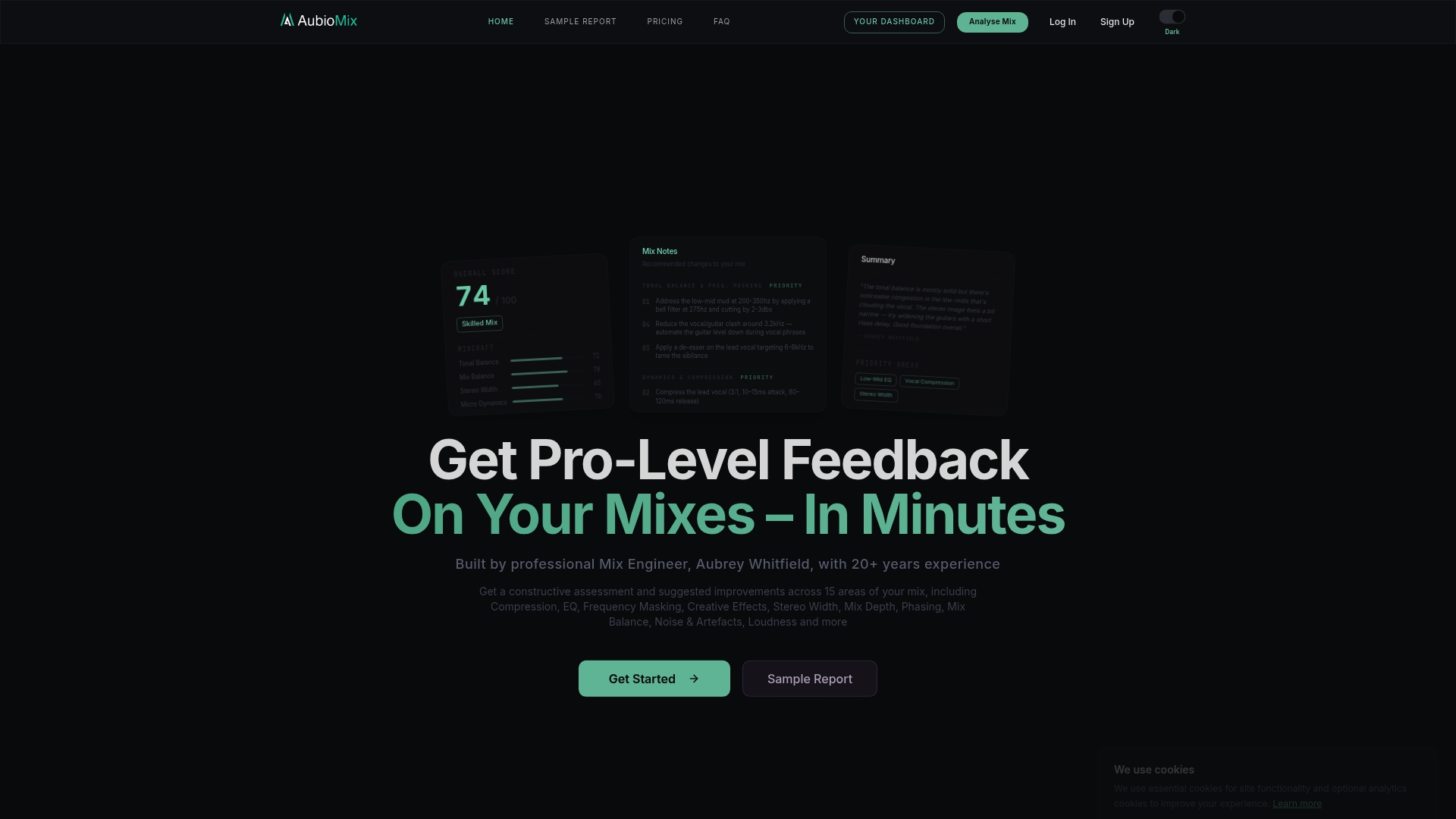
For occasional use, a pay-as-you-go credit pack keeps things flexible with no monthly commitment. If you are reviewing mixes regularly, a monthly or annual subscription gives you a fixed number of reviews at a lower per-track cost. Both options include the full report, visual assets, and progress tracking. UK pricing is listed in GBP on the site. Upload your first mix and see the LUFS and True Peak breakdown alongside the written feedback at aubiomix.com.
Useful sources and further reading
- AudioAuditor — Bedroom Producers Blog: Community write-up on a free, open-source audio analysis toolkit with waveform, spectrogram, and AI music detection features. Read this to understand what FOSS tools can and cannot do for mix engineers.
- SoundsLike — Fraunhofer IDMT: Official product page for a licensable annotation and similarity engine available as a REST API or C++ library. Relevant if you are evaluating enterprise or pipeline integration options.
- soundalike — GitHub (yassinsolim): Open-source project using acoustic DSP and neural embeddings; runs locally as a CLI or web app. Useful for understanding the self-hosted alternative category.
- AudiCable — Best Alternatives to Audials Music: Illustrates how many consumer audio tools focus on recording or streaming capture rather than mix-specific feedback, a useful contrast for scoping your search.
- Aubiomix audio content policy: Published policy on how uploaded audio is handled, retained, and deleted. Essential reading before uploading client work.
- How to review your mix objectively — Aubiomix Blog: Practical guide to objective mix review that complements any automated report.
- Best aural training apps for musicians: Overview of aural training tools for musicians looking to sharpen their critical listening alongside technical analysis.
- Audiomixr.com alternatives — Aubiomix Blog: Category-level comparison of platforms offering constructive mix advice; useful secondary reading.
- Mixcheckstudio.roexaudio.com alternatives — Aubiomix Blog: Lists further options in the automated analytics category for engineers wanting a longer shortlist.