
Mixing a song in sections is the single most effective way to give every part of its own space, energy, and clarity. Rather than treating the whole track as one static balance, you make deliberate, targeted decisions for each musical moment — verse, pre-chorus, chorus, bridge, drop — so the mix breathes and builds the way the arrangement intends. Producers and mix engineers working on multi-section songs feel this difference immediately: the chorus hits harder, the verse sits back with purpose, and the whole thing translates predictably across speakers, headphones, and phones.
Here is what you can act on straight away:
- Mark your section boundaries in your DAW before touching a single fader.
- Run a quick mono check at the start of each section pass to expose masking early.
- Treat each section as a separate mixing target with its own level, EQ, compression, and effects settings.
- Use Aubiomix to get section-specific diagnostic feedback before you commit to your final automation passes.
Table of Contents
- What 'mixing in sections' actually means — and how granular to go
- How section-based mixing improves clarity, energy, and translation
- How to spot section boundaries and map the arrangement
- Section-specific mixing techniques: what to change and why
- Handling transitions so section changes feel natural
- A compact session workflow with realistic time estimates
- Common mistakes when you skip section-based mixing — and quick fixes
- How to use Aubiomix to spot and fix section problems faster
- Songs that show section-based mixing in action
- How to talk to artists and producers about section mixing decisions
- Adapting section mixing to different genres
- Key takeaways
- Section-aware mixing is what separates good mixes from great ones
- Get section-specific mix feedback with Aubiomix
- Further reading and sources
What 'mixing in sections' actually means — and how granular to go
Section-based mixing means treating each musical section as a distinct mixing target with its own balance, processing, and effects decisions, rather than setting one static mix and leaving it to run. Reading the arrangement first is what converts reactive fader-pushing into deliberate, musical choices.
Common section types and their typical energy characteristics:
- Verse: lower density, space for the vocal, restrained low end.
- Pre-chorus: builds tension; often needs a slight lift in the upper midrange to create anticipation.
- Chorus: full energy, wider stereo field, more aggressive compression on the mix buss.
- Bridge: contrast moment — often narrower, drier, or stripped back to reset the listener.
- Drop (electronic): maximum impact; sub-bass and kick need careful headroom management.
- Outro: gradual release; reverb tails and delays can open up without cluttering the arrangement.
Granularity checklist: whole-section processing (verse vs. chorus) handles the big energy shifts; phrase-level sweetening (a single vocal line, a fill, a transitional bar) handles the moments that need a nudge within a section. Use whole-section passes first, then drop to phrase level only where a specific moment still isn't working.
Pro Tip: Before you open a single plugin, play the track straight through once and note the three moments that feel most wrong. Those are your first section targets — everything else can wait.
How section-based mixing improves clarity, energy, and translation
Mixing in sections gives you control over five things that a single static mix simply cannot manage:
- Clearer frequency separation: EQ decisions made in the context of a specific section's arrangement density are more accurate than decisions made against the full song average.
- Controlled dynamics: compression settings that suit a sparse verse will over-compress a dense chorus; per-section compression preserves the natural punch of each moment.
- Predictable automation: when your static balance is already right for each section, automation becomes a fine-tuning tool rather than a rescue operation.
- Better translation: arrangement awareness helps you craft a mix that behaves predictably on different playback systems because tension and payoff are built into the processing, not just the arrangement.
- Faster revision cycles: a problem flagged in the chorus is easy to fix when the chorus has its own processing chain; on a single static mix, the same fix risks breaking the verse.
Before/after scenario: imagine a pre-chorus where the vocal keeps disappearing behind a pad. On a static mix, the instinct is to push the vocal fader up — but that makes the verse vocal too loud. With section-based mixing, you carve 3–4dB at around 300Hz on the pad only during the pre-chorus, add a gentle 2kHz lift on the vocal send, and the vocal cuts through without touching a single fader. The verse is untouched. That is the practical value of segmented mixing in a single example.
How to spot section boundaries and map the arrangement
Mapping sections before you mix is a five-minute investment that saves hours of reactive fader work.
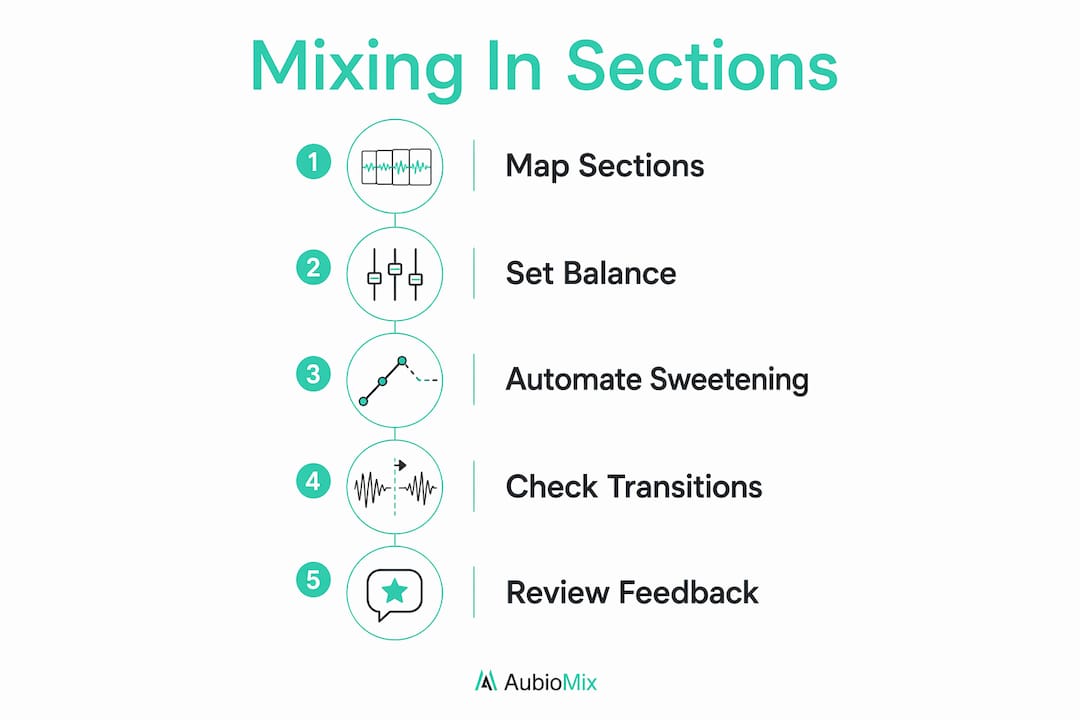
- Full playthrough listen: play the track from start to finish without touching anything. Note where the energy clearly shifts — these are your primary boundaries.
- Mark obvious changes: drop a DAW marker at every point where the instrumentation, density, or groove changes significantly.
- Count phrases: most sections run in four- or eight-bar phrases. If a change happens mid-phrase, it is usually a fill or transitional moment — mark it separately.
- Flag energy markers: drops, fills, vocal entries, and breakdowns all signal section edges. These are the moments where your processing needs to switch.
- Reference-track comparison: load a reference track with a similar arrangement and compare its section map to yours. Gaps in energy or density become obvious quickly.
Pro Tip: After marking, play only the loudest section and the quietest section back-to-back. If the contrast feels wrong — either too subtle or too jarring — you have found your most problematic section in under two minutes, before you have touched a single plugin.
Section-specific mixing techniques: what to change and why
Each section deserves its own pass across these processing categories:
- Level automation: ride the mix-buss gain or group-bus faders between sections before touching individual tracks. A 1–2dB lift into the chorus is often all you need.
- EQ carving: check 100–250Hz for mud in dense sections (chorus, drop) and cut where the low-mids pile up. Boost 2–5kHz on lead vocals and melodic elements in sections where presence needs to cut through.
- Dynamic control: start with a 4:1 ratio and a medium attack on vocal buses for verses; tighten the attack and increase the ratio slightly for choruses to add glue without killing transients.
- Stereo width: keep the verse relatively narrow (centred bass, centred lead vocal, moderate width on pads) and open the stereo field in the chorus using mid-side processing on synth buses or room reverbs.
- Reverb and delay tailoring: shorter pre-delay and tighter decay in verses keeps things intimate; longer tails and wider sends in choruses create that lush, open feeling. Automate your send levels between sections rather than changing the reverb plugin settings.
- Saturation switches: a gentle saturation on the mix buss or drum bus can be automated in for the chorus to add harmonic density and perceived loudness without touching the limiter.
The goal is to make the listener feel the energy change, not just hear a volume jump. Sweetening — moment-by-moment enhancements like reverb throws, muted parts, and small rearrangements — is a separate cognitive task from balance work, so keep these passes distinct to avoid session fatigue.
Handling transitions so section changes feel natural
A great section mix can still fall apart if the transitions between sections are jarring. Here is a practical order of operations:
- Automate group buses first: get the macro moves right (drums, bass, synths, vocals as groups) before diving into individual tracks. This keeps the overall energy arc coherent.
- Ride send levels for reverb and delay: automate the send level to your main reverb bus so it opens up just before the chorus hits, then pulls back slightly in the verse. This creates a sense of space expanding without changing the reverb plugin itself.
- Use filter sweeps and FX throws: a high-pass filter sweep on a synth bus in the final bar of a verse, or a reverb throw on the last snare hit before a drop, signals the transition to the listener's ear before the new section arrives.
- Apply clip gain at section boundaries: rather than heavy fader automation at the exact cut point, use clip gain to trim the tail of one section and the attack of the next. This avoids audible artefacts at the edit point.
- Test every transition in mono: fold to mono and play through each boundary. Phase issues and masking that hide in stereo become obvious immediately, and fixing them here saves you from chasing ghosts later.
Pro Tip: The most common automation mistake is drawing in too many small moves. Write one clean macro move per section change, export a rough bounce, and listen back on your phone. If a transition still feels wrong on the phone, the problem is usually arrangement density, not automation precision.
For a deeper look at automation types and approaches, the Aubiomix blog covers the full range of techniques.

A compact session workflow with realistic time estimates
A well-structured mixing session is what separates a mix that gets finished from one that drifts for days. Here is a practical phase breakdown for a typical 3–4 minute pop or electronic track:
- Prep and reference (15–30 min): organise stems, label all markers, load a reference track, and set your monitoring level. A structured session start with calibrated monitoring reduces perspective bias across section passes.
- Gut/balance pass (30–60 min): get a rough static balance that works for the loudest section. Quick wins on the mix buss here create confidence that improves later section decisions.
- Section passes (20–40 min per problematic section): work through each section in order of priority — start with the section that felt most wrong during your diagnostic listen.
- Sweetening and automation (30–60 min): add reverb throws, fill mutes, width automation, and transitional FX. Keep this phase separate from the balance pass.
- Final checks and translation (30 min): check in mono, on headphones, and on a small speaker. Export a rough bounce and listen away from the studio.
Session prep checklist:
- Stems organised and labelled by section where possible.
- DAW markers placed at every section boundary.
- Reference track loaded and level-matched.
- Monitoring level set and noted.
- Song prepped for mixing with clean exports and no clipping on individual tracks.
Phased mixing is validated by experienced engineers precisely because separating balance from sweetening keeps decisions cleaner and faster. Setting a time limit per phase and exporting early also builds better judgement over time.
Common mistakes when you skip section-based mixing — and quick fixes
These are the errors that show up most often when engineers treat the whole song as a single static mix:
- Over-automation: compensating for a bad static balance with dozens of micro-moves. Fix: go back to the static balance for the problem section and sort the EQ or compression before writing any automation.
- Fader-rolling instead of fixing masking: if you keep pushing a fader to make a part audible, the problem is almost always frequency masking or arrangement density. Repeated fader pushes signal that an upstream EQ fix is needed, not more automation.
- Mono/stereo imbalance: using stereo width tricks to hide a muddy low-mid build-up. Fold to mono early and expose the overlap with targeted EQ cuts before opening the stereo field.
- Ignoring arrangement density: a chorus that sounds muddy often has too many elements competing in the same frequency range. The fix is sometimes an arrangement edit — muting a pad or a rhythm guitar — rather than more EQ.
- Treating the mix buss as a rescue tool: heavy limiting on the mix buss to compensate for a bad section balance. Fix with clip gain on individual tracks or group-bus level rides before reaching for the limiter.
How to use Aubiomix to spot and fix section problems faster
Automated mix feedback speeds up section-based diagnostics significantly. Here is a practical workflow:
- Upload your stereo mix or stems to Aubiomix after your gut/balance pass.
- Review the section-specific feedback: Aubiomix flags issues across 15+ areas including frequency masking, stereo width, compression, sibilance, and low-end build-up — often pointing to the exact section where the problem is most severe.
- Prioritise the flagged sections: if the feedback highlights low-end masking in the chorus and sibilance in the verse, address those two sections first before touching anything else.
- Implement targeted changes: for a chorus lacking punch, try EQ cuts on competing pads (around 200–400Hz) and automate the vocal send level up by 1–2dB into the section. Re-submit after changes to track progress.
- Use the feedback as diagnostic, not prescriptive: combine Aubiomix's written and visual reports with your own mono checks and reference listening. The tool identifies where to look; your ears make the final call.
Pro Tip: Download the PDF report after your first submission and annotate it with your own notes from the mono check. Comparing the two perspectives reveals the fastest path to a fix — and gives you a clear record of what changed between versions.
For guidance on interpreting feedback effectively, the Aubiomix post on mix feedback delivery is worth reading alongside your first report.
Songs that show section-based mixing in action
The impact of section-aware mixing is audible in some of the most well-known records of the past two decades. Billie Eilish's Bad Guy is a textbook example: the verse sits in an almost uncomfortably intimate space, with the bass and vocal sharing a narrow, close-mic'd world, while the production deliberately withholds a traditional chorus build. That restraint is a mixing decision as much as an arrangement one. The engineer kept the verse processing tight so that the subtle energy shift into the post-chorus felt enormous by contrast.
Daft Punk's Get Lucky uses a different approach: the sections are relatively consistent in density, but the mix engineer automated the width and reverb send levels so that the chorus feels wider and more open without any additional instrumentation. The listener perceives a lift that isn't really there in the arrangement.
In UK garage and grime, producers like Wiley and Skepta have long used section-specific low-end decisions to make drops land harder — pulling sub-bass back in the verse and letting it fully open in the hook. That technique is pure section-based mixing applied to a genre where the drop is the whole emotional payoff.
How to talk to artists and producers about section mixing decisions
Most artists do not think in mixing terms, and that is fine. Your job is to translate technical decisions into musical language they can respond to. Instead of saying "I'm going to cut 3dB at 250Hz on the pad bus in the chorus," say "I want the chorus to feel more open and punchy — I'm going to thin out the pads slightly so the vocal and kick have more room to breathe."
A few principles that make these conversations easier:
- Reference the feeling, not the frequency: "the verse feels a bit crowded" lands better than "there's low-mid masking between 200 and 400Hz."
- Play before and after: a 30-second A/B comparison of a section before and after your EQ decision is worth ten minutes of explanation.
- Ask about intent first: before making any section-specific decision, ask the artist what they want the listener to feel at that moment. Their answer tells you whether to add energy or pull back.
- Be specific about what you are not changing: artists sometimes worry that fixing one section will break another. Reassure them by naming exactly which section you are working on and why the others are staying as they are.
Clear communication also reduces revision rounds, which saves everyone time. When an artist understands why the chorus sounds different from the verse, they are far less likely to ask you to "make it all sound the same."
Adapting section mixing to different genres
The principles of section-based mixing are universal, but the parameters shift significantly by genre.
Electronic and dance music lives and dies by the drop. Section mixing here is almost entirely about managing the contrast between breakdown and drop — pulling elements out in the breakdown, automating the sub-bass back in, and using filter sweeps and FX throws to signal the incoming energy. The electronic music mixing guide on the Aubiomix blog covers genre-specific approaches in detail.
Pop and singer-songwriter tracks need the vocal to sit differently in each section. The verse vocal often benefits from a slightly more intimate reverb and a tighter compression ratio; the chorus vocal wants more glue, a touch more high-end air, and a wider send to the room reverb.
Hip-hop and grime place the beat and the vocal in constant competition. Section mixing here means managing the low-end relationship between kick, 808, and bass line as the arrangement changes — a verse with a sparse trap pattern needs different kick and bass processing than a hook with a fuller, more layered beat.
Rock and indie tracks often have the most dramatic section contrasts of all: a stripped-back verse into a wall-of-guitars chorus. The key is to avoid over-compressing the chorus into a flat, lifeless wall. Keep the attack on the drum bus slightly slower in the chorus to let the transients breathe, and use the verse's relative sparseness to make the chorus feel genuinely loud by contrast rather than just louder.
Key takeaways
Mixing in sections is the most direct route to a mix that has clarity, energy, and consistent translation across playback systems.
| Point | Details |
|---|---|
| Map sections before mixing | Place DAW markers at every section boundary before touching a fader or plugin. |
| Mono check per section | Fold to mono at the start of each section pass to expose masking and low-mid build-up early. |
| Fix upstream, not with automation | Repeated fader pushes signal a masking or arrangement problem; fix with EQ or arrangement edits first. |
| Automate macro moves first | Ride group buses and mix-buss gain between sections before writing individual track automation. |
| Use Aubiomix for targeted diagnostics | Upload after your balance pass to get section-specific feedback across 15+ mixing areas before committing to final automation. |
Section-aware mixing is what separates good mixes from great ones
There is a version of mixing where you set a balance, slap a limiter on the mix buss, and call it done. Plenty of records get made that way. But the mixes that genuinely hold up — the ones that sound right on a club system, on earbuds, and on a laptop speaker — almost always have a deliberate, section-aware approach underneath them.
What we find, time and again, is that the engineers who struggle most with translation are the ones treating the whole song as a single problem to solve. The chorus is not the same mix as the verse. The drop is not the same mix as the breakdown. When you give each section its own processing context, the mix stops fighting itself, and the arrangement does the emotional work it was designed to do.
The other thing worth saying: knowing when a section is done is a skill in itself. Set a time limit per section pass, export a rough bounce, and listen away from the studio. If it holds up on your phone, it is probably right. Move on. The engineers who finish mixes and move to the next project develop better judgement faster than those who endlessly refine the same session.
Get section-specific mix feedback with Aubiomix
If you are ready to stop guessing which section is holding your mix back, Aubiomix gives you a clear answer in minutes. Upload your audio file and receive detailed, written feedback across 15+ mixing and mastering areas, with specific, prioritised steps for each problem the analysis finds — including frequency masking, stereo width, compression, sibilance, low-end build-up, and more. Visual and written reports mean you can see exactly where the issues are, and downloadable PDF reports let you annotate and track changes across multiple submissions.

Pay-as-you-go credit packs mean you can run a single mix analysis without any ongoing commitment, while monthly and annual subscriptions suit engineers who are working through multiple projects and want progress tracking and leaderboard comparison built in. Whether you are finishing a track for release or mid-session on a tricky chorus, run your first mix analysis on Aubiomix and get the section-specific feedback your mix needs.
Further reading and sources
- How to Mix: The 5 phases of every good mix — Recording Revolution's breakdown of phased mixing, including the gut mix, sweetening, and translation checks. Essential reading for understanding why staged passes produce better results.
- Mix philosophy and approach — Beat Kitchen's guide to using the fader as a diagnostic tool and building a consistent mix philosophy. Particularly useful for understanding when to fix upstream rather than automate.
- Track arrangement: read songs for better mixes — Vibes DJ's practical guide to reading arrangement for mixing decisions. Covers how arrangement knowledge converts reactive mixing into deliberate, musical choices.
- The role of arrangement in mixing — Aubiomix's own guide to how arrangement decisions shape mixing choices, with practical examples for producers.
- Types of automation in mixing — A producer-focused breakdown of automation approaches, from macro bus rides to phrase-level sweetening.
- How to structure a mixing session — Session templates and timing guidance for producers who want a repeatable workflow.
- The art and science of mixing — Beat Kitchen's perspective on finishing mixes, setting time limits, and developing judgement through completed work.